Israel

Shabbat Mosaic in Netanya

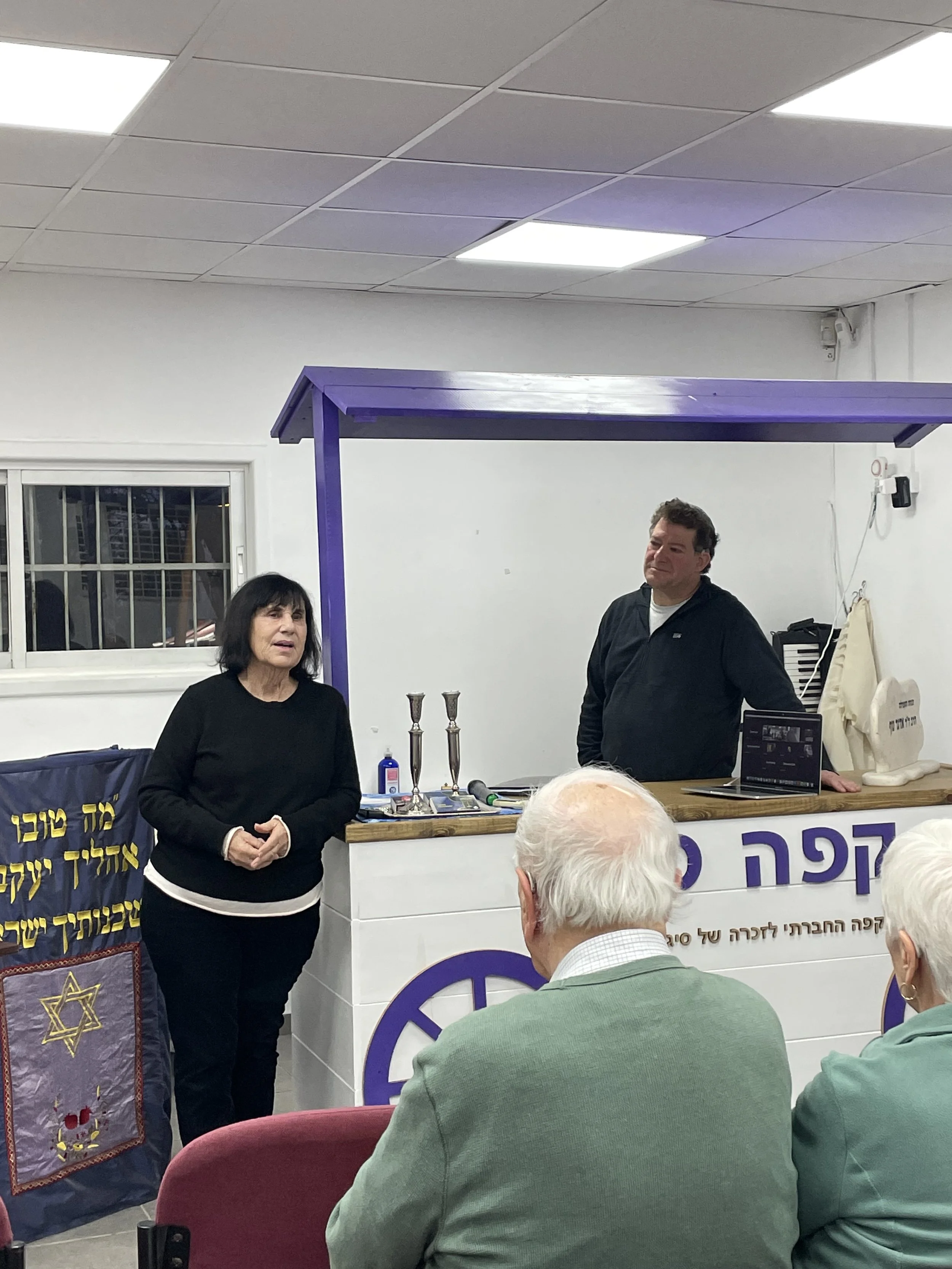
Netanya, the coastal Mediterranean city halfway between Tel Aviv and Haifa, has become one of our regular Shabbat destinations in Israel. This is thanks to the remarkable work of Rabbi Edgar Nof—more about him in a moment—and our dear friends Anita and Fred Finkelman, who bring me in as a scholar-in-residence to teach some classes. I’m so grateful, because this is one extraordinary community.

Kehillat Natan-Ya, part of the Israel Movement for Progressive Judaism, is a mosaic of nationalities. Looking around the packed room during the Shabbat services, I saw people who came here from Africa, Russia, Ukraine, Thailand, Georgia, Central and South America, the Philippines, the U.K., France, South Africa, and the U.S.—as well as the stam Israelis who were there. Part of the miracle of this place is that many of these are people who would not have found a place in a more mainstream Jewish community, for any of a variety of reasons. But Rabbi Edgar Nof brought them all home.

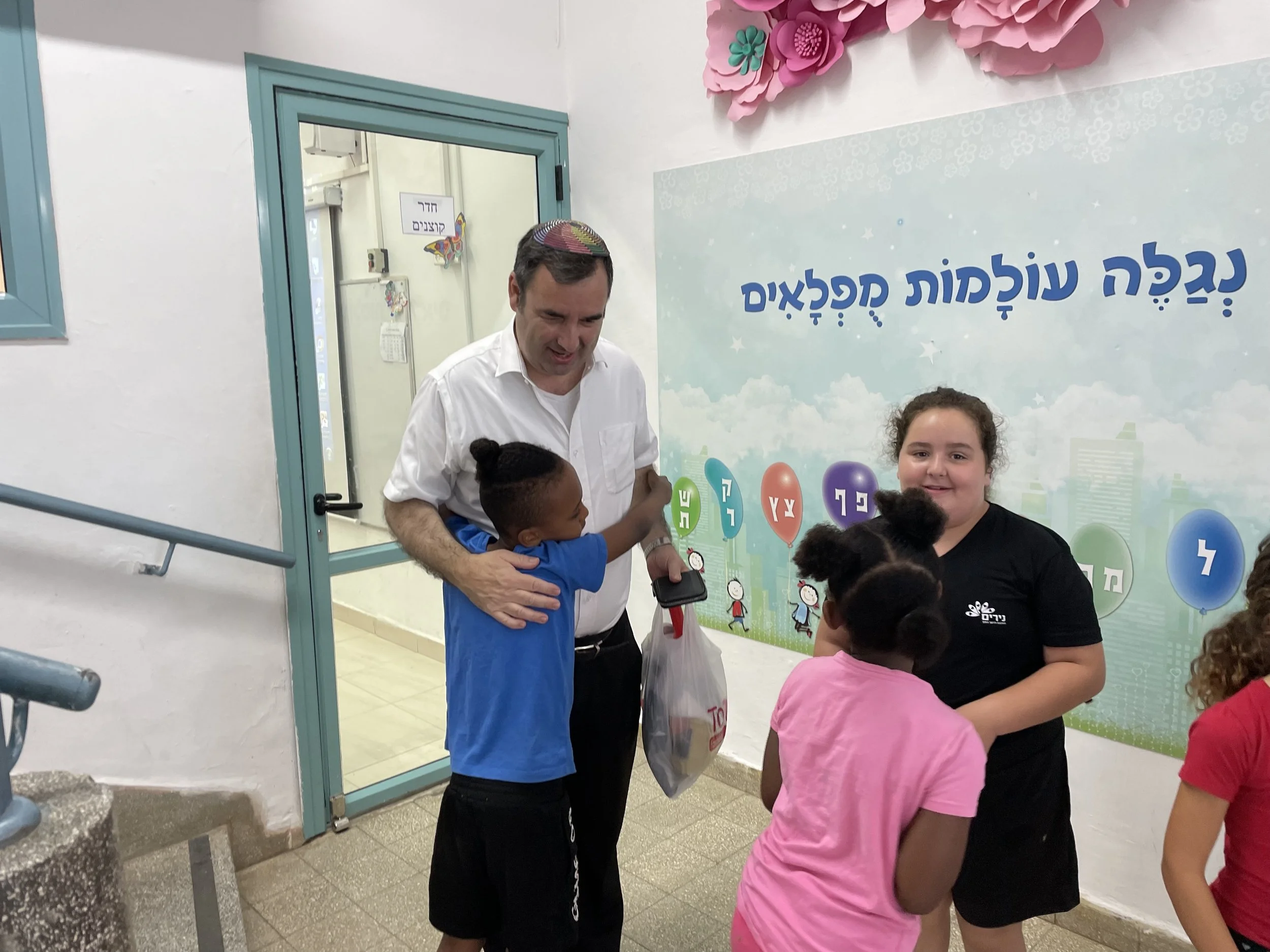
Here’s a photo of Rabbi Edgar Nof doing Mitzvahs in a Haifa school from two years ago. (Photo: NG)

Edgar is a whirlwind of Mitzvahs. The Kavod Tzedakah Fund, which my friends and I founded over 30 years ago, has supported Edgar’s organization Bridges for Hope (Gesharim LeTikvah) since its inception. He’s supporting impoverished families, victims of terror, new immigrants, elderly Holocaust survivors, and other people living on the fringe. He’s in a half-dozen of the poorest schools in Haifa, teaching pluralistic and open-hearted Judaism and working with administrators to get supermarket food cards to the neediest families.

Like everyone else, Edgar’s life and the life of this community was profoundly changed after October 7. He once told me about how, in the wake of the massacres, he officiated at a funeral of a family of four. And there are memorials all around the synagogue of its local heroes who were killed that day and in the aftermath.

Most indefatigably, he’s doing Jewish life-cycle events for those who may not have had any Jewish connection otherwise. Edgar must have officiated at four bar/bat mitzvah ceremonies this week alone. And conversions to Judaism: he tells Heidi and me that at this point he’s brought over 800 people to Judaism in his career. Just amazing, and we got to see some of it up close on Friday.

I arrived at Netanya to teach my class. Edgar said he couldn’t be with us beforehand—he had a memorial service earlier in the day and a bar mitzvah in the afternoon; then my class, which segues into Shabbat. (I used to think I had a busy schedule.)

The service is gloriously energetic. It’s noisy, and there are no formalities, and there aren’t enough  siddurim. Children are up and down to the bimah to help Edgar out throughout the service; so, too, are adult honorees who come up to mark joyful milestones. Half the room has been given percussion instruments to tap or shake as we sing out the Shabbat prayers; it’s Shabbat Shirah, after all. The whole thing is a whirlwind and it’s wonderful.

In the middle of the service, a boy and his father are called up to the pulpit. Edgar opens the Aron Kodesh and places the Torah in the boy’s arms. He’s been studying and preparing for conversion—his mother is not Jewish—and this moment will make it official. He processes the Torah around the room, as everyone else rains candies upon his head and sings, Siman Tov u’Mazel Tov! The boy is composed, but his father has an awestruck look in his eyes—the echo of a hundred generations of Jews before him—as if he can’t believe that this moment was actually possible.

And then the entire room—this congregation from at least five continents—erupts and cries out: Achinu Atah! Achinu Atah! Achinu Atah! (Three times: “You are our brother!”).

Excuse me a moment, there’s something in my eye.

The service continues, Edgar strumming his guitar. Singing beside him is his longtime volunteer cantor Anna—she’s a young Philippine immigrant whom Edgar also brought to Judaism.

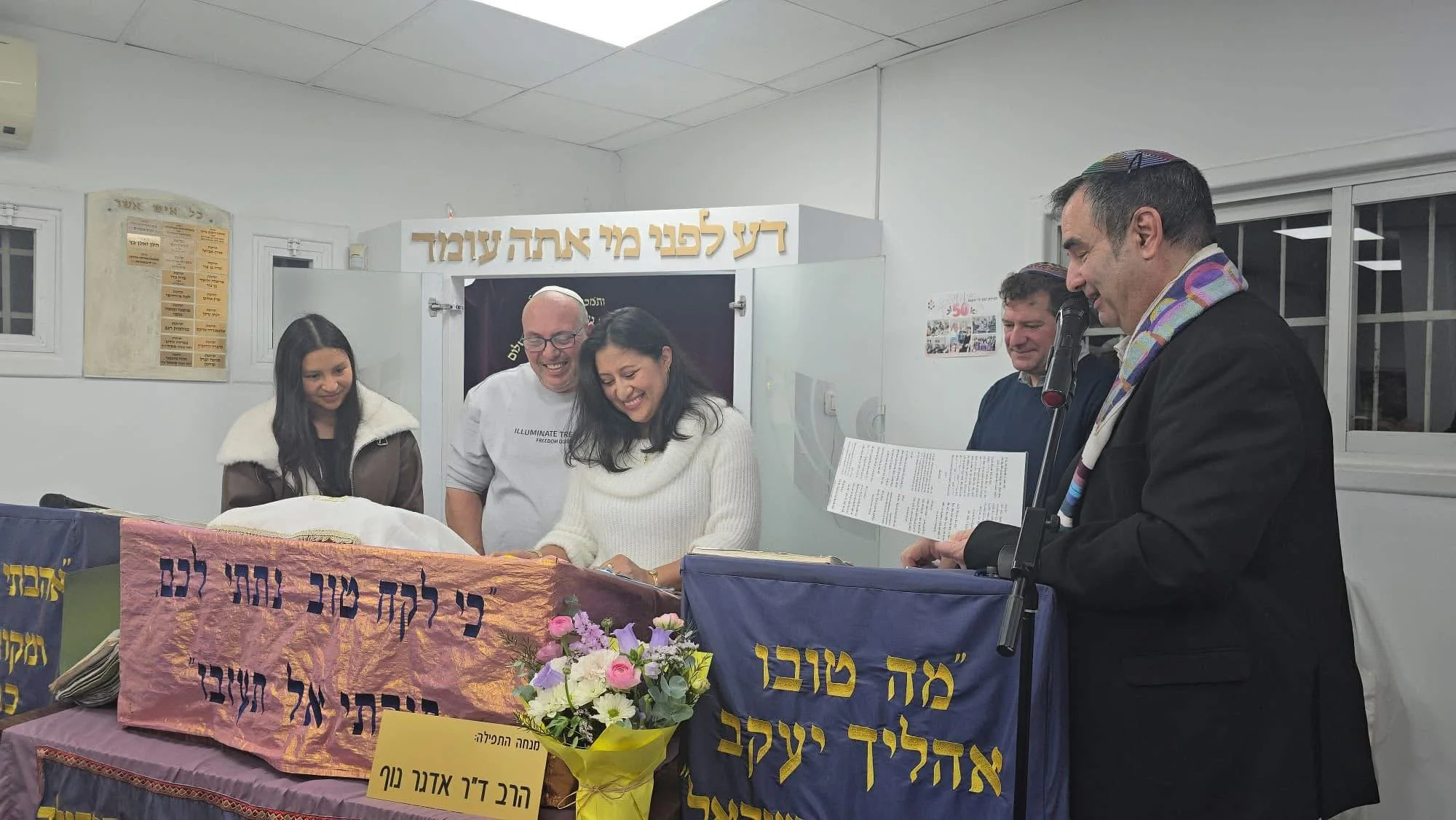
Elisheva officially becomes part of the Jewish people (screenshot from Natan-Ya’s livestream)

And then, breaking with the idea that the sequel is never as good as the original, another woman is called to the podium. She’s originally from Guatemala; she came to Israel and married a Sefardi man. Her husband and a handful of children stand beside her; she’s the second person tonight to celebrate a conversion to Judaism. She’s taken the Hebrew name Elisheva.

Elisheva takes out her prepared notes, and starts to thank her family, and the rabbi, and this community… but she gets choked up; it takes a while for her to regain her composure. And so, too, for the rest of us. And then, in unison and resounding with unbelievable excitement:  Achoteinu At! Achoteinu At! Achoteinu At! (“You are our sister! You are our sister! You are our sister!”).

In the language of our tradition, she has been embraced “under the wings of the Shekhinah.” But she’s also just been embraced by the Jewish people, as represented by this beautiful mosaic of worshippers.


Frankly, it was one of the most joyful and loving Shabbat services I’ve been to in a long time, amidst the joyful cacophony. This is the authentic face that I wish Israel were more adept at putting forward to the world: pluralistic, joyful, and welcoming—with room for everyone.

Shadow and Light (Israel Reflections #1)

Heidi and I came to Israel this week with some particular goals. We wanted to be with as many of our friends and friends-who-are-like-family as possible, to do some volunteering and demonstrating, and to give away Tzedakah money to people and places that are making the society better. It’s not a vacation; Israel evokes deep feelings and I’ve been on shpilkes for much of my time here.

This has been a poignant week in Israel, a week of shadow and light.

First, the shadows.

I hope that by the time you read this we are not at war with Iran. This is a war-scarred and traumatized society; nearly two-and-a-half years since the terrorist massacres of October 7, it seemed as if some sort of equilibrium was, at least, within sight. Everyone seems to be going about their daily lives with some semblance of normality, but the emotions beneath the veneer are complicated.

Last July, Iranian missiles fell from the skies, sending people in the middle of the nights into their shelters and safe rooms. Everyone is geared up for that to happen again this week, as American carriers are in place in the Persian Gulf, the U.S. Air Force is conducting drills, and Iran is threatening to respond in kind on Israel.

I’ll admit I’m a little nervous about all this, but my Israeli friends have told me how to take precautions and prepare for an attack that seems like it’s coming.

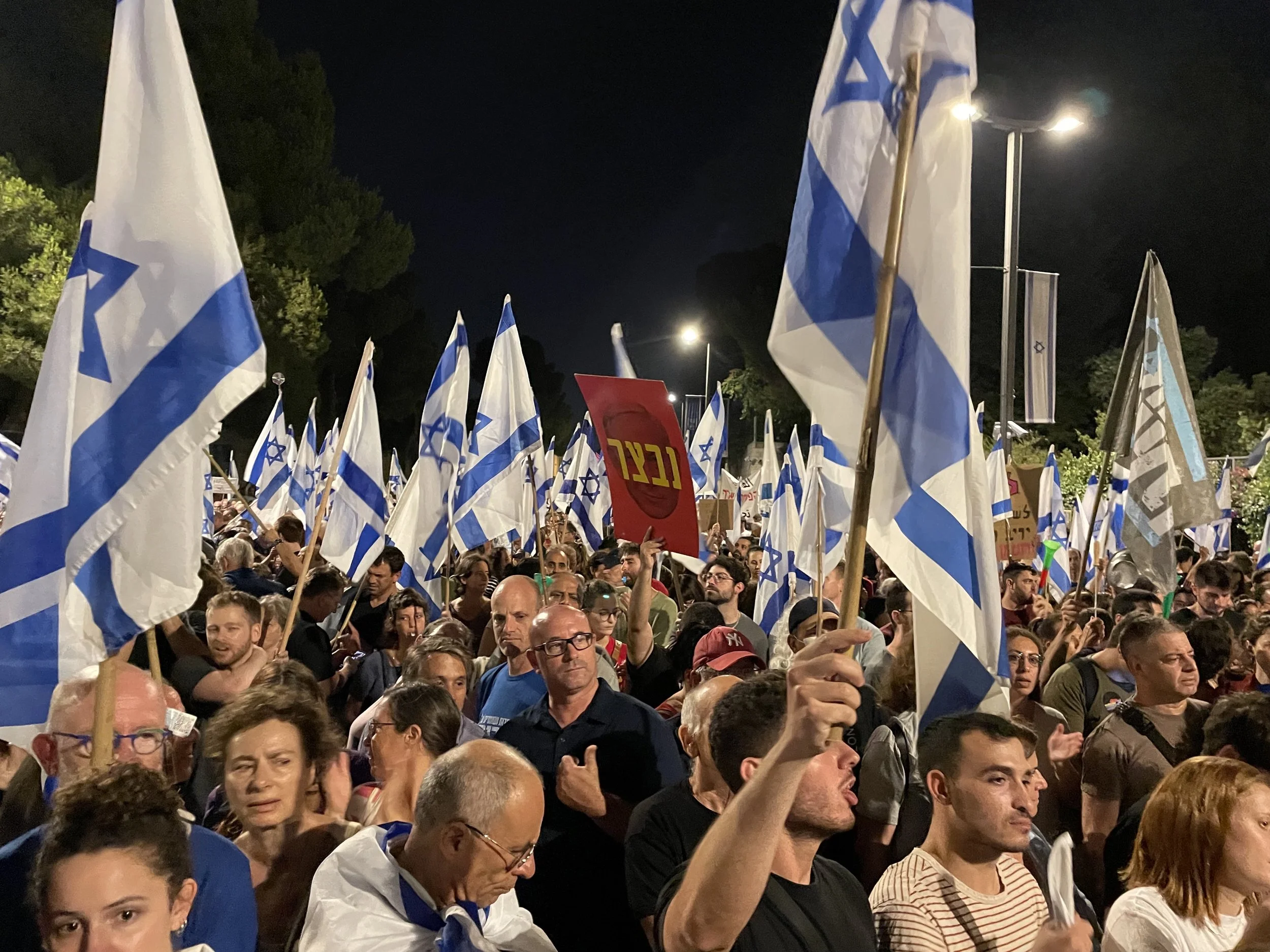
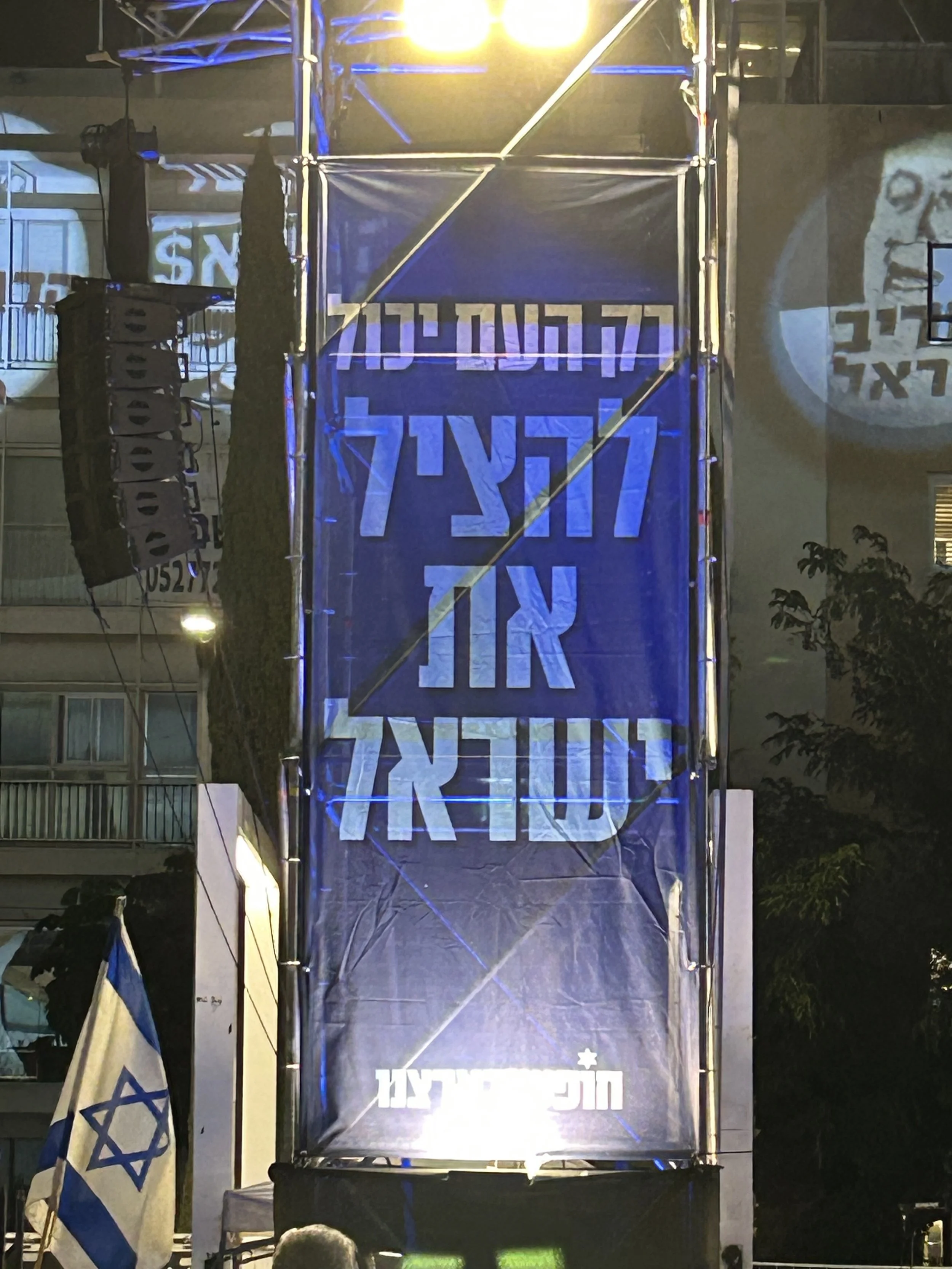
Beyond that, Israelis are wrestling with a parallel dilemma as Americans: the assault on democratic institutions by a corrupt administration. The horrible situation of unchecked settler violence in the West Bank — as well as surging rates of intra-Arab violence — is at a boiling point here. So we joined, with thousands of others, the pro-democracy rallies and demonstrations that have been running perpetually for years. Everyone knows that the status quo can’t hold.

So of course there are shadows in Israel. But shadows don’t exist in unrelenting darkness, and we’ve also experienced an enormous amount of light.

The biggest story in Israel this week was—finally, 843 days after that cursed Oct. 7—the retrieval and return of Ron Gvili’s body from Gaza. For the first time in 12 years, there are no Israeli hostages, alive or dead, in the dungeons and tunnels of Gaza. Every Israeli is cognizant of this; everyone was aware of his funeral that took place this week. Ron Gvili was an Israeli hero, and his family had been desperately holding on to the slimmest hope that he was perhaps still alive. This week they received the closure of at least knowing his fate.

So the yellow and blue ribbons are coming down. The Hostages and Missing Families Forum / “Bring Them Home Now” organization held its final Kabbalat Shabbat service in Tel Aviv.  Synagogues no longer recite special prayers for the hostages. And I removed “Bring Them Home” from my email signature. People are finally trying to move forward and confront the long process of healing a traumatized generation.

Considering the trauma and the healing, there were two particular points of light that I want to share with you:

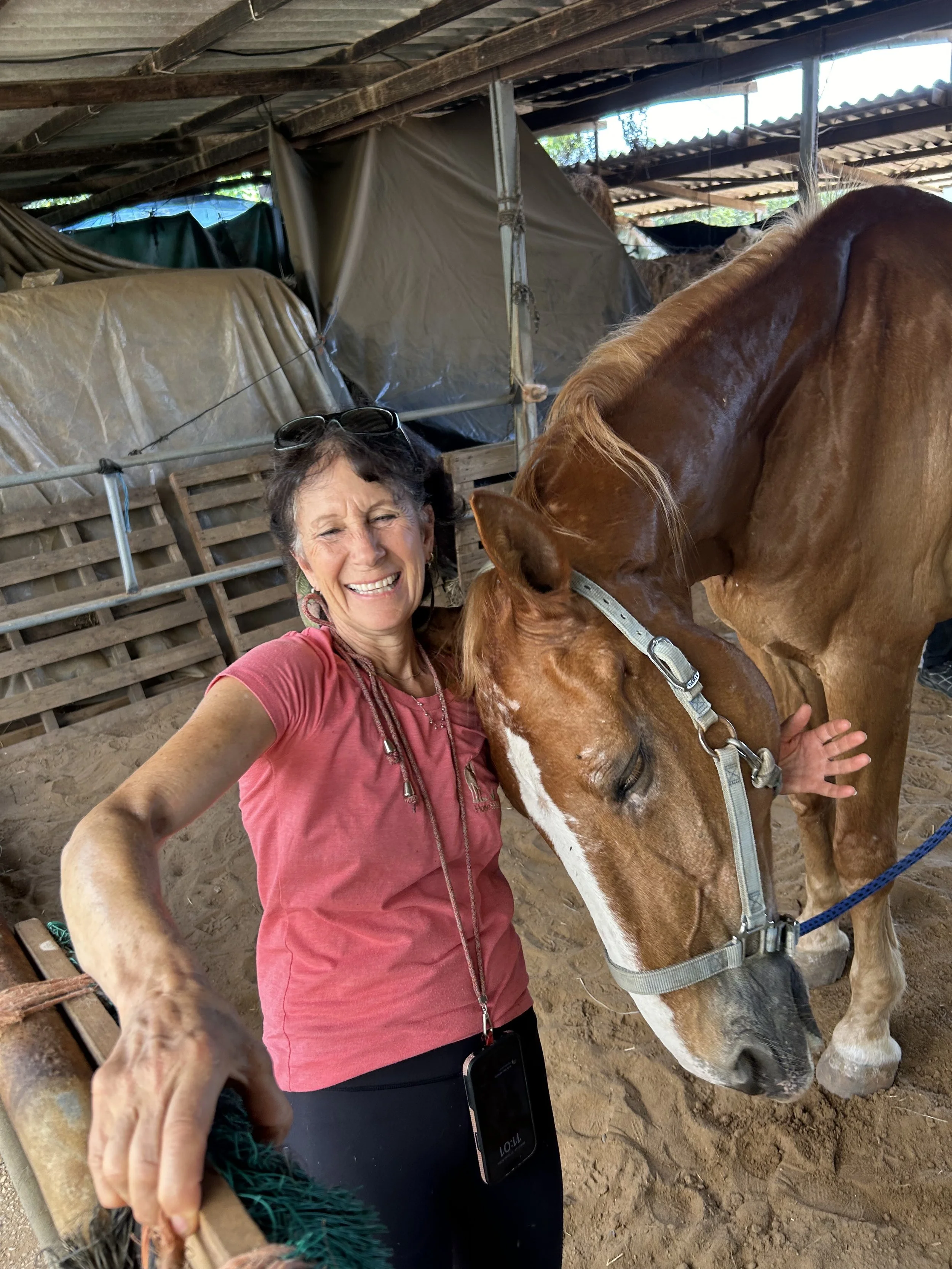
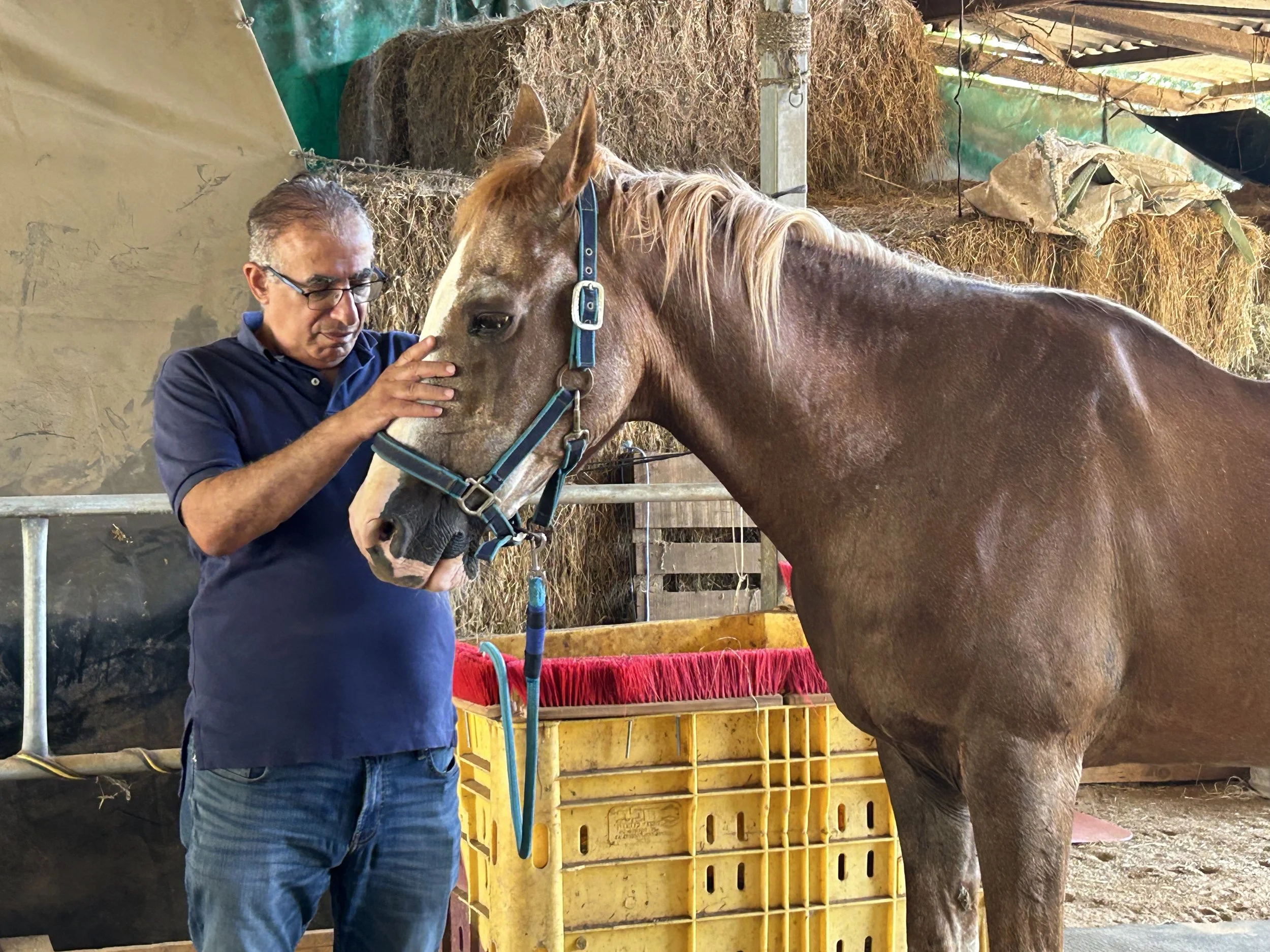
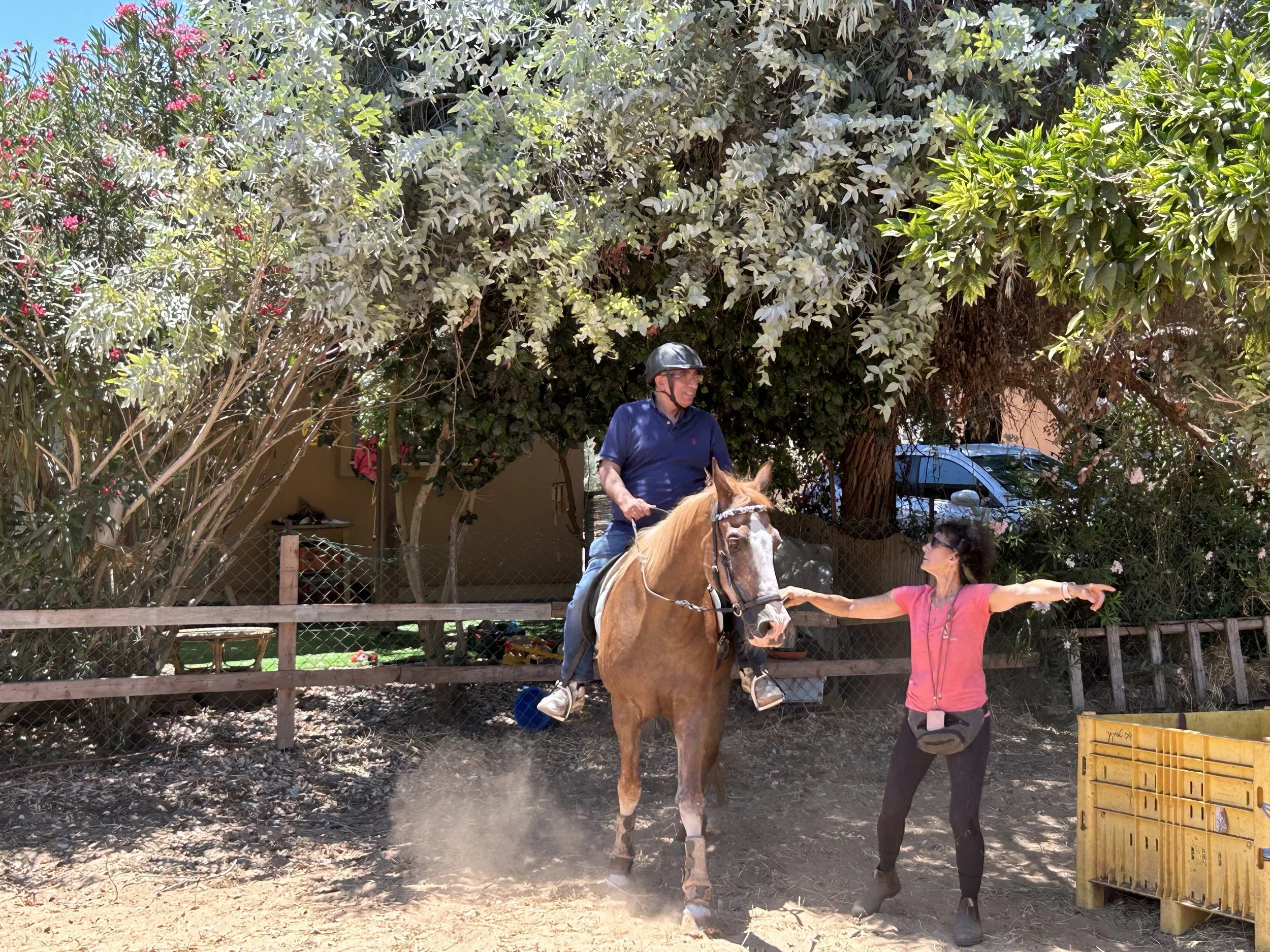
Transcending Trauma: We visited with my friend Anita Shkedi this week. I’ve written about Anita before; she is an internationally recognized authority on hippotherapy, using horses for physical and emotional therapy. But that’s just the tip of the iceberg. Anita’s most recent book is Horses Heal PTSD, and since Oct. 7 she and her Transcending Trauma team have been caring for survivors of the massacre and the IDF soldiers who have been in Gaza and elsewhere. How clearly can I say this? She puts shattered lives and bodies back together, teaching her clients the art of grooming and caring for and bonding with horses, and then the therapy that takes place on horseback. It’s awesome to be in her presence and to hear the stories of her people; it’s a great privilege to support her work through the Kavod Tzedakah Fund.

Neal and Anita Shkedi of Transcending Trauma teaching in Netanya, January 29, 2026

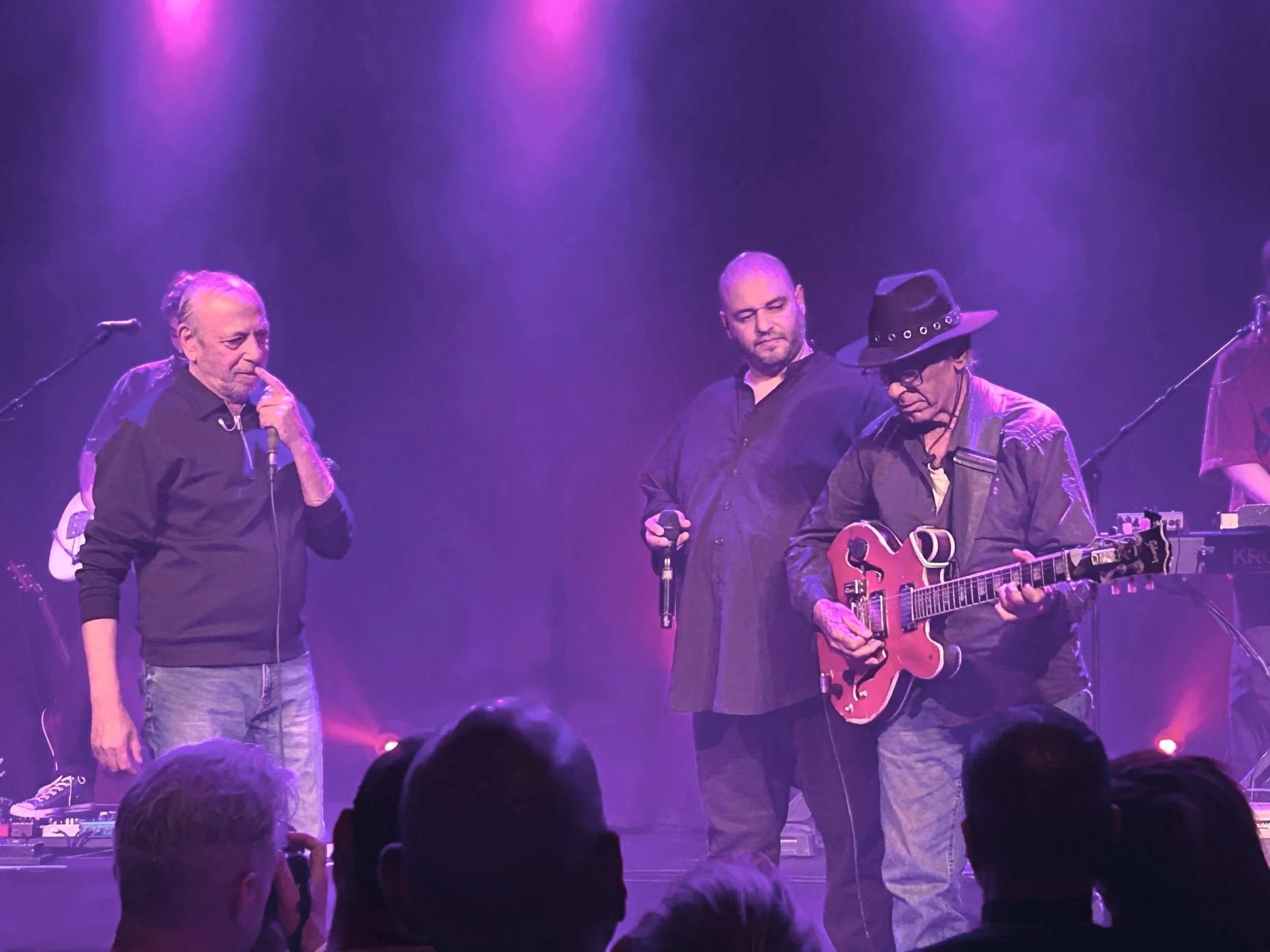
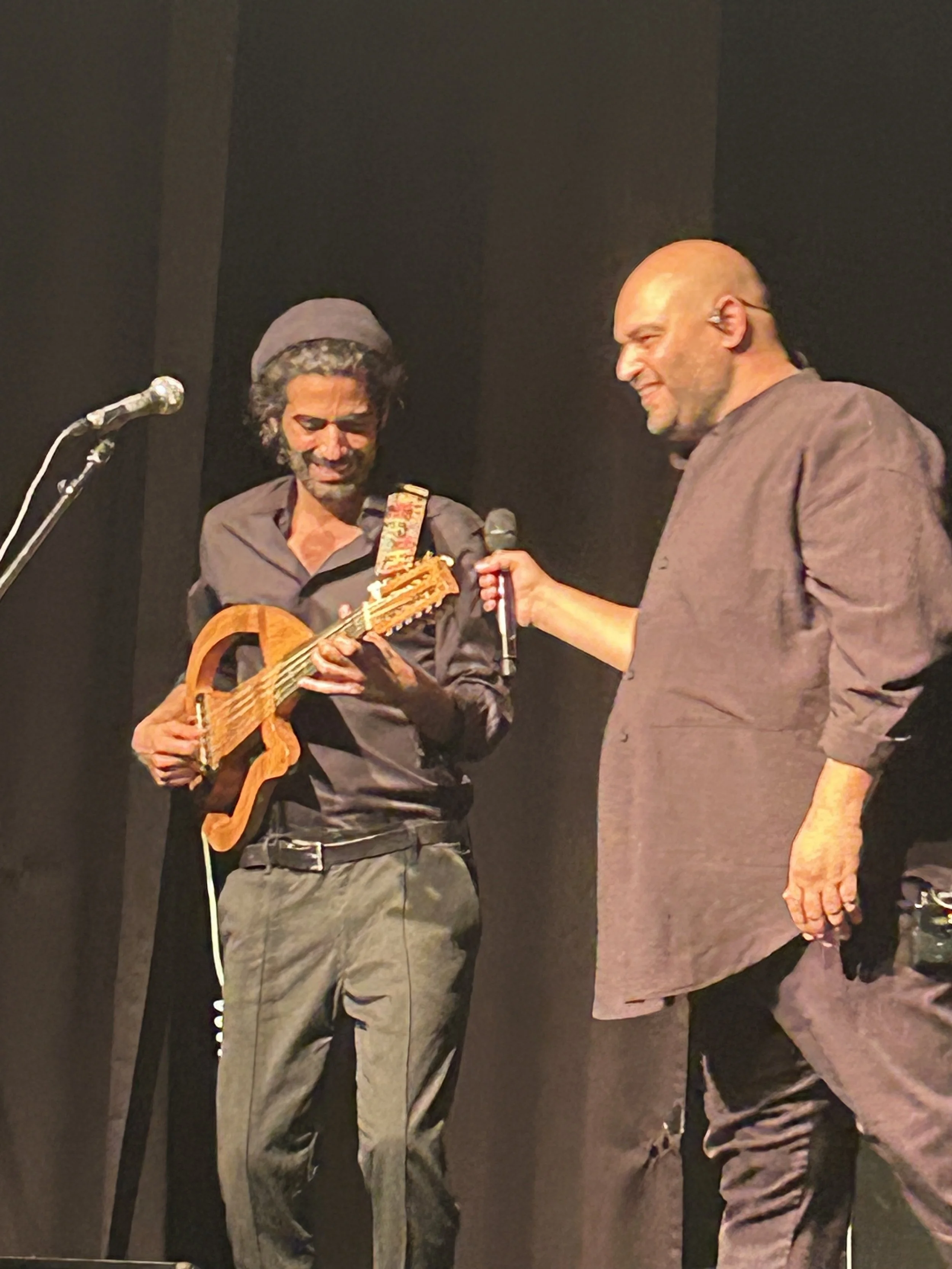
 Shai Tsabari with Avner Gadasi and Yehuda Keisar: Heidi and I did some volunteer work and spent time listening to a lot of Israeli stories over the past few days. By Wednesday night we were ready for a break, and I spotted that Israeli musician Shai Tsabari was performing with two of the most renowned Jewish Yemenite musicians of the generation, Avner Gadasi and Yehuda Keisar. Tsabari is of  the generation of Israeli rock stars whose music is a mixture of western (rock, dance, psychedelia) and eastern (Jewish piyyutim, and especially the melodies of Tsabari’s ancestry in Yemen). He’s also known for his engaging and soulful personality that draws people in and gets them up and dancing.

Avner Gadasi, Shai Tsabari, Yehuda Keisar (photo: NG)

Shai Tsabari and a member of his band with a unique instrument (photo: NG)

I knew the concert would be fun—but I didn’t realize how deeply it would move me. The place was packed with Israelis, who by the second half of the show were on their feet, singing every word, and some dancing on chairs and tables. It struck me: here is a nation that has been so traumatized and so soaked in grief; a society that for the past two-and-a-half years could recite the name of every hostage. Tonight I felt a catharsis, a release, a transcendence that is reflected in the slogan “We Will Dance Again.”

It doesn’t mean that the next morning the nation won’t resume confronting its PTSD. But for one night, a few hundred of us were smiling, slapping hands, dancing to the old-new sounds of Jewish musicians, and realizing that there is an unspoken spirit that binds this people together in history and hope.

Of Elvis, Jerusalem, Loneliness, and Distance

Tisha B’Av in 2025 is the diagnosis, not the cure.

The music critic Lester Bangs (1948-1982) was one of the great chroniclers of rock and roll. He emerged in the late 1960s with the maturation of rock—after The Beatles psychedelicized, after Dylan went electric, after the Velvet Underground teamed up with Andy Warhol—and wrote in a style that read like the noise and chaos of the music. Just as the Beat Generation wrote books that bopped with the rhythms of jazz in the 1950s, Lester wrote lines that pounded like drums and spun off like electric guitar solos.

I’m thinking of Lester (his writing invites the informality of first names) because of a few sentences he wrote in August 1977, on the occasion of the death of Elvis, a pivotal “changing of the guards” moment in rock history. In an extraordinary obituary in the Village Voice, Lester wrote:

If love truly is going out of fashion forever, which I do not believe, then along with our nurtured indifference to each other will be an even more contemptuous indifference to each other’s objects of reverence… We will continue to fragment in this manner, because solipsism holds all the cards at present; it is a king whose domain engulfs even Elvis’s.

But I can guarantee you one thing: we will never again agree on anything as we agreed on Elvis. So I won’t bother saying goodbye to his corpse. I will say goodbye to you.[1]

I don’t have much affinity for Elvis beyond his place in the history of pop culture; I was seven years old when he died and it barely registered. At the time of his demise his significance had long since passed, and his musical descendants fragmented into many camps and styles.

But that final line of Lester’s elegy haunts me in a much deeper place than, say, “Don’t Be Cruel.”

Part of the reason I cling to that sentence “I will say goodbye to you” is because I think Lester inadvertently (he was raised a Jehovah’s Witness in southern California) gets at the heart of Tisha B’Av, at least on its spiritual and emotional levels.

And for me, Tisha B’Av seems to be more and more spiritually relevant every year, especially this year.

The 9th of Av, of course, is the most sober and solemn day in the Jewish calendar. Ostensibly it is about historical horrors: most obviously in the destructions of the First (586 BCE) and Second (70 CE) Temples that stood in Jerusalem, but also G-d’s decree that the generation that came out of Egypt would die in the wilderness (Numbers 14); the plowing over of Jerusalem by the Romans; and the quashing of the Bar Kochba revolt at Beitar in 135 CE. (All this is enumerated in the Mishnah, Ta’anit 4:6.)

As horrific as those historical moments were, they’re also meant to be understood on a spiritual level. They all emphasize the idea of Exile; that is, the forces of entropy that drive us away from our foundations, and one another, and G-d. The destruction of the Temples, the plowing over of Jerusalem, and end of the rebellion against Rome at Beitar were all historical traumas—but they were also moments when the chasm between our ideals and our reality felt insurmountable.

Does that describe our reality today? Some days it feels that way, and that makes Tisha B’Av for me feel more relevant and meaningful than ever. The centrifugal forces that pull us apart from one another, and ever further from our Source, seem incredibly powerful.

Certainly I’m thinking about Israel—I’m always thinking about Israel.

I’m thinking of my brothers and sisters in Israel who have endured months of sitting in bomb shelters. Who have been conscripted to fight three, four, and more tours of duty to defend their homes. Who endured the hail of Iranian missiles at the beginning of the summer. Who have shown over and over again what it means to be a society that cares for one another at a time of crisis.

I’m thinking of Israelis who day in and day out demonstrate that they are much better and more decent than the government that speaks for them.

Israel once was supposed to be the thing that bound all Jews together. Even if we located ourselves at different places along the political, religious, or ideological spectrum, we agreed on one thing: the creation of a democratic Jewish state in the 20th century was our response—our antidote—to the centuries of hate and exclusion of Jews, and an awesome new chapter in Jewish history.

But now Israel is the stick we use to beat each other with.

There was a moment—a few weeks after Hamas terrorists massacred, raped, and took Jews hostage on October 7, 2023—when it seemed like unity would rule the day. Jews everywhere mourned together and the world’s capitals were lit up with blue and white.

But that seems as long ago as the Second Temple. Outside the Jewish community, we are increasingly perceived as aggressors of a war we didn’t ask for. Inside the Jewish community, we rip ourselves apart by analyzing what we’ve become after two years of this horrific war. Has fighting this just war coarsened our souls to the point where we cannot empathize with the pain of others, including our enemy’s children?

And in Jerusalem today, just as on the eve of destruction in 70 CE (see Gittin 56a), a minority of political and religious zealots are manipulating the destiny of the majority of Jews who are seeking a just path out of this morass.

Maybe disunity and unraveling will describe the rest of our lives, as Lester Bangs described in 1977: “We will never again agree on anything as we agreed on Elvis.” Maybe our fate is the same as the one that Joseph faced: “I am looking for my brothers” (Genesis 37:16).

Maybe. But I hope not.

So what is Tisha B’Av in 2025? It’s the diagnosis, not the cure. The diagnosis is estrangement, distance, the utter failure to see in one another a sense of suffering and pain that might in some way resemble our own wounds.

Only after the diagnosis can we reach for a cure. “Only those who mourn for Jerusalem will get to see her future joy,” says the Talmud (Ta’anit 30b).  After recognizing on Tisha B’Av how far we have moved from each other, something remarkable happens in the rhythms of Jewish life: Gravity takes over. We begin to move back towards one another.

In synagogue life this is marked by seven weekly Haftarah readings, each one on the themes of comfort and restoration taken from the final chapters of the Book of Isaiah. Seven weeks mark our return to first principles, until we arrive at Rosh Hashanah and culminate with Yom Kippur. The forces that pull us apart begin to reverse themselves in their courses, and we start to draw closer together once again.

This year, I hope we can make it back. I’m not quite prepared to draw the line that Lester Bangs did when Elvis died and he wrote I will say goodbye to you.

Instead I’ll say I’ve seen that point of estrangement—politically and otherwise—and I don’t want to live there. Instead, I’ll say: I’m looking for you, and maybe we can find a way back, together.


Forwarded to you? You can sign up to receive updates from me via A Tree with Roots.

[1] Lester Bangs, “Where Were You When Elvis Died?”, collected in Psychotic Reactions and Carburetor Dung, ed. Greil Marcus, 1987.

From October 7 to 17 Tammuz

Our calendar is beginning to bulge with days that have become so notorious that they are simply known by their dates. “9/11,” of course. “January 6.” And “October 7.” Days that live in infamy because of the awful events that happened on them.

Jewish tradition has long had a few of these as well—commemorations that are just known by their dates on the calendar. The 17th day of Tammuz is a minor fast day that falls this year on Tuesday, July 23. According to the Talmud (Ta’anit 26a-26b), 17 Tammuz is associated with historical tragedies for the Jewish people. Some of these calamities can be seen as “preludes” for disasters that would fall on the 9th Av, exactly three weeks later:

…חֲמִשָּׁה דְּבָרִים אֵירְעוּ אֶת אֲבוֹתֵינוּ בְּשִׁבְעָה עָשָׂר בְּתַמּוּז
,בְּשִׁבְעָה עָשָׂר בְּתַמּוּז נִשְׁתַּבְּרוּ הַלּוּחוֹת
,וּבָטַל הַתָּמִיד
,וְהוּבְקְעָה הָעִיר
,וְשָׂרַף אַפּוֹסְטְמוֹס אֶת הַתּוֹרָה
.וְהֶעֱמִיד צֶלֶם בַּהֵיכל

Five terrible things happened to our ancestors on the 17th of Tammuz…

1. The tablets were shattered (by Moses upon seeing the Golden calf; Ex. 32:19);
2. The Tamid/daily sacrifice in the Temple was cancelled (by the Roman authorities);
3. The city walls of Jerusalem were breached;
4. The Roman general Apostemos publicly burned the Torah;
5. And an idol was placed in the Sanctuary of the Temple.

It's that third item that cuts to the quick this year. It’s not difficult to imagine the carnage of the “breaching of the walls.” After all, we saw it with our own eyes on October 7, nine-and-a-half months ago, when Hamas terrorists tore through the Israeli villages and kibbutzim in the western Negev, murdering and raping their victims, setting fire to the towns, and seizing hostages, 120 of whom are still being held prisoner in Gaza.

Last week, I visited the ruins of Kibbutz Nir Oz. Of the 427 residents of that community, one in four were murdered, wounded, or taken hostage on October 7, 2023, that cursed Simchat Torah. Nine-and-a-half months later, the kibbutz is a ghost town—desolate and frightening. And like a prehistoric insect embalmed in amber, Nir Oz is frozen in time. Broken glass still carpets the ground, the walls remain ashen, children’s toys litter the floor—and the sukkah is still standing.

It was brutal to be there, and I struggle to post this here. But it’s essential that we keep sharing the images and telling the stories of what happened in Nir Oz (and Be’eri, and Kfar Aza, and all the other devastated towns, and at the site of the Nova music festival), so that the world can bear witness.

Images are more powerful than words (at least they’re more powerful than my words), so I’ll share this as a photo-essay of what I saw at Nir Oz last week. The images are devastating, but important. Please note: I’m posting this from a laptop computer, and the photos are neatly arranged on my screen—my apologies if the formatting is messed up on phones or iPads.

The entrance to the main building at Kibbutz Nir Oz today.

Some of the destroyed homes of the kibbutz:

The Hadar Ochel / communal dining hall and kitchen of the kibbutz:

The kindergarten classroom of Nir Oz:

The sukkah is still standing, in shambles, nine months after the festival (“the Season of our Joy”) ended:

And the rage and resentment against this government’s failures - in preventing the attack and in bringing the hostages home - is palpable everywhere:

This sign, posted outside one of the scorched homes, says, “Netanyahu: My family’s blood is on your hands!”, and is signed by the residents.

A few more images from the houses of the kibbutz, include the burnt house of Oded Lifshitz, an octogenarian journalist and lifelong activist for peace between Israelis and Palestinians, now one of the hostages.

The names that are on everyone’s lips in Israel are those of the Bibas family of Nir Oz. Their family of four - parents Shiri (age 32) and Yarden (age 34), and their children Ariel (age 4) and Kfir (age 9 months) - were kidnapped and remain hostage in Gaza today. Shiri’s parents Yossi and Margit Silberman were murdered on Oct. 7. Kfir Bibas has now lived more than half of his life as a hostage to the Hamas terrorists. The scene at the Bibas home is devastating:

The Bibas family mailbox, with four labels that read “hostage.”

THIS is why we’re fighting this just war. THIS is what is at stake when we say “BRING THEM HOME.” It pains me to post these pictures here, but the world must know about what happened here and elsewhere on October 7.

The view through the fence at the border of the Kibbutz, with Gaza just beyond.

The flag flying half-mast at the entrance to the kibbutz.

What are You Reading?💔

A visit with my friend Rabbi Dalia Marx today took me for the first time to the new building of the National Library of Israel. It’s a marvelous place - the world’s largest collection of Hebraica and Judaica - and a must-visit on a trip to Jerusalem. (It’s across the street from the Knesset, and the 24-hour non-stop demonstrations against this government are particularly intense on the streets out front.)

But even in this quiet place of reflection and intellectualism, the trauma of the war pervades. There is a profoundly moving exhibition near the entrance to the main hall of the library. A chair is set for each and every person still held hostage in Gaza. And on each seat lies a book, custom-selected to reflect the interests or passions of that unique individual:

Some of the books are history, or sports, or classic literature; each has been selected by a family member, or loved one, or by volunteers in honor of that person. Everyone is just waiting for each of them to come home (now!) to claim their book.

My eyes gaze from one seat to the next, as I read the names and ages and the books that have been selected: fiction, non-fiction, hardcovers, paperbacks, old books, recent books…

And then I get to the end of the row, and I see this - and the tears come again:

Kfir Bibas, 9 months old, kidnapped from Kibbutz Nir Oz on October 7, hostage of Hamas terrorists in Gaza. Kfir’s book: איה פלוטו, “Where’s Pluto?”

Ariel Bibas, 4 years old, kidnapped from Kibbutz Nir Oz on October 7, hostage of Hamas terrorists in Gaza. Ariel’s book: אמא ואני, “Mommy and Me.”

Transcending Trauma in Israel

Trauma is a brutal word. It’s not only the damage that occurs from physical or psychological wound; it’s also the wound that festers, long after the initial damage has been inflicted.

Israel is a traumatized nation this summer. On the surface, the cafés are occupied, the beaches are full, the tourists are touring, and so on. But the trauma is everywhere, barely beneath the surface. Even if every hostage were to return home tonight (amen!), and if Hamas were to surrender, and if Hezbollah were to cease raining missiles on the North—still it will take a generation to heal the trauma.

My friend—truly one of my heroes—Dr. Anita Shkedi is an authority on trauma, and earlier this week I went to observe the power of the therapeutic work she is doing.

I’ve known Anita for 30 years; she’s one of many Mitzvah-heroes I first met through Danny Siegel. She is a world-renowned expert on equine therapy (“therapeutic horseback riding”), which uses the holistic power of horses to heal broken bodies and broken spirits. In recent years, her attention has moved to healing trauma; her book Horses Heal PTSD: Walking New Paths is full of staggering stories of love and hope that should be read even by people who have never given horses more than a moment’s thought.

And then, October 7 and its aftermath: the massacres, the hostages, the horrors of war; the 125,000 Israelis from the Gaza envelope and the northern border who have been forced from their homes. The nation is grieving and writhing. In response, Anita and her team pivoted and created a new program: TRANSCENDING TRAUMA, “supporting individuals in the early, mid, and post stages of trauma, and then later if chronic PTSD has developed. It provides immediate intervention and treatment, builds resilience and encourages post traumatic growth. Transcending Trauma is an excellent way to regain a sense of trust and learn to manage this ongoing crisis.”

They’ve created groups from survivors of the Nova Festival. They’ve had groups of survivors from the kibbutzim that were devastated by the terrorists. Today, it’s a group of traumatized soldiers.

Anita Shkedi (left)

Nikki Kagan

I visited Anita and the team at “Piloni’s Place” on Moshav Hibbat Tzion, at the backyard horse farm of Nikki Kagan, a noted leadership consultant and horse expert. I met the group of eight participants who had gathered there for the day’s program:

·      A soldier who is the lone survivor of his unit of thirteen fighters. Can you imagine the trauma that he carries with him?

·      Another soldier whose job in Gaza is to recover the dead; to piece together pieces of bodies, give positive IDs, and get the bodies out of the combat zone to central command. Can you imagine…?

·      A young soldier from Westchester County, New York, who came to be in the army of the Jewish people…

·      And so on; five more people each of whom has seen death and destruction among friends and comrades-in-arms.

None of them, as far as I know, was a “horse person” before discovering this place.

The day unfolds this way:

First, the group gathers to say good morning and greet each other in the mercifully air-conditioned patio. They’ve become an intimate group in a short amount of time. Prior to finding Piloni’s Place, they had never met each other; each comes from a different army unit and lives in a different part of the country. As they arrive, we discover that each has brought a snack to share with the group: a watermelon, pastries, cookies, and so on—far more than we could eat that morning. As each person comes in and places onto the table the snack they’ve brought for the others, the whole groups bursts into laughter. No one asked anyone to bring anything! Anita tells me this instinct to take care of each other is a sign of their growing camaraderie and friendship.

Next, Nikki leads us in a short meditation and spiritual intention. And Anita gives gentle instructions for the day: “Talk to your horse as you’re riding,” she tells each participant. Not superficially, but she encourages each one to share how they’re feeling—what terrifies them, what keeps them awake at night, what they’re feeling deep inside. The bond between horse and rider is remarkably deep and holistic.

Then we adjourn to the stable, where the participants began to dress and groom the horses. But I also observe a process of getting in sync. The grooming is so physical and tactile: human hands caress the horses’ bodies as manes are combed, saddles are assembled, hooves are cleaned of debris, and so on. I can see the horses grow calm and comfortable, and the riders, too, are becoming attuned to their animals.

Then it’s time for riding and exercises. Each student mounts their horse and rides, occasionally raising their hands, or moving through obstacles, and following some basic exercises as instructed by Anita and her daughter-in-law Shani. There are smiles, serenity, a growing sense of security and self-awareness. The horses are steady and calm. Even though the day is brutally hot, I could stand in this spot and watch these riders for hours.

When the exercises end, the riders hose down their horses, return the equipment, and reassemble in the room where we began. There is some discussion and processing of emotions, as in any sort of therapeutic support group. There is laughter. Everyone seems looser, relaxed, and enjoying each other’s company.  A beautiful sort of camaraderie has taken place among them; over the weeks that they’ve become part of this group, they’ve shared some intense therapeutic time together. They’re on the long, slow march to a place of confidence and self-worth, and fewer night terrors and isolation and doubt.

Tomorrow, a different group will be meeting here: Anita will be training trainers, who can spread out around the country and offer similar therapeutic groups on horseback for a traumatized nation.

I’m glad to be an emissary for the Kavod Tzedakah Fund, and I deliver a check for a few thousand dollars (each day’s session costs about $1000 to run; of course none of the participants pay anything). I’m also eager to give Anita some of the cash that friends entrusted me to give away in Israel: This, I tell her, is for ice cream and snacks for future groups, to make everything that much gentler.

This is an awesome place, and Anita and Nikki and their team are doing life-saving work. But the need is huge, for a damaged nation coming to grips with its trauma.

If you’d like to support the work of Transcending Trauma (the non-profit is officially registered as “Friends of Jonathan”) from America, there are three ways to do so: 

1.     A wire transfer directly to their bank in Israel; more information here: https://www.anitashkedi.com/transcending-trauma/

2.     The Good People Fund, run by my friend Naomi Eisenberger in Millburn, NJ: www.goodpeoplefund.org;

3.     The Kavod Tzedakah Fund, for which I am a volunteer allocations director, founded by Rabbi Yoshi Zweiback: www.kavod.org. (If you give through Kavod, please send me an email saying that you’ve directed a donation for Transcending Trauma.)

The Mood of Israel from Its Graffiti

I just returned 24 hours ago, so I’m still processing the complicated feelings and spirit of Israel that I’m encountering. I’ll have more to say about the national trauma (literally; as well as the people who are trying to heal it) in the days to come.

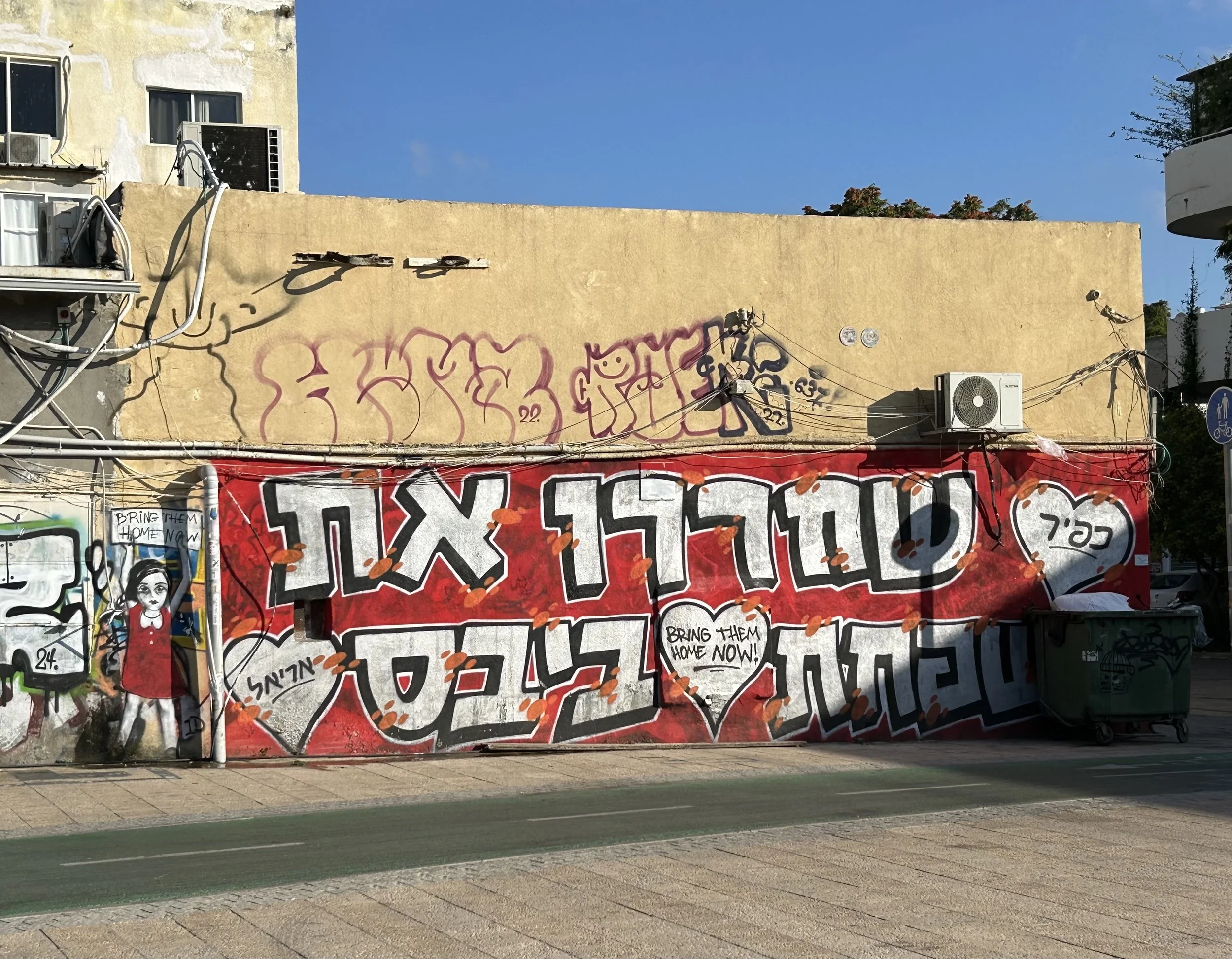
But below is a collection of images of Israel from the past 24 hours, especially the graffiti of Tel Aviv, that tell a story about the national pain, anguish, and resilience of the extraordinary nation, the Jewish people. Last year the graffiti was all about the fight for democracy against Israel’s internal demagogues; today it’s about the shared destiny of the nation.

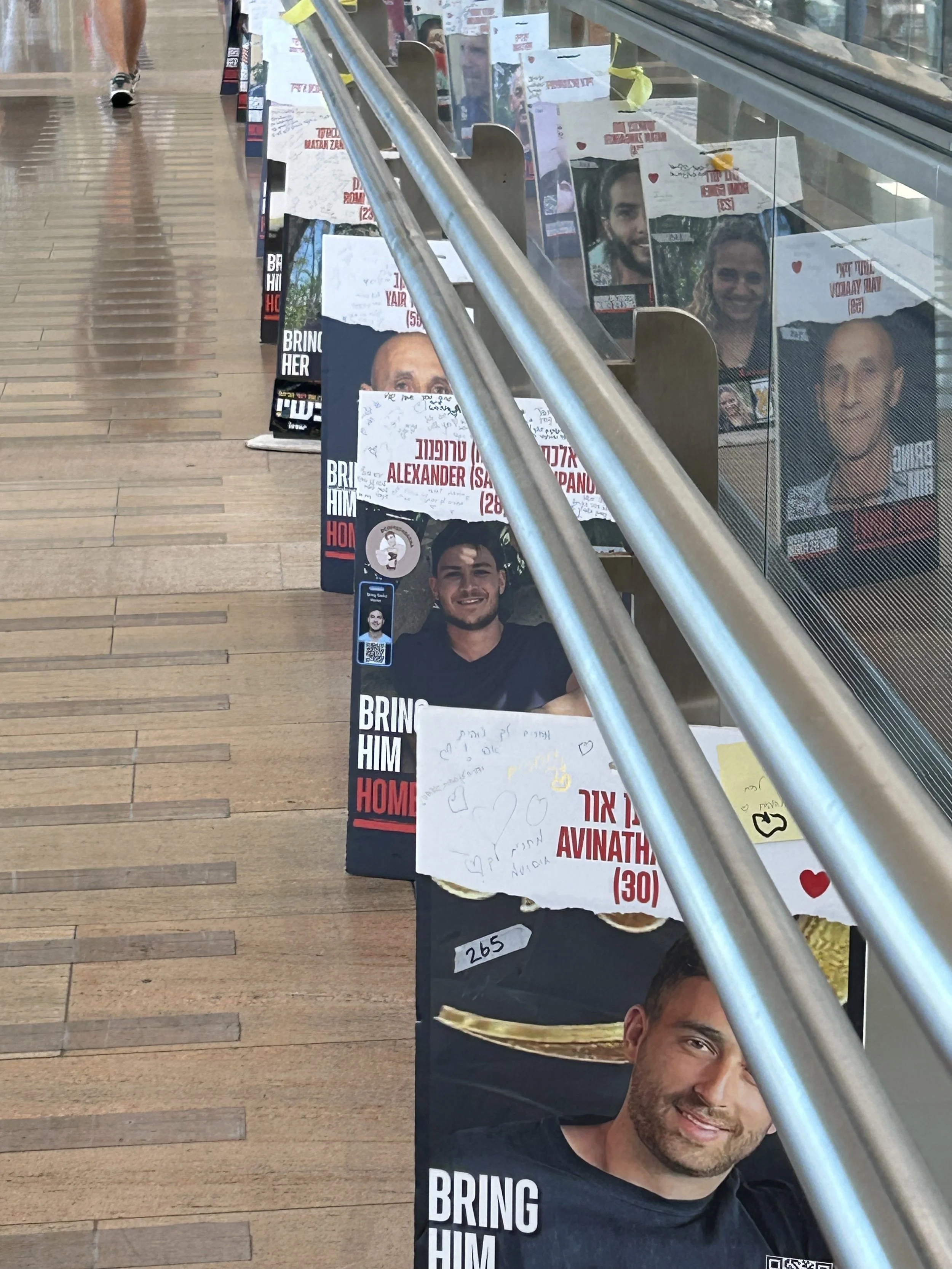
Upon arrival at Ben Gurion airport, on the long ramp from the gate to passport control, we are confronted with the faces of every hostage that remains captive in Gaza - not one is forgotten - courtesy of Bring Them Home Now-The Hostages and Missing Families Forum:

To each one, people have added personalized inscriptions of love and hope. No one is a statistic or a number. Hersh Goldberg-Polin: we are thinking of YOU, and want YOU to come home now! The numbers that have been added to the poster represent the number of days he has been held hostage.

Their faces, and the message BRING THEM HOME, is everywhere. This is one people, one family - and when part of the people is in pain, the whole people feels it:

This image pops up on the ATM before you withdraw cash.

And so it goes, throughout Tel Aviv - on billboards, placards, and on the sides of skyscrapers:


”Bring the kids back home”

“Release them from their hell!” Seen on the streets of Tel Aviv in different forms.

“Free the Bibas family / Bring them home now!” The Hamas terrorists kidnapped the family of four: 34 year-old mother Shiri, 35 year-old father Yarden, 4 year-old Ariel, and 9 MONTH OLD Kfir; Shiri’s parents were massacred in Kibbutz Nir Oz on the same day. Hamas and every sycophant in the west who justifies the terror has the family’s blood on their hands.

On the side of a Tel Aviv highrise: One People, One [Shared] Fate

In this most progressive of cities, there is a spirit of defiance against the hypocrisies of the world that have come out into the open since the war began. For instance, all those who consider rape a war crime, always and forever—except, it seems, when the victims are Jews. So here are two powerful images asking: where have the UN women’s forums and everyone else been as Hamas’s sexual assaults have been documented over and over, including by the perpetrators themselves?:

But below are the ones that I’ve found most powerful - and haunting. These are images from the walls of one of the train stations in downtown Tel Aviv. Each sticker is about one of the victims: who they are, who’s missing them at home, and so on. If they are a hostage, there’s a call to bring them back to the circle of family life. And if they’re dead - massacred on Oct. or killed in the line of duty - each is a howl of pain that they will not be forgotten, by their loved ones or by their people.

Actually, it’s astonishing how many of these contain a message of optimism, or love, or hope; epitaphs that represent the love the each of these individuals brought into the world:

What a country this is! From the Midrash:

.וְאַתֶּ֧ם תִּהְיוּ־לִ֛י [מַמְלֶ֥כֶת כֹּהֲנִ֖ים וְג֣וֹי קָד֑וֹשׁ]…מלמד שהם כגוף אחד ונפש אחת…לקה אחד מהן כולן מרגישין…

You shall be to Me a kingdom of priests and a holy nation (Exodus 19:6).

This teaches that they, Israel, are like a single body and a single soul…
And if one of them is stricken, all of them feel pain
.


More to come in the days ahead…

Bein Ha-Sh’mashot: Between Memory and Independence

Sunday evening, May 12, is Yom HaZikaron / Israel’s Memorial Day.
Monday evening, May 13, is Yom HaAtzma’ut / Israel’s 76th Independence Day.

תָּנוּ רַבָּנַן: בֵּין הַשְּׁמָשׁוֹת סָפֵק מִן הַיּוֹם וּמִן הַלַּיְלָה
.סָפֵק כּוּלּוֹ מִן הַיּוֹם, סָפֵק כּוּלּוֹ מִן הַלַּיְלָה

Our Sages taught:
Bein Ha-Sh’mashot, twilight, is a place of uncertainty. Day or night?
It is uncertain if it belongs to the day or if it belongs to the night.
 
(Talmud Bavli, Shabbat 34b)


The Israeli national calendar does something rather extraordinary: it juxtaposes Memorial Day and Independence Day, so the former segues directly into the latter.

We find ourselves in a twilight place between memory and freedom.

I’ve often wondered, as an American, how each of those days in our calendar would be more profound and meaningful if our national holidays were similarly positioned. As it is, the American Memorial Day, the last Monday in May, mostly becomes a three-day weekend of barbecues and the informal beginning of summer—unless, of course, you happen to be in a military family.  And the 4th of July becomes a day of fireworks and beachgoing. Physically separated by five-and-a-half weeks in the calendar, these days are distinct and isolated from one another. Imagine how the meaning of each day would be deepened if they weren’t so far apart.

By contrast, in the Israeli model, the two days are inextricably connected, and each throws light upon the other. In other words, Israel’s fallen soldiers (and victims of terror) are remembered in the context of paying the ultimate price for everyone else’s gifts of freedom.

The flow from Yom HaZikaron into Yom HaAtzma’ut is organic, meaningful, and solemn.

This year, that seam between the two days seems to be the profoundest metaphor of the condition of Zionism. We truly find ourselves בֵּין הַשְּׁמָשׁוֹת /  bein ha-sh’mashot, in a twilight place between memory and freedom.

Please, please this year take a moment on Yom HaZikaron to remember. Remember not only the victims of Israel’s wars and the terrorist onslaughts she has faced throught the decades. Remember, too, the Hamas butchery of innocents on October 7: 1,139 people who were murdered, including the 364 who were killed at the Nova Music Festival in the desert, and the others from the kibbutzim and towns where the terrorists ruthlessly went door-to-door, executing children, elders, women, and men.

Remember that 250 people (in some situations, several generations of a single family; toddlers and grandparents) were kidnapped and held hostage in the dungeons beneath Gaza.

Remember that many of these women were raped and assaulted by the terrorists, and then their humiliations were sadistically posted to terrorist social media (with beheadings, torture, and more).

Remember that 128 people remain hostages today. May they be returned home before the holidays conclude on Tuesday.

And yes, we have room in our hearts to remember ALL the victims of war and terror, including the innocent Palestinian victims in Gaza. We have not forgotten, and we weep for all the victims. By mourning all the innocents, we assert that we are of a different moral caliber than our enemies.

But we also remember that there are such things as just wars, and we did not seek out or choose this war. The massacre of innocents and the hostages who are still behind enemy lines, without any Red Cross lifelines:  we remember them, and we will not forget, until every one is brought home.

Our Day of Memory will segue into our Day of Independence. And it may be hard to celebrate this year. But even acknowledging our diminished joy, I believe it is incumbent upon us to observe Yom HaAtzma’ut this year; to say in awe: “My G-d! We live in a generation that knows a State of Israel. What would our great-great-grandparents have said to us, to remind us that we live in one of the most extraordinary moments in all of Jewish history?”

Included in that sense of wonder is this: The reminder that Israel represents our refusal to be victims ever again. We have known pogroms and hostage-taking before in Jewish history. But the difference in our generation is the agency to fight for our freedom, to stand for justice and decency and independence and not to wait desperately for “deliverance from another place” (as Esther 4:14 would have it).

With that agency, of course, comes grave responsibility. A just war must be fought with just means. And the internal debates and wrestling that are going on within the Jewish community are (mostly) fair and, in the very fact that they are happening, a fruit of Independence.

As the world seethes—as antisemites aggressively spew their hate on college campuses and hypocrites dominate the opinion pages, as Jews are threatened once again from every quarter and every political angle—it occurs to me: I will observe Yom HaAtzma’ut with a renewed sense of vigor this year.

Observing Yom HaAtzma’ut with gratitude, commitment, and no small amount of wonder, will demand a certain amount of intention:

It will be an act of commitment to truth, which is in ever-diminishing supply.

It will be an act of pride in all the marvels that make up modern Israel.

It will be an act of solidarity with Jews everywhere, who continue to look towards Zion in hope.

It will be an act of rededication to working towards building the democratic and free society that is described in its Declaration of Independence:

The State of Israel will be open for Jewish immigration and for the Ingathering of the Exiles; it will foster the development of the country for the benefit of all its inhabitants; it will be based on freedom, justice and peace as envisaged by the prophets of Israel; it will ensure complete equality of social and political rights to all its inhabitants irrespective of religion, race or sex; it will guarantee freedom of religion, conscience, language, education and culture; it will safeguard the Holy Places of all religions; and it will be faithful to the principles of the Charter of the United Nations.

In other words, celebrating Israeli Independence this year will be an act of countercultural DEFIANCE that is at the heart of the Torah and Jewish tradition.

It may be hard to tell if this moment between memory and freedom belongs primarily to day or night, as the Talmud (above) would have it. But Israel and its extraordinarily resilient people continue to shine the light of courage, and I for one will raise a glass this year with my community to celebrate that unextinguished hope.


Forwarded to you? You can sign up to receive these notifications via email: https://www.atreewithroots.org/contact

Chanukah and the Fear of PDJs (Public Displays of Jewishness)

Chanukah always occurs at the darkest time of the year (the new moon closest to the winter solstice) and this year, for sure, the world feels inescapably dark. We reel from the massacre of 1,200 Israelis, Hamas’s sadistic trickle of releasing hostages in exchange for convicted criminals, and all the tragedies of war.

Simultaneously, the Jewish community is thunderstruck by the surging antisemitism that we’re experiencing. On Tuesday, the presidents of three elite universities—Harvard, MIT, and the University of Pennsylvania—testified at a congressional hearing on the Jew-hatred that is raging on America’s elite college campuses. They were each asked if calling for the genocide of Jews constituted antisemitic hate speech and violate their schools’ code of conduct. Not one of those presidents had the courage to answer “yes.”

Self-evident are the disgraces of America’s college campuses, the aggressions that every Jew is experiencing on social media, and the hypocrisy of “progressives” who deserve no claim to the term—as the antisemitism of the far-left bends around backward so far that it kisses the far-right. When you say you believe that rape is always and forever a war crime—except when it is perpetuated by Hamas against Israelisyou forfeit your right to be called “progressive.”

The ripple effects of the war are broad, but here I want to address one in particular: the fearfulness of PDJs, “public displays of Jewishness.”

Most people know about lighting the Menorah, but many forget that an essential aspect is to put the Menorah prominently where it can be seen, to announce to the world the miracle of the Maccabees long ago, and that miracles still happen today.

There are many reasons to be nervous. More and more Jewish institutions have been vandalized in the past few months with anti-Jewish slogans. In my suburban town, swastikas have found in both a middle school and the high school in the past few weeks. Every synagogue has a security guard or police officers keeping a carefully eye on Shabbat worshippers; in more densely populated communities, there’s a police car out front during Shabbat services.

(Still, it’s hardly as fearful as it has been for Jewish communities in Europe, who in many places have learned that in order to be tolerated by their neighbors they have to remain as innocuous as possible. If you intend visit a synagogue as a tourist in much of Europe these days, expect to tell them of your visit weeks in advance and to send ahead a copy of your passport; it is simply not safe in much of the world to pray as a Jew in a synagogue unannounced. No doubt your local sociology professor can explain why this is an aspect of an emerging social justice movement.)

What I hear from many of my students is an increasing fear of being recognizably Jewish in public. Some parents are telling their children—even in the tony suburbs of Massachusetts—to tuck in that chai or Jewish star before going out in public. I’ve even heard, with shock and sorrow, of children asking their parents to take down the Mezuzah from their front door. (Ironically, a Mezuzah case is often decorated with a biblical name of G-d, “Shaddai,” which is often interpreted as an acronym for shomer delatot yisrael, “Guardian of the Doorways of Israel.”)

I understand these fears, even while I chafe at them and push back. Chanukah couldn’t be timelier.

After all, the core of message of Chanukah is: when the world seems dark, have courage to assert yourself. This is found in the basic Mitzvah of lighting the Menorah:

נר חנוכה מניחו על פתח הסמוך לר"ה מבחוץ אם הבית פתוח לר"ה מניחו על פתחו
ואם יש חצר לפני הבית מניחו על פתח החצר, ואם היה דר בעליה שאין לו פתח פתוח לר"ה מניחו בחלון הסמוך לר"ה
ובשעת הסכנה שאינו רשאי לקיים המצוה מניחו על שלחנו ודיו

We place the Chanukah light at the entrance which faces the public domain, on the outside.
If the house opens to the public domain, place the Menorah at its entrance. If there is a courtyard in front of the house, place it at the entrance to the courtyard. If one lives on the upper floor, with no entrance to the public domain, one should place the Menorah in a window that faces the public domain.
In a time of danger, it is enough to place the Menorah on the table.

—Shulchan Arukh, Laws of Chanukah, 671:5

 This is the central Mitzvah of Chanukah. Most people know about lighting the Menorah, but many forget that an essential aspect is to put the Menorah prominently where it can be seen, to announce to the world the miracle of the Maccabees long ago, and that miracles still happen today.

In other words, Chanukah is about proclaiming our identity without apology, even at a time when our instinct is to be more circumspect. Personally? I feel prouder than ever to be a Jew, as Israel fights a just war and as apologists for terrorism rip down posters of 5 year-old Jewish hostages in Gaza.

I realize that I write from a place of privilege. I really am in no danger, even at this time, in asserting my identity, but the same is not true for others. For instance, I realize that as a male, I don’t experience the vulnerabilities that women feel. Nonetheless, even with the caveats, I think this is a time like never before for Jewish self-assertion:

1. To wave those signs that say BRING THEM HOME or STAND WITH ISRAEL AGAINST TERRORISM or to wrap our trees and mailboxes with blue ribbons.

2. To represent as a Jew publicly, unafraid. (I wear a kippah all the time in public now—as much a celebration of my identity as it is an act of spiritual awareness of the omnipresence of the Shekhinah.)

3. And by all means, and most importantly, to put that Menorah in the window as its light increases day by day.

As Judah Maccabee might have instructed us: Let the world know we’re here, and we will not be cowed by those prefer their Jews quiet and quavering.

Let them know that we are committed to sharing the light of the season—and that we are, as we have always been, full-fledged partners in the work of freedom and justice and peace. But when hypocrisies and slanders are flung in our faces, or when they dissemble about dead Jews or consider Zionism to be racism, we will defend ourselves, and stand prouder for our values that go against the grain of the cultural conformist fashion. 

Forwarded to you? You can sign up to receive these notifications via email: https://www.atreewithroots.org/contact

Seeking Inspiration Before Shabbat Noach

Like you, I can’t think of anything else.

I can’t sleep; I wake up thinking about Israel and go to sleep at night saturated with the war. I can’t stop thinking of the victims, the bereaved families… and the 200 people seized by terrorists and being held hostage in the subterranean web of tunnels beneath Gaza City.

And I suspect, like you as well, my thoughts occasionally drift to Hamas’s apologists nearby: the sycophants so consumed with satanic bloodlust that they would gaslight the Jews, suggesting that the victims of rape and murder justifiably brought this on themselves.

I’m not afraid to use that word, “satanic”; I wish I could find in my vocabulary an even stronger word. I think of the kibbutzim where a significant portion of their residents were slaughtered, like Nahal Oz and Be’eri (400 people massacred on Be’eri alone). Children and their grandparents – a merism for others in-between, too – kidnapped, raped, beheaded; paraded through the streets of Gaza and displayed to the world on social media by human monsters with the same looks on their faces that we see in the old photos of southern lynchings from a generation ago.

Tonight, The Atlantic is reporting on a seized Hamas handbook that describes in detail how to kidnap children and adults (yes, kidnapping children was part of their plan from the beginning) – and how to execute any hostages that prove to be difficult.

As I think of those at Harvard, Yale, Berkeley, Columbia, and so many other campuses who think that their facile commitment to “social justice” justifies their blood libel, I keep returning to this poem by Natan Alterman:

אז אמר השטן: הנצור הזה
איך אוכל לו
אתוֹ האמץ וכשרון המעשה
.וכלי מלחמה ותושיה עצה לו

 ואמר: לא אטל כחו
ולא רסן אשים ומתג
ולא מרך אביא בתוכו
ולא ידיו ארפה כמקדם,
רק זאת אעשה: אכהה מחו
.ושכח שאתו הצדק

 כך דיבר השטן וכמו
חוורו שמים מאימה
בראותם אותו בקומו
.לבצע המזימה

So Satan said: This besieged one,
how can I defeat him?
He has bravery and talent,
Weaponry and cleverness and knowhow.

 And he said: I will not take his strength
And I will not harness him with a bridle and rein
And I will not make him succumb to fear
Nor will I weaken his arms like in the past.
No, this is what I will do: I’ll blur his thinking
And he will forget that his cause is just.

Thus spoke the devil,
And the heavens grew pale
Watching him step up
To fulfill the scheme.

I’ve been thinking about this poem all week. I’m ambivalent, because of my difficulty with Alterman. He’s one of the great voices of the first generation of the State. But his politics were quirky: early on he was the conscience of the new nation, associated with the left wing Mapai party; but after 1967, he shifted to the far-right. In a sense, he’s claimed by every Israeli—and he’s a bit of heretic to everyone, too.

But those words—“he will forget his cause is just”—are emblazoned on my mind as I hear about intelligent people who are devoid of decency or morality.


Yet Shabbat is coming. I’m searching for words of… not hope, and not comfort; offering those things would be shallow and fake.  But there is inspiration to be found:

I find inspiration in the staggering stories of bravery of individuals like Noam and Gali Tibon, who drove into the combat zone and rescued their children and grandchildren and other survivors of the music festival massacre on October 7. And there are more stories like this: of responders whose impulse is to go towards the chaos to save lives, not to run.

I find inspiration in the student leaders who are putting themselves at significant risk by standing up for truth in the face of dissembling professors and the forces of antisemitic hate on their campuses.

I’m inspired by those who do the work of Tzedakah and Tikkun Olam. My inbox—like yours—is full of invitations to support the work of those who are providing healing and strength; this is the Jewish reflex. The Kavod Tzedakah Fund gave away over $8,000 this week to support Israelis who are hurting.

And, frankly, I’m inspired by some of our leaders—G-d bless President Biden for his moral clarity!

I’m even grateful for certain elements of the news media. It is very easy (and appropriate) to criticize the tendency for moral equivalency in the media, and I realize that I may be naïve and this may change next week. But I have to say:  I’ve had CNN on constantly these past few days, and I’ve seen reporting that is overwhelmingly sympathetic to the victims of terror and will provide no outlet for the dissembling of Hamas or its sycophants. Shoutouts to Jake Tapper! Kaitlin Collins! Wolf Blitzer! Anderson Cooper!

And I find inspiration in the Torah. This week, we read anew the story of the Noah and the Flood, recalling a time when the whole world seemed full of nothing but brutality, cruelty, lawlessness, and hate. But that’s my translation. In the Hebrew Bible, there is a single word for “brutality, cruelty, lawlessness, and hate” that describes the state of the world before the Flood. That word is חָמָֽס / hamas.

Of course, in the Torah hamas subsumes the world, and Creation is destroyed.

But after the Flood, G-d makes a promise to Noah and to all subsequent humankind:

וְזָכַרְתִּ֣י אֶת־בְּרִיתִ֗י אֲשֶׁ֤ר בֵּינִי֙ וּבֵ֣ינֵיכֶ֔ם וּבֵ֛ין כּל־נֶ֥פֶשׁ חַיָּ֖ה בְּכל־בָּשָׂ֑ר
וְלֹֽא־יִֽהְיֶ֨ה ע֤וֹד הַמַּ֙יִם֙ לְמַבּ֔וּל לְשַׁחֵ֖ת כּל־בָּשָֽׂר׃

I will remember My covenant between Me and you and every
living creature among all flesh, so that the waters shall never again
become a flood to destroy all flesh.
(Genesis 9:15)

The point is: G-d tells humankind that there are no more “do-overs.” When the fires of hate and murderousness rise, it will take human beings to put out the flames. And, as Alterman said, don’t be distracted by those forces that will make you doubt the justice of your existence.

One more thing: I’ve heard many Jewish friends remarking, “Where are our interfaith neighbors? Why are they so silent at this time?” Perhaps you’ve felt this way too. I was starting to think that way on Tuesday, and my mind was drifting to some very dark places…

And then my doorbell rang. It was my next-door neighbor, an older woman who moved in over the summer; we’ve just begun getting to know her and her husband. In her arms—a large peace lily, whose white flowers were just beginning to bloom. She said:  “You and your family have been constantly in our thoughts. You must be in so much pain. We wanted to bring you this gift, with our affection and blessings.”

And then I was inspired anew, because all these cases remind me that light and love and decency have not been completely extinguished from this world.