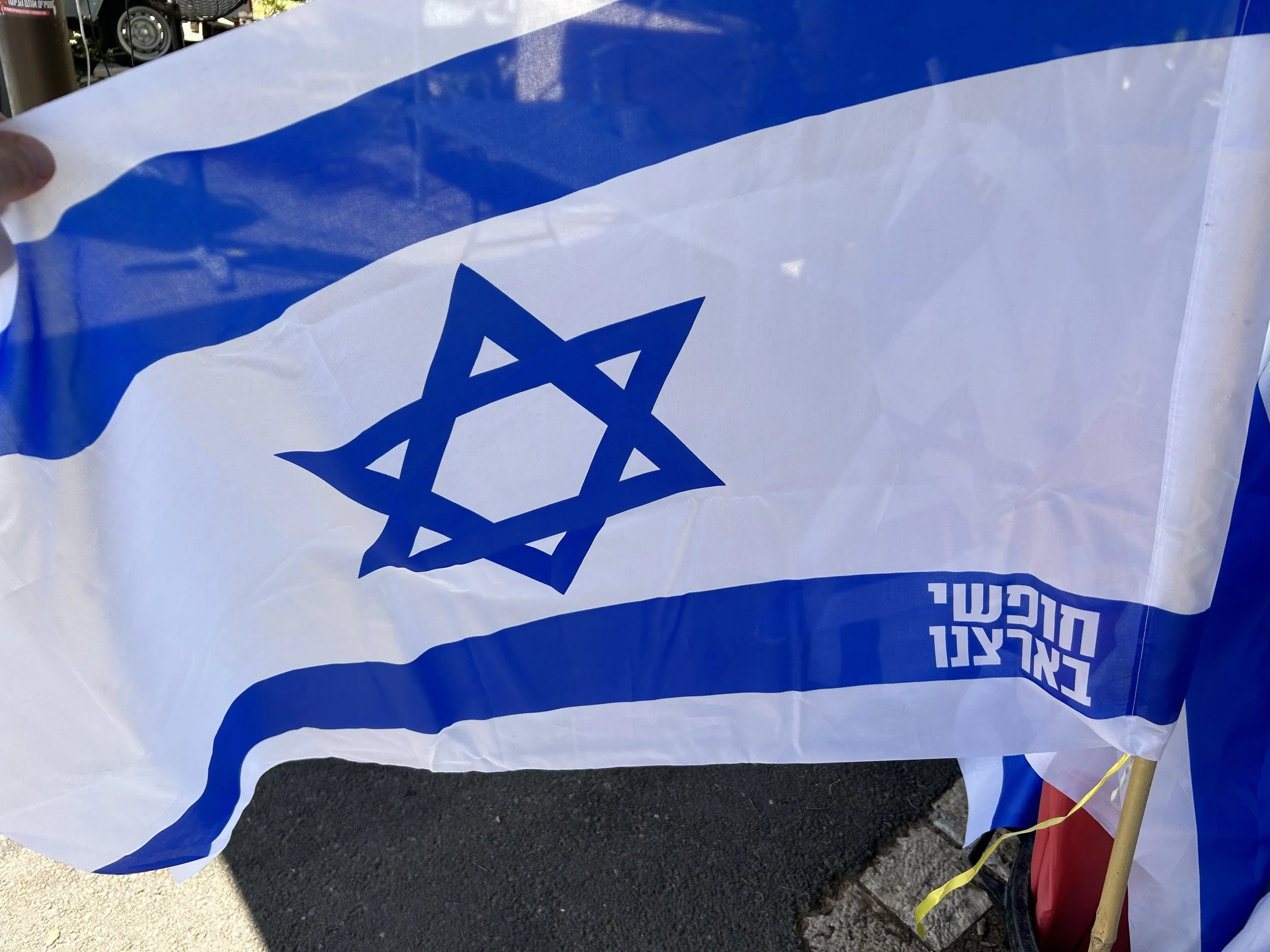
National Independence Days should be celebrations—but they should also be times for reflection and looking within, about what it means to belong to a nation and the relative health and stability of that society. Today, Israel’s 78th Independence Day, provides no shortage of these opportunities.
This year—and likewise anticipating the 250th Independence Day of the United States—I’m thinking of the things I wish that Americans should learn from Israelis at this fraught moment for both of our nations.
Of course, Jews and all lovers of Israel are living at a perilous moment—surely it’s the most perilous moment of my lifetime—when surging antisemitism, often cloaked as anti-Zionism, comes at us from every ideological direction. Many Jews, myself very much included, feel more politically homeless than we ever have before.
(As for the exhausted “Is anti-Zionism antisemitism?” debate, I’m sick of it. If they aren’t quite the same thing, at least we can say: The Venn diagram of the two has an enormous amount of overlap.)
For three years at least, Yom Ha-Atzma’ut has been a day of conflicting emotions. In 2025 and 2024, we celebrated Independence amidst unspeakable heartache while hostages were still held by Hamas terrorists in Gaza. In 2023, the enemy clearly was within; Independence Day was marked during the perpetual protests against the government’s antidemocratic “judicial reform.” This year, we observe the holiday with the backdrop of the War with Iran, the constant rain of missiles upon Israel, and the seething antisemitism that is affecting all Jews everywhere.
What, exactly, is there to celebrate in the midst of so much anguish and violence?
Of course, there is plenty to celebrate when it comes to national pride, a nation’s extraordinary accomplishments against all odds, and the beauty of a society that is much better than its elected government. But there’s something else—something about the confluence of Israel’s 78th and America’s 250th.
The resistance movement in Israel has been activized now for years. Throughout the “judicial reform years” (and they’re certainly not over; just postponed), Israelis took to the streets week-in and week-out to protest their government’s antidemocratic excesses. After October 7, that movement pivoted, and the massive weekly protests refocused on bringing home the hostages, supporting grief-stricken families, and continuing to protest the excesses of a government that was more invested in politics and posturing than in the suffering of its own people (let alone the suffering of others). I was privileged to be with the demonstrators on each of my return trips to Israel in the past few years.
I believe that American society would be much healthier if it learned a few things from these Israelis.
First and most important, the Israeli demonstrations are so utterly patriotic.
The demonstrations, especially throughout 2023 and in the later days of the war against Hamas, were outright condemnations of a despised and corrupt government. Names were named.

Look at all the flags. July 2023 in Jerusalem (Photo: NG)
But simultaneously, the demonstrations were awash in the national colors of blue and white. There were Israeli flags everywhere. Every gathering paused to commence or conclude with the singing of Hatikvah. It was not lost on a single soul that the purpose of the demonstrations was to reclaim the very idea of “Israeli-ness,” to take it back from zealots who insisted that only those who conformed to their vision were the true lovers of the nation.
In the past few years, we’ve attended no shortage of demonstrations in America as well—Women’s Marches, Black Lives Matter, No Kings, and so on. And I have no doubt that we who oppose MAGA are patriots—but try a little thought experiment. Imagine marching at any of those with an American flag and distributing flags to fellow demonstrators. Imagine stopping the rallies at strategic moments and saying, “Now we’re going to all sing ‘The Star-Spangled Banner.’” It would have been awkward; it would have been tone-deaf. I know; I was there.
In America, the center-left has long conceded the rhetoric of flag, nation, and putting-country-first to the political right. That is one of the right’s big strategic victories—and it’s tragic.
It’s tragic because I’ve always believed that love—and we’re talking about love, aren’t we?—is always about encouraging the loved one to be the best it can be. When I think of the love of my family, I know that my love is unconditional, but it does not mean I always approve of their decisions or choices. (And vice-versa for my family towards me. Trust me.) Love means: I want you to grow into the best version of yourself. Love means caring so much that the lover must sometimes say “No” or “The road you’re going down is destructive to you and others.”
A relationship without loving critique [in Hebrew, תוכחה] and redirection from a harmful path is certainly not the highest expression of love. It may not even be “love” at all.
“ It was not lost on a single soul that the purpose of the demonstrations was to reclaim the very idea of “Israeli-ness,” to take it back from zealots who insisted that only those who conformed to their vision were the true lovers of the nation.”
This surely applies to the love of one’s country. And that’s profoundly what I saw at every anti-government, pro-hostage-family rally in Israel over the past few years. Israelis—and, G-d knows, Palestinians—are suffering under a government that has given license to the most extremist zealots and Kahanists. PM Netanyahu has empowered Ben Gvir and Smotrich and their ilk to prop up the government with their zealotry; there is a moral rot at the heart of the ruling coalition that the demonstrators are responding to in the name of their love of country and the country’s future.
We could use more of this at home.
Second, the Israeli rallies have been inclusive, not exclusive. The demonstrations that took place week after week throughout the war clearly had a political point of view: Netanyahu’s coalition of violent ultra-nationalists and religious zealots is toxic. But the thrust of the demonstrations was not the far-left. It was a coalition of the pro-democracy center-left, center, and center-right. It was composed of neighbors and fellow citizens who probably disagreed about a wide swath of policies—but agreed that the moral health of their country was at stake, so they were able to find common ground.
No doubt compromises were made by some in order to be there. Good. Moral purity is fine for a Mussar beit midrash, but compromise is a very healthy thing for democratic societies.

“Only the people can save Israel.” February 2026. (Photo: NG)
As for me, when I attended the New York pro-immigrant march in the wake of the ICE slayings of Renee Good and then Alex Pretti in January, I couldn’t have felt more peripheral. I’m appalled by the violent excesses of ICE and want to stand with the immigrant community. But that rally was dominated by the DSA—and their severity, intolerance, and outright antisemitism couldn’t have been clearer. I couldn’t get away from these people quickly enough.
Third, the Israelis have the persistence to be in this for the long haul. The most astonishing thing about the Israeli demonstrations was their refusal to go away—for months, then for years. The judicial crisis was such that people kept showing up, week after week; hundreds of thousands of them in cities all over Israel (this, for a country whose population is only 10.2 million). For years, Saturday nights have been given over to standing up for one’s country.
Again, I think of the American resistance rallies. They demand weeks of notification, publicity, planning. And the next day? Back to business or sports or our phones, as usual. Maybe the crowds will come out again six months from now.
So Chag Samayach to the People of Israel and all who support her and love her. Celebrate our accomplishments with pride and hope and endless resilience in the face of so much heartbreak. I’d give the last word to Amos Oz ז״ל, the great Israeli novelist whose voice of peace was profound because it was so unromantic, but absolutely pragmatic.
No man is an island, said John Donne, but I humbly dare to add: No man and no woman is an island, but every one of us is a peninsula, half attached to the mainland, half facing the ocean—one half connected to family and friends and culture and tradition and nation and sex and language and many other things, and the other half wanting to be left alone to face the ocean…
The condition of peninsula is the proper human condition. That’s what we are and that’s what we deserve to remain. So, in a sense, in every house, in every family, in every human condition, in every human connection, we actually have a relationship between a number of peninsulas, and we’d better remember this before we try to shape each other and turn each other around and make the next person turn our way while he or she actually needs to face the ocean for a while.
—Amos Oz, How to Cure a Fanatic [1]
[1] Amos Oz, How to Cure a Fanatic (Princeton: 2002), pp.69-71