Shabbat Mosaic in Netanya

Netanya, the coastal Mediterranean city halfway between Tel Aviv and Haifa, has become one of our regular Shabbat destinations in Israel. This is thanks to the remarkable work of Rabbi Edgar Nof—more about him in a moment—and our dear friends Anita and Fred Finkelman, who bring me in as a scholar-in-residence to teach some classes. I’m so grateful, because this is one extraordinary community.

Kehillat Natan-Ya, part of the Israel Movement for Progressive Judaism, is a mosaic of nationalities. Looking around the packed room during the Shabbat services, I saw people who came here from Africa, Russia, Ukraine, Thailand, Georgia, Central and South America, the Philippines, the U.K., France, South Africa, and the U.S.—as well as the stam Israelis who were there. Part of the miracle of this place is that many of these are people who would not have found a place in a more mainstream Jewish community, for any of a variety of reasons. But Rabbi Edgar Nof brought them all home.

Here’s a photo of Rabbi Edgar Nof doing Mitzvahs in a Haifa school from two years ago. (Photo: NG)

Edgar is a whirlwind of Mitzvahs. The Kavod Tzedakah Fund, which my friends and I founded over 30 years ago, has supported Edgar’s organization Bridges for Hope (Gesharim LeTikvah) since its inception. He’s supporting impoverished families, victims of terror, new immigrants, elderly Holocaust survivors, and other people living on the fringe. He’s in a half-dozen of the poorest schools in Haifa, teaching pluralistic and open-hearted Judaism and working with administrators to get supermarket food cards to the neediest families.

Like everyone else, Edgar’s life and the life of this community was profoundly changed after October 7. He once told me about how, in the wake of the massacres, he officiated at a funeral of a family of four. And there are memorials all around the synagogue of its local heroes who were killed that day and in the aftermath.

Most indefatigably, he’s doing Jewish life-cycle events for those who may not have had any Jewish connection otherwise. Edgar must have officiated at four bar/bat mitzvah ceremonies this week alone. And conversions to Judaism: he tells Heidi and me that at this point he’s brought over 800 people to Judaism in his career. Just amazing, and we got to see some of it up close on Friday.

I arrived at Netanya to teach my class. Edgar said he couldn’t be with us beforehand—he had a memorial service earlier in the day and a bar mitzvah in the afternoon; then my class, which segues into Shabbat. (I used to think I had a busy schedule.)

The service is gloriously energetic. It’s noisy, and there are no formalities, and there aren’t enough  siddurim. Children are up and down to the bimah to help Edgar out throughout the service; so, too, are adult honorees who come up to mark joyful milestones. Half the room has been given percussion instruments to tap or shake as we sing out the Shabbat prayers; it’s Shabbat Shirah, after all. The whole thing is a whirlwind and it’s wonderful.

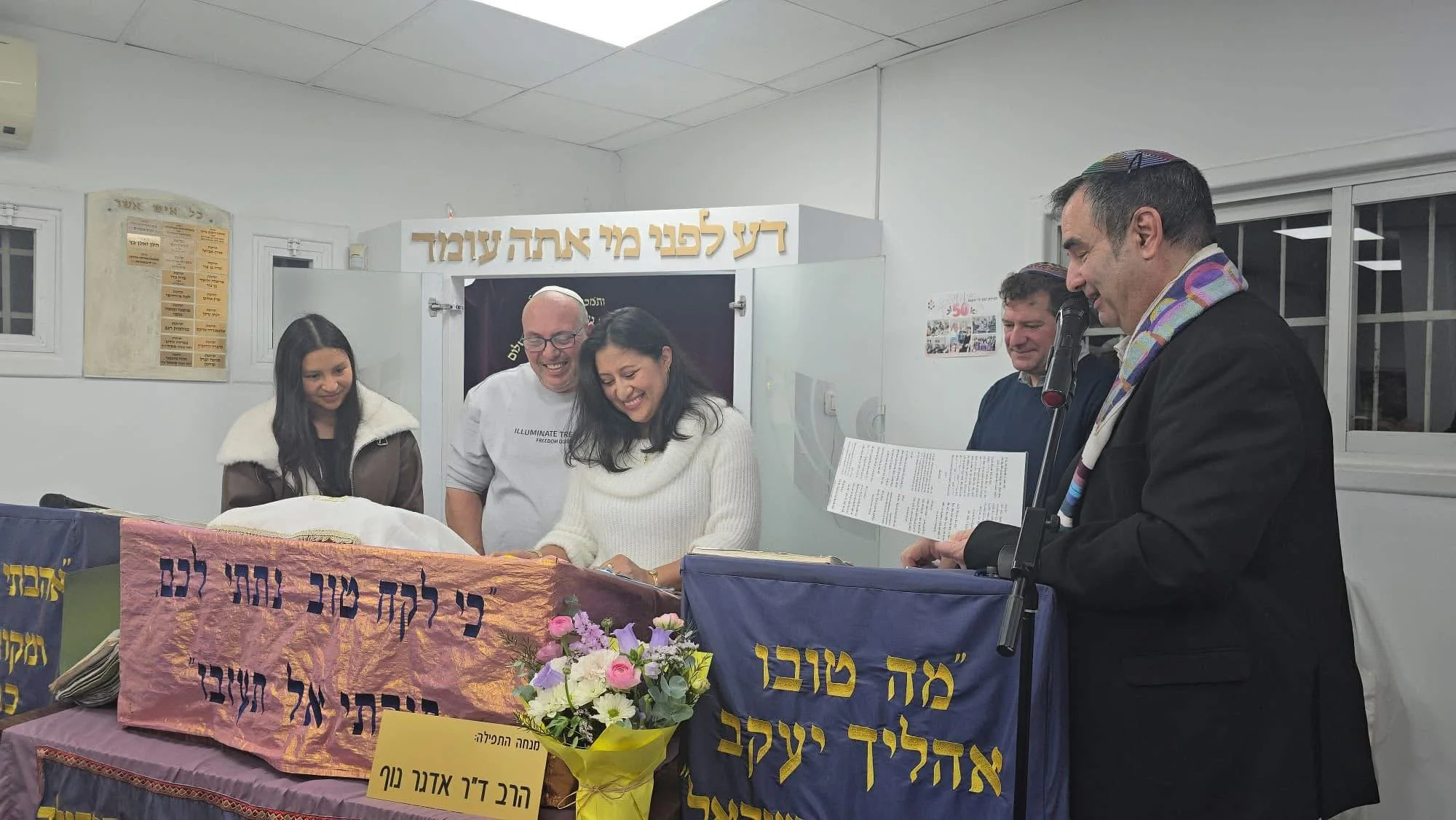
In the middle of the service, a boy and his father are called up to the pulpit. Edgar opens the Aron Kodesh and places the Torah in the boy’s arms. He’s been studying and preparing for conversion—his mother is not Jewish—and this moment will make it official. He processes the Torah around the room, as everyone else rains candies upon his head and sings, Siman Tov u’Mazel Tov! The boy is composed, but his father has an awestruck look in his eyes—the echo of a hundred generations of Jews before him—as if he can’t believe that this moment was actually possible.

And then the entire room—this congregation from at least five continents—erupts and cries out: Achinu Atah! Achinu Atah! Achinu Atah! (Three times: “You are our brother!”).

Excuse me a moment, there’s something in my eye.

The service continues, Edgar strumming his guitar. Singing beside him is his longtime volunteer cantor Anna—she’s a young Philippine immigrant whom Edgar also brought to Judaism.

Elisheva officially becomes part of the Jewish people (screenshot from Natan-Ya’s livestream)

And then, breaking with the idea that the sequel is never as good as the original, another woman is called to the podium. She’s originally from Guatemala; she came to Israel and married a Sefardi man. Her husband and a handful of children stand beside her; she’s the second person tonight to celebrate a conversion to Judaism. She’s taken the Hebrew name Elisheva.

Elisheva takes out her prepared notes, and starts to thank her family, and the rabbi, and this community… but she gets choked up; it takes a while for her to regain her composure. And so, too, for the rest of us. And then, in unison and resounding with unbelievable excitement:  Achoteinu At! Achoteinu At! Achoteinu At! (“You are our sister! You are our sister! You are our sister!”).

In the language of our tradition, she has been embraced “under the wings of the Shekhinah.” But she’s also just been embraced by the Jewish people, as represented by this beautiful mosaic of worshippers.


Frankly, it was one of the most joyful and loving Shabbat services I’ve been to in a long time, amidst the joyful cacophony. This is the authentic face that I wish Israel were more adept at putting forward to the world: pluralistic, joyful, and welcoming—with room for everyone.

Shadow and Light (Israel Reflections #1)

Heidi and I came to Israel this week with some particular goals. We wanted to be with as many of our friends and friends-who-are-like-family as possible, to do some volunteering and demonstrating, and to give away Tzedakah money to people and places that are making the society better. It’s not a vacation; Israel evokes deep feelings and I’ve been on shpilkes for much of my time here.

This has been a poignant week in Israel, a week of shadow and light.

First, the shadows.

I hope that by the time you read this we are not at war with Iran. This is a war-scarred and traumatized society; nearly two-and-a-half years since the terrorist massacres of October 7, it seemed as if some sort of equilibrium was, at least, within sight. Everyone seems to be going about their daily lives with some semblance of normality, but the emotions beneath the veneer are complicated.

Last July, Iranian missiles fell from the skies, sending people in the middle of the nights into their shelters and safe rooms. Everyone is geared up for that to happen again this week, as American carriers are in place in the Persian Gulf, the U.S. Air Force is conducting drills, and Iran is threatening to respond in kind on Israel.

I’ll admit I’m a little nervous about all this, but my Israeli friends have told me how to take precautions and prepare for an attack that seems like it’s coming.

Beyond that, Israelis are wrestling with a parallel dilemma as Americans: the assault on democratic institutions by a corrupt administration. The horrible situation of unchecked settler violence in the West Bank — as well as surging rates of intra-Arab violence — is at a boiling point here. So we joined, with thousands of others, the pro-democracy rallies and demonstrations that have been running perpetually for years. Everyone knows that the status quo can’t hold.

So of course there are shadows in Israel. But shadows don’t exist in unrelenting darkness, and we’ve also experienced an enormous amount of light.

The biggest story in Israel this week was—finally, 843 days after that cursed Oct. 7—the retrieval and return of Ron Gvili’s body from Gaza. For the first time in 12 years, there are no Israeli hostages, alive or dead, in the dungeons and tunnels of Gaza. Every Israeli is cognizant of this; everyone was aware of his funeral that took place this week. Ron Gvili was an Israeli hero, and his family had been desperately holding on to the slimmest hope that he was perhaps still alive. This week they received the closure of at least knowing his fate.

So the yellow and blue ribbons are coming down. The Hostages and Missing Families Forum / “Bring Them Home Now” organization held its final Kabbalat Shabbat service in Tel Aviv.  Synagogues no longer recite special prayers for the hostages. And I removed “Bring Them Home” from my email signature. People are finally trying to move forward and confront the long process of healing a traumatized generation.

Considering the trauma and the healing, there were two particular points of light that I want to share with you:

Transcending Trauma: We visited with my friend Anita Shkedi this week. I’ve written about Anita before; she is an internationally recognized authority on hippotherapy, using horses for physical and emotional therapy. But that’s just the tip of the iceberg. Anita’s most recent book is Horses Heal PTSD, and since Oct. 7 she and her Transcending Trauma team have been caring for survivors of the massacre and the IDF soldiers who have been in Gaza and elsewhere. How clearly can I say this? She puts shattered lives and bodies back together, teaching her clients the art of grooming and caring for and bonding with horses, and then the therapy that takes place on horseback. It’s awesome to be in her presence and to hear the stories of her people; it’s a great privilege to support her work through the Kavod Tzedakah Fund.

Neal and Anita Shkedi of Transcending Trauma teaching in Netanya, January 29, 2026

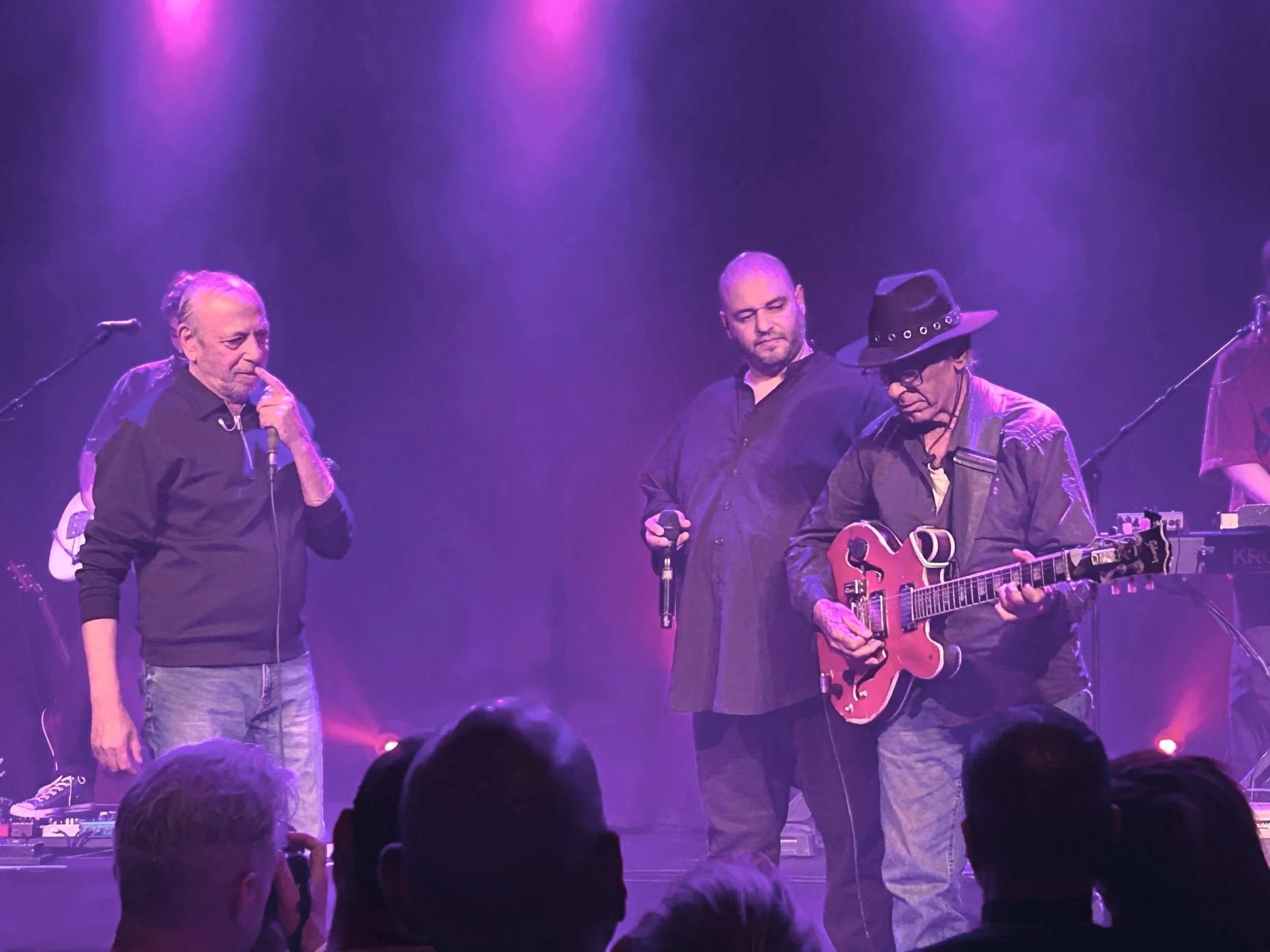
 Shai Tsabari with Avner Gadasi and Yehuda Keisar: Heidi and I did some volunteer work and spent time listening to a lot of Israeli stories over the past few days. By Wednesday night we were ready for a break, and I spotted that Israeli musician Shai Tsabari was performing with two of the most renowned Jewish Yemenite musicians of the generation, Avner Gadasi and Yehuda Keisar. Tsabari is of  the generation of Israeli rock stars whose music is a mixture of western (rock, dance, psychedelia) and eastern (Jewish piyyutim, and especially the melodies of Tsabari’s ancestry in Yemen). He’s also known for his engaging and soulful personality that draws people in and gets them up and dancing.

Avner Gadasi, Shai Tsabari, Yehuda Keisar (photo: NG)

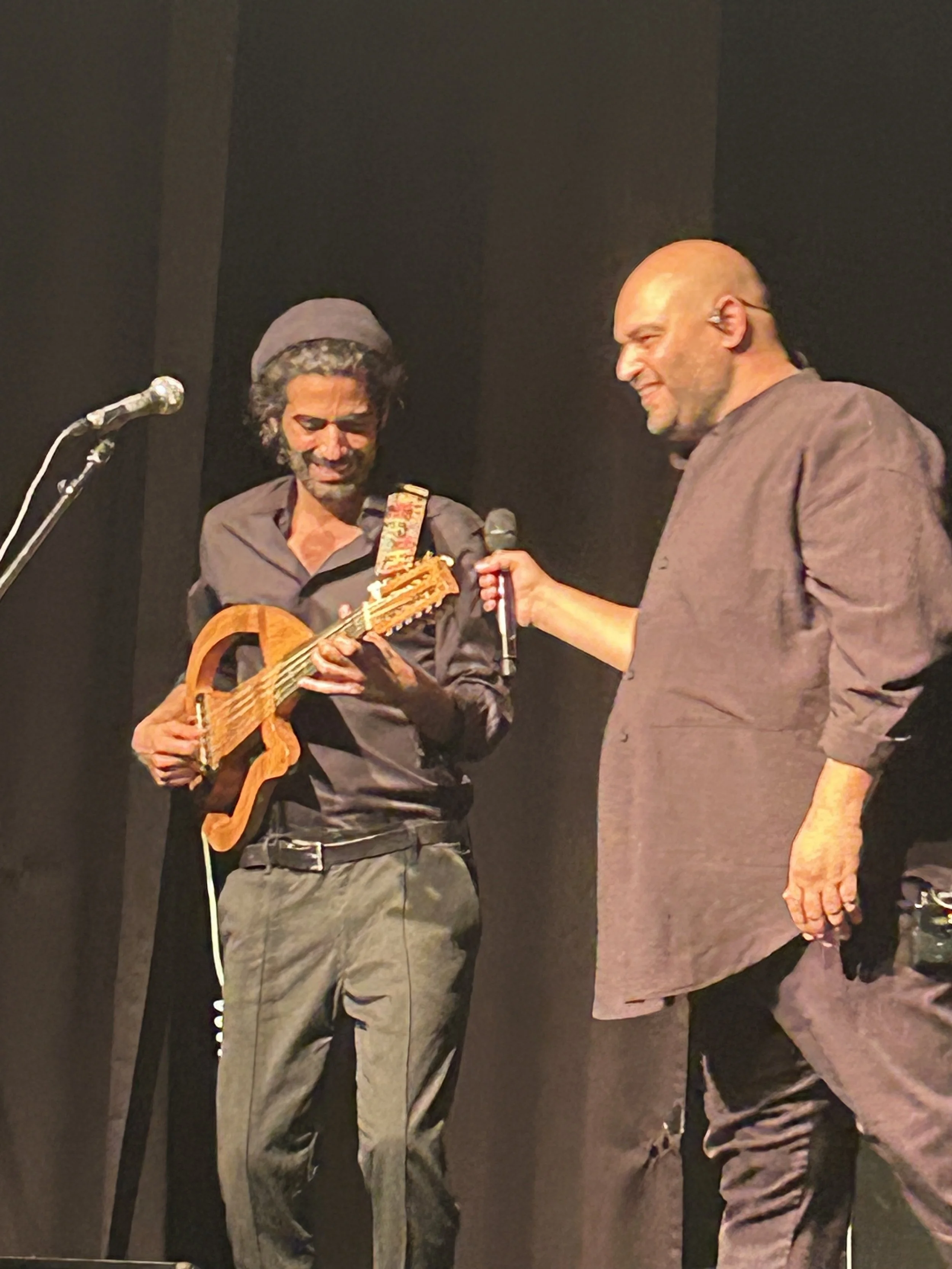
Shai Tsabari and a member of his band with a unique instrument (photo: NG)

I knew the concert would be fun—but I didn’t realize how deeply it would move me. The place was packed with Israelis, who by the second half of the show were on their feet, singing every word, and some dancing on chairs and tables. It struck me: here is a nation that has been so traumatized and so soaked in grief; a society that for the past two-and-a-half years could recite the name of every hostage. Tonight I felt a catharsis, a release, a transcendence that is reflected in the slogan “We Will Dance Again.”

It doesn’t mean that the next morning the nation won’t resume confronting its PTSD. But for one night, a few hundred of us were smiling, slapping hands, dancing to the old-new sounds of Jewish musicians, and realizing that there is an unspoken spirit that binds this people together in history and hope.

They are Home! The Simcha of This Moment

A time for mourning, and a time for dancing.
—Ecclesiastes 3:4

 There is only one thing we say to Death: “Not today.”
—Syrio Forel, Game of Thrones

 
What an extraordinary moment in history this is.

For two years—738 days—I’ve started every online class I’ve taught with a prayer for the hostages, the 251 babies, children, teenagers, and adults who were kidnapped by the Hamas death cult on Oct. 7. On Monday the last of the living hostages were brought home to their families (although as I write, only four of the bodies of those who were murdered by the terrorists have been returned).

These images, clockwise from upper left:
1.     Omri Miran reunited with his daughters (Roni, 4, and Alma, 2) and his wife Lishay Miran-Lavi (GPO)
2.     Alon Ohel reunited with his family (courtesy of the Ohel family)
3.     Matan Zanguaker reunited with his mother Einav (IDF photo)
4.     Eitan Mor reunited with his parents (IDF photo)
All photos from The Times of Israel, October 13, 2025

Emotionally, this is a complicated moment. We’ve been through so much: The death and destruction of war. The surging Jew-hatred locally and around the world. The silence or outright abandonment of friends who turned away from Jewish suffering.

On Simchat Torah, we should dance, and we should dance like everything depends on it—because in a sense it does.

Yet for two years my priority has been the hostages. I’ve woken up in the morning thinking of them and gone to sleep at night thinking of them. So the outrageous (but not unmitigated) joy of seeing the survivors coming home is just staggering.

In case you haven’t seen this clip yet, this 5-minute collection of some of the hostages being reunited with their families is one of the most incredible videos I’ve ever seen. Pay attention to the father reciting Sh’ma Yisrael when he sees his son for the first time in two years; listen to the voice of the mother when she says the Shehecheyanu blessing:

There remain, of course, many things to parse about this moment—politically, socially, and religiously. But in the short term, there are some Jewish priorities to attend to. We’re on the eve of Simchat Torah, the culmination of the Sukkot holiday when it is a Mitzvah to be joyful and dance with our communities and our Torah. The past two Simchat Torahs have been so utterly ambivalent. We all asked: how dare we celebrate and dance when the reality of Simchat Torah is the Yartzeit of 1,195 people who were massacred and the date when 251 people were taken hostage? Would we ever celebrate this holiday again?

This year, we’ll dance.

The Book of Ecclesiastes—that is, Kohelet, which is traditionally read on Sukkot—knows a secret about dancing. In the famous poem at the beginning of Chapter 3 (“To everything there is a season… A time to be born and a time to die,” etc.), one of the couplets is: A time for mourning and a time for dancing.

Do you see it? For Kohelet, dancing is life; it’s the antonym of mourning!

Simcha doesn’t simply mean “be happy.” Jewish texts speak of  שִׂמְחָה שֶׁל מִצְוָה /  the simcha of being involved in a Mitzvah. But some Mitzvot are sad: burying the dead, comforting mourners, and so on. Where is the “joy” there? The answer is that “simcha” is something much deeper:  It means choosing life, connecting ourselves with the Source of Life, and turning our backs on cults of death and destruction.

“Simcha”—choosing life—feels like a countercultural value; it’s an act of spiritual resistance against the forces of nihilism that can threaten to swallow us up.

There is so much to be skeptical about; about the reliability of the bad actors involved, about the ability for cease fires to hold, and so on. But that video of families reunited tells us everything about what simcha is all about. On Simchat Torah, we should dance, and we should dance like everything depends on it—because in a sense it does.

Let’s dance on Simchat Torah because we embrace life, not annihilation. Dance with the simcha of the families that have been reunited. Dance as the Kotzker Rebbe instructed his disciples: “Imagine yourselves on a mountain peak, on a razor’s edge, and now: dance, dance, I tell you!”[1]


[1] In Elie Wiesel, Souls on Fire (1972)

Of Elvis, Jerusalem, Loneliness, and Distance

Tisha B’Av in 2025 is the diagnosis, not the cure.

The music critic Lester Bangs (1948-1982) was one of the great chroniclers of rock and roll. He emerged in the late 1960s with the maturation of rock—after The Beatles psychedelicized, after Dylan went electric, after the Velvet Underground teamed up with Andy Warhol—and wrote in a style that read like the noise and chaos of the music. Just as the Beat Generation wrote books that bopped with the rhythms of jazz in the 1950s, Lester wrote lines that pounded like drums and spun off like electric guitar solos.

I’m thinking of Lester (his writing invites the informality of first names) because of a few sentences he wrote in August 1977, on the occasion of the death of Elvis, a pivotal “changing of the guards” moment in rock history. In an extraordinary obituary in the Village Voice, Lester wrote:

If love truly is going out of fashion forever, which I do not believe, then along with our nurtured indifference to each other will be an even more contemptuous indifference to each other’s objects of reverence… We will continue to fragment in this manner, because solipsism holds all the cards at present; it is a king whose domain engulfs even Elvis’s.

But I can guarantee you one thing: we will never again agree on anything as we agreed on Elvis. So I won’t bother saying goodbye to his corpse. I will say goodbye to you.[1]

I don’t have much affinity for Elvis beyond his place in the history of pop culture; I was seven years old when he died and it barely registered. At the time of his demise his significance had long since passed, and his musical descendants fragmented into many camps and styles.

But that final line of Lester’s elegy haunts me in a much deeper place than, say, “Don’t Be Cruel.”

Part of the reason I cling to that sentence “I will say goodbye to you” is because I think Lester inadvertently (he was raised a Jehovah’s Witness in southern California) gets at the heart of Tisha B’Av, at least on its spiritual and emotional levels.

And for me, Tisha B’Av seems to be more and more spiritually relevant every year, especially this year.

The 9th of Av, of course, is the most sober and solemn day in the Jewish calendar. Ostensibly it is about historical horrors: most obviously in the destructions of the First (586 BCE) and Second (70 CE) Temples that stood in Jerusalem, but also G-d’s decree that the generation that came out of Egypt would die in the wilderness (Numbers 14); the plowing over of Jerusalem by the Romans; and the quashing of the Bar Kochba revolt at Beitar in 135 CE. (All this is enumerated in the Mishnah, Ta’anit 4:6.)

As horrific as those historical moments were, they’re also meant to be understood on a spiritual level. They all emphasize the idea of Exile; that is, the forces of entropy that drive us away from our foundations, and one another, and G-d. The destruction of the Temples, the plowing over of Jerusalem, and end of the rebellion against Rome at Beitar were all historical traumas—but they were also moments when the chasm between our ideals and our reality felt insurmountable.

Does that describe our reality today? Some days it feels that way, and that makes Tisha B’Av for me feel more relevant and meaningful than ever. The centrifugal forces that pull us apart from one another, and ever further from our Source, seem incredibly powerful.

Certainly I’m thinking about Israel—I’m always thinking about Israel.

I’m thinking of my brothers and sisters in Israel who have endured months of sitting in bomb shelters. Who have been conscripted to fight three, four, and more tours of duty to defend their homes. Who endured the hail of Iranian missiles at the beginning of the summer. Who have shown over and over again what it means to be a society that cares for one another at a time of crisis.

I’m thinking of Israelis who day in and day out demonstrate that they are much better and more decent than the government that speaks for them.

Israel once was supposed to be the thing that bound all Jews together. Even if we located ourselves at different places along the political, religious, or ideological spectrum, we agreed on one thing: the creation of a democratic Jewish state in the 20th century was our response—our antidote—to the centuries of hate and exclusion of Jews, and an awesome new chapter in Jewish history.

But now Israel is the stick we use to beat each other with.

There was a moment—a few weeks after Hamas terrorists massacred, raped, and took Jews hostage on October 7, 2023—when it seemed like unity would rule the day. Jews everywhere mourned together and the world’s capitals were lit up with blue and white.

But that seems as long ago as the Second Temple. Outside the Jewish community, we are increasingly perceived as aggressors of a war we didn’t ask for. Inside the Jewish community, we rip ourselves apart by analyzing what we’ve become after two years of this horrific war. Has fighting this just war coarsened our souls to the point where we cannot empathize with the pain of others, including our enemy’s children?

And in Jerusalem today, just as on the eve of destruction in 70 CE (see Gittin 56a), a minority of political and religious zealots are manipulating the destiny of the majority of Jews who are seeking a just path out of this morass.

Maybe disunity and unraveling will describe the rest of our lives, as Lester Bangs described in 1977: “We will never again agree on anything as we agreed on Elvis.” Maybe our fate is the same as the one that Joseph faced: “I am looking for my brothers” (Genesis 37:16).

Maybe. But I hope not.

So what is Tisha B’Av in 2025? It’s the diagnosis, not the cure. The diagnosis is estrangement, distance, the utter failure to see in one another a sense of suffering and pain that might in some way resemble our own wounds.

Only after the diagnosis can we reach for a cure. “Only those who mourn for Jerusalem will get to see her future joy,” says the Talmud (Ta’anit 30b).  After recognizing on Tisha B’Av how far we have moved from each other, something remarkable happens in the rhythms of Jewish life: Gravity takes over. We begin to move back towards one another.

In synagogue life this is marked by seven weekly Haftarah readings, each one on the themes of comfort and restoration taken from the final chapters of the Book of Isaiah. Seven weeks mark our return to first principles, until we arrive at Rosh Hashanah and culminate with Yom Kippur. The forces that pull us apart begin to reverse themselves in their courses, and we start to draw closer together once again.

This year, I hope we can make it back. I’m not quite prepared to draw the line that Lester Bangs did when Elvis died and he wrote I will say goodbye to you.

Instead I’ll say I’ve seen that point of estrangement—politically and otherwise—and I don’t want to live there. Instead, I’ll say: I’m looking for you, and maybe we can find a way back, together.


Forwarded to you? You can sign up to receive updates from me via A Tree with Roots.

[1] Lester Bangs, “Where Were You When Elvis Died?”, collected in Psychotic Reactions and Carburetor Dung, ed. Greil Marcus, 1987.

This is Not Zionism

Offensive, unworkable, dangerous.

While I occasionally write about political issues in this blog, I don’t do so very often. I don’t feel like it’s my responsibility here to reply to every crisis, especially when there are those who can do so with much more knowledge and authority than me. I’ll write when I feel like I have a perspective that isn’t being addressed by others, or when it simply feels like a moral responsibility to speak out in this forum.

I suppose the astounding announcement on Tuesday of Donald Trump’s vision for Gaza falls into the second category. Sane Zionists—the overwhelming majority of American Jews who represent the widest swath of the political spectrum, left, center, and right—need to call out Trump’s proposal to forcibly displace two million Gazans for what it is: offensive, unworkable, and dangerous.

A plan to remove two million people from their homes and resettle them in another country is obviously abominable. The Jewish historical experience speaks directly to the moral revulsion of being forcibly removed from our homes. The fact that once-glorious and vigorous  Jewish civilizations flourished in Europe, Asia, and a dozen Arab countries that are now judenrein speaks to this. But what part of “What is hateful to you, do not do to other people” is so hard to understand?

There’s also that fact that the Trump scheme is unworkable. Others will address this more directly than I can, but certain aspects seem obvious. Two million Gazans will not submit to being forcibly repatriated. And the Arab nations of the Middle East have no capacity nor intention of absorbing hundreds of thousands of refugees, many of whom are surely Hamas radicals. Jordan’s population is already predominantly Palestinian; it surely is not going to destabilize itself by bringing them in. Egypt, too, can hardly be expected to bring in potential radicals to bolster the Muslim Brotherhood that already gives it enough problems. Lebanon and Syria are failed states that have no capacity to absorb thousands of refugees. And so on. It’s hard to imagine any of these countries giving the Trump administration a “win” on this anyhow.

But what I don’t hear people talking about is how utterly reckless and dangerous the Trump plan is—dangerous for people whom Zionists are supposed to care about. For instance, just as the hostages are finally starting to be released from their terrorist captors, Trump and Netanyahu drop this bomb about depopulating Gaza. I pray that there is not a violent counterreaction to Trump’s irresponsible declarations—with the hostages as the victims.

Moreover, there is the issue of surging antisemitism—locally and around the world. I’m thinking of the Jews of central and western Europe. Typically I would not blame antisemitism on Jewish behavior; antisemitism is the derangement and the problem of antisemites, not Jews. (Same goes for every other form of hate: It is always abominable to say that the victims “asked for it.”)

But that doesn’t mean that Trump and Netanyahu aren’t brazenly pouring gasoline where there are already open flames. While I’m concerned for Jewish communities in America, especially on our disgraced college campuses, I’m downright fearful for the well-being of the Jews of France, the U.K., Australia, and across Europe, where it is already open season and Jewish blood is cheap. Violent responses, G-d forbid, against Jews across the globe are not hard to imagine.

One of the true horrors of Trump’s rise and Netanyahu’s relentless grip on power is the way that each of them have brought into the fold extremists who were once beyond the pale. For decades there have been voices that urged the “transfer” of Palestinians out of Israel—but those voices were always the radical far-right that were considered unacceptable in civilized discourse. In the 70s and 80s, those voices were represented by the despicable Meir Kahane and his followers; but Kahane’s party was outlawed in 1988 by a special law prohibiting racist political parties. In the 90s, Kahane’s ideology of “transfer” was adapted by the Moledet party—but they, too, were recognized as the lunatic fringe, even if they garnered a few ultra-right Knesset seats. But Netanyahu legitimized and elevated Itamar Ben-Gvir and Bezalel Smotrich, both adherents of violent strains of Kahanism, and brought them and their parties into his bloc. Even if “transfer” wasn’t Netanyahu’s plan all along (and I think Trump took Netanyahu totally by surprise with his scheme), he has empowered and normalized those voices that were once considered too extreme for decent society.

As a Zionist, I believe passionately in the legitimate Israeli narrative to be a free people in our historic homeland. And also as a Zionist, I believe it is our absolute imperative to work toward a just solution to the horrible status quo, under which Israelis live under the fear of terror and Palestinians are subject to constant humiliation—and no small amount of terror from far-right thugs.

Look, I know that the Israeli-Palestinian conflict is a disaster, and I share the desire for a game-changer about how to live in an Israel free from terror. Especially post-October 7, I appreciate that the old thinking has been more than non-productive; it’s been catastrophic. There is a genuine need for new thinking and big ideas. This is where the Abraham Accords emerged from, which was the last time there were any glimmers of optimism in the Middle East. But “new thinking and big ideas” must come with a sense of moral obligation and decency.

So what should we American Zionists do? A few obvious responses are demanded of us:

·      SUPPORT Zionist organizations that offer a different vision of the future:  the Israel Movement for Progressive Judaism, ARZA, Zioness Movement, Hiddush, and so on.

·      VOTE in the upcoming World Zionist Congress election: It is crucial that American Zionist Movement is represented by Zionists who are committed to democracy, pluralism, and human rights.

·      SPEAK OUT AS SUPPORTERS OF ISRAEL against this plan—for the sake of Zion and Judaism.

As Zionists, we have a moral responsibility to say: This is not the path for a sustainable future. It is a road to moral oblivion.

A Chanukah Reflection in the Guise of a Review of the New Dylan Movie

            We spent Christmas Eve in the traditional Jewish manner: we went to the movies. And there was really only one movie I had any interest in seeing: the new Bob Dylan biopic A Complete Unknown, which tells the story of Dylan’s arrival and departure from the Greenwich Village folk scene from 1961-1965.

            There’s a scene at the beginning of the film that reveals a lot in a very understated way. There are three characters in a hospital room in Morris Plains, New Jersey: Woody Guthrie (played by Scoot McNairy), who is dying of Huntington’s disease; his loyal friend Pete Seeger (Edward Norton); and twenty year-old Bob Dylan (Timothee Chalamet).[1] Dylan is singing “Song for Woody” to its namesake, his hero. It was the first great song that Dylan ever wrote.[2] The camera pans to each man’s face, and without a word of dialogue, each shot speaks volumes.

Dylan’s eyes are focused far away, on a land that only he can see, as if he knows that his musical journey will soon travel far beyond the confines of “trad. arr.” music.

Woody, devastated by illness, has a look of awe in his eyes, as if this young acolyte whom he’s just met already has absorbed all of his influence and transcended it; as if the dying legend knows that Dylan will inhabit a space towards which he could only gesture.

            And Seeger’s eyes, too, indicate that he can see where this is going. Seeger is a political radical but a cultural conservative, determinedly preserving old forms and styles. His gaze indicates that he intuits that Dylan will take Woody’s legacy to unimagined places—and yet Dylan’s progress will bring no small amount of pain and destruction in its wake, at least for those who refuse to get out of the new road if they can’t lend a hand.

            It’s all unspoken and subtle, and my interpretation may be wrong. Still, I liked the movie a lot. The 2:20 running time flies by, and it’s one of those rare films that I wished was longer. But be forewarned: the title of the movie should be a tipoff that there are no astounding revelations about Bob Dylan’s life and art here. If anything, the greatest songwriter in American history remains an enigma, even as the movie explores some important ideas.

            In fact, I’m sure the real Bob Dylan wouldn’t have it any other way. No one is a bigger liar about his past than Dylan—and I consider that to be one of the fascinating things about him. Robert Zimmerman famously arrived in Greenwich Village in the early 1960s with a new name and a farcical biography. In retrospect, his stories about hopping freight trains and joining traveling carnivals are so funny and ridiculous that it’s hard to imagine people took him seriously. But part of the folk music scene of the day was so sanctimonious that they took him at his word; after all, you can’t recognize a joke if you don’t have a sense of humor.

            To this day, Bob Dylan loves obscuring his background. His memoir Chronicles was published to great fanfare in 2004, and immediately Dylan’s biographers howled about all its distortions, inaccuracies, and outright fictions. Even more to the point, many people pointed out that the book managed to ignore many of the moments that most fans would actually be curious about! (But there sure is a lot about the Oh Mercy! sessions in 1987...!) As ever, Dylan performed a biographical sleight-of-hand and delivered only what he wanted to deliver.

            I think there’s integrity in that position. By stubbornly refusing for seven decades to reveal too much about his personal life, Dylan has just as stubbornly made his songs his definitive statement. Just think about how contrarian that is today. When “CELEBRITY” is the primary cultural value in our world—far more than “ART”—then the art simply becomes saleable product. The TikTok revelations of today’s “influencers” who want to tell you all their private thoughts, likes and dislikes, political views, and fashions preempt creating anything in particular. Or, more to the point: THEY have become the product, more than their creations.

            This has never been a problem with Bob Dylan. He flees from making his biography the focal point, so much so that even the most dogged biographers can’t really keep track of how many times he’s been married or how many children he has.  He is the anti-celebrity in an age when Nothing is Private. And—in a postmodern twist—that attitude has made him one of the most famous performers in the world. Crazy.

            So A Complete Unknown is decidedly not history—and I don’t think that mitigates the movie’s success. Much of it is terrific. The key performance at the heart of the film is stellar: Timothee Chalamet is just superb. He looks and sounds just like a youthful Bob Dylan without seeming forced or self-conscious at all.

            Other aspects of the movie are less satisfying. Some of the supporting characters are flat and one-dimensional. The weakest part is the romance with Dylan’s first “true love of mine,” Suze Rotolo. Her character is far enough removed from the real Suze that the filmmakers had the courtesy to change her name. (They call her “Sylvie,” which is a nice allusion to the old-world folk scene represented by the Lead Belly song, “Bring Me a Little Water, Silvy.”) The real Suze Rotolo was a sophisticated and worldly denizen of the cultural and civil rights scene in Greenwich Village, but in the film she is basically a jilted lover who spends most of her scenes on the verge of tears.

            Joan Baez gets slightly better treatment. She was a star before Dylan and jumpstarted his career when he needed it. Monica Barbaro does a fine job portraying Baez, and again the musical performances are impeccable (although Baez’s music is much less interesting than Dylan’s). Still, the real Joan Baez has much more gravitas than her onscreen character, and in the film she’s largely reduced to being the “other woman” in a love triangle. I imagine that the real Joan isn’t too thrilled with this movie.

            The biggest liberties in the film concern elevating Pete Seeger as the full-fledged second protagonist in the story. Again, the performance is fantastic: Ed Norton completely inhabits Seeger’s persona, with its contradictory aspects of Pete’s inherent decency and goodness, passionate love for tradition, and egoless support of artists who deserve recognition alongside his flashes of anger, frustration, and self-doubt.  There’s a grain of truth in the way their relationship is presented, but it’s also a convenient ruse for the filmmakers to set up Seeger as Dylan’s foil. He is an emblem of the old-world folk scene that Dylan quickly found stifling, but I sense that Pete didn’t loom as large in Dylan’s life as he does in the film.


II.

            What’s missing is Dylan’s Judaism, which, in my viewing, received a nanosecond of screentime. The scene is a house party at Sylvie’s place, where Dylan has been crashing. Someone spots his old Minnesota yearbook and some other memorabilia and says, “His name is Zimmerman?” The scrapbook seems to be open to a few photos of teenage friends at summer camp. Yes: Camp Herzl, where Dylan learned about Judaism and Zionism. It goes by in a flash; I’ll have to freeze the scene when it’s available to stream to see if my suspicions are confirmed. But nothing else in the film alludes to his Jewish identity.

            That doesn’t bother me much. At this time in his life, Dylan was obscuring everything about his past.

            But in a world where there are scores of Dylan biographies, critical analyses, and annual scholarly seminars, it’s important to note how Dylan’s Jewish identity is constantly shortchanged. Perhaps that’s because so many Dylanologists aren’t Jewish themselves, so they miss that essential feature in his make-up.

            That’s why Louie Kemp’s 2019 biography Dylan & Me a is so important. Kemp has the advantage over other Dylan biographers of actually being an intimate friend of the artist. Kemp was a childhood pal and a recurring figure in most of Dylan’s life: he was there for Dylan’s teenage “first public performance” at Camp Herzl, he was a producer on the barnstorming Rolling Thunder Revue, Dylan was best man at Louie’s wedding—and his frozen fish business even catered The Last Waltz! Kemp is also a baal teshuvah who takes his Judaism seriously—and has shared many Jewish moments with Dylan. His book is important because it fills in this dimension of Dylan’s character where every other biography falls short. (Louie Kemp made Aliyah in the summer of 2024 in a show of solidarity while Jewish people were under attack. When asked if he has family in Israel, Kemp answered, “I have 7 million family members in Israel.” Kemp is a mensch.)


III.

            The essential conflict at the heart of A Complete Unknown is centered on that lefty cultural and political scene of the early ‘60s, indeed a portentous moment in U.S. history. There’s no wonder that a young Dylan was drawn there. He was in love with songs, the “Old, Weird America” that murmured beneath the surface of “official” post-War history, as recorded by hillbilly and blues performers. Dylan was already a walking encyclopedia of that secret history.

            But the folk scene was also stifling. One thing that comes through loud and clear in Chronicles is how nauseating Dylan finds the idea of being called the “voice of a generation.” He devotes significant space to saying, essentially, who the hell would want to be the “voice” of anyone’s generation?!  He has an ornery streak—a need to do the opposite of people’s expectations—which I’ve written about elsewhere and which I personally find appealing.

            In the movie, we see how the folkies’ embrace starts with warmth but soon becomes suffocating. “Blowing in the Wind” is a revelation when Suze/Sylvie first hears it. But soon everyone was solemnly intoning it like scripture, especially the humorless Peter, Paul and Mary who drove it to the top of the charts. So the expectation was that he would continue to rewrite such anthems for pious liberals, as they nodded and stroked their goatees.

            But Dylan always was more than that. At one point in the film, he warms to a TV appearance of Little Richard, his teenage favorite, before the Seeger-character shuts it off, as if rock and roll was beneath them. (The fact that Little Richard and Chuck Berry were African-American, and that early rock was as Black as folk music, raises interesting questions whether or not the folkies, for all their activism, were really more racially enlightened than other music scenes in the 60s.) The Beatles don’t appear in the movie at all, but in real life, hearing “I Want to Hold Your Hand” for the first time was, for Dylan, a revelation opening up entire realms. Rock was open-ended, anarchic, and filled with possibilities; folk was orthodox and governed by rules and hierarchies.

            The film’s climax is the Newport Folk Festival of 1965, where Dylan showed up with the Paul Butterfield Blues Band behind him, a mixed-race electric group with the great Jewish guitarist Mike Bloomfield playing icepick leads. The conservative curators of the festival freaked. So did many fans. (The film conflates the events of Newport with the drama in Manchester, UK from the following year, where an outraged folkie yelled “Judas!” at Dylan, the Jew on the stage.) In real life, after Dylan’s scorching three songs, a desperate Peter Yarrow returned to the stage, coaxing “Bobby” back out, “This time with an acoustic guitar.”

            What A Complete Unknown is really about is: the fight for an artist to be true to himself, and to prevail over the stifling orthodoxies where “everybody wants you to be just like them.” That is much easier said than done. We’d still be talking about Bob Dylan today even if he never left the rarified air of the folk scene—I mean, he’d be immortal for “A Hard Rain’s A-Gonna Fall” alone. But we wouldn’t be talking about a once-in-a-lifetime artist who upset established pieties and pushed boundaries. Instead, he’d be remembered as one who stayed in his lane and wrote anthems of validation for people who were already believers.


IV.

So, Chanukah. Does the timing of the movie’s release shed any light on Chanukah this year? I think it does.

Civilization looked at Jewish difference and said, “Really, how is it that you are still here?”

Chanukah celebrates the world’s oldest fight for religious freedom. The Maccabees fought against the anti-Jewish edicts of Antiochus IV and his regime. But the bigger backdrop of the Chanukah story is the world of Hellenization.  Greek clothes, Greek philosophy, the gymnasium, the celebration of the human body… this was the cultural zeitgeist of the era. Greek civilization was seductive for everyone, including the people of Judea.

The first meaning of the Chanukah battle is: the right to be a Jew in the face of overwhelming opposition—against political persecution, sure; but also against a raging cultural tide that mocks our values. In the Maccabees’ time—quite like today—civilization looked at Jewish difference and said, “Really, how is it that you are still here?

Sometimes that opposition was expressed as oppression. Sometimes it was expressed with excessive love. (Yes, there are those out there who will love you to death. Just ask Bob Dylan.)

At the heart of freedom is the freedom to be different, to go against the grain. Freedom includes the assumption that the majority is not always, or even often, right.

That may sound platitudinous. I don’t mean to say that all forms of cultural assimilation are wrong. Obviously there are elements of secular society that we accept into our lives. After the Chanukah revolution, Jews became free to experiment with Hellenism, to figure out for themselves what aspects of assimilation made their cultural identity stronger, versus those aspects that merely diluted their Jewishness away. (After his electric revolution, Bob Dylan would return to folk music forms throughout his career—but on his own terms.)

That ancient challenge recurs in every generation. That is the Chanukah battle yet to be won.

Especially in the past year, Jews have felt this tension. Everywhere since Oct. 7—in the press, in social media, and especially on America’s disgraced college campuses—we have slanders thrown in our faces. “We’re not antisemitic,” the world keeps telling us, “we just hate Zionism”—as if the impulse for peoplehood and building up our homeland were somehow separate from authentic Judaism. And we’ve spent an enormous amount of capital trying to defend ourselves, explain our positions, build bridges.

Perhaps it is time for Jews—especially young Jews—to realize that there is something fundamentally countercultural about Judaism. For all our efforts to explain our story, and Israel’s, more cogently and directly, for all our efforts to conform and adapt and build coalitions, we should recognize the places where we embrace “the dignity of difference” (in Rabbi Jonathan Sacks’s phrase). Being true to one’s self and one’s people can be challenging and occasionally painful. Periodically someone may howl “Judas!”—or worse—in your face on your way across the quad.

But in the end, the Chanukah struggle for integrity—to “know my song well before I start singing”—is worth every tear. Just ask Bob Dylan.

Forwarded to you? You can sign up to receive these blog posts and updates from me at this link.


[1] The scene is a fiction. Of course Dylan famously did visit Woody’s bedside and sing Guthrie’s songs to him, but there is no indication that these three men were ever there alone together.

[2] More precisely, “Song to Woody” is the first great lyric that Dylan set to music; the melody is Guthrie’s “1913 Massacre.”

Rabbi Leonard Kravitz ז״ל

Belief in coincidences is a theological category, so I don’t know if you buy into them or not. But on Sunday evening, I was at a conference in New York that happened to be taking place at my alma mater, Hebrew Union College-Jewish Institute of Religion in New York. In fact, I was sitting in the Beit Knesset, listening to a lecture by the great social activist Ruth Messinger, when I received a text on my phone telling me that Rabbi Leonard Kravitz had died.

The astonishing serendipity of that moment: This was my first time back on the New York campus of HUC-JIR in many years. And there I was, getting this news while I was in the very chapel where I often sat next to Rabbi Kravitz during Tefillah over the four years that I was a student there. The wave of emotions, memories, and warm feelings was just amazing.

I loved Rabbi Kravitz dearly. He was an expert in medieval Jewish philosophy and Maimonides in particular, and I cherish my copy of his scholarly work, The Hidden Doctrine of Maimonides’ Guide for the Perplexed (1988; only $230 on Amazon!).

I had the great pleasure of having him as my rabbinic thesis advisor all those years ago.  Rereading that previous sentence, I wonder how many people look back on writing a graduate thesis as a “great pleasure.” I truly do, in large part because of my relationship with him. At that time, I used to meet with him on a weekly basis for an hour of studying the Rambam in his office. It wasn’t always germane to my thesis-writing, but it was like having a weekly one-on-one hevruta-study with someone who was a great scholar and a generous teacher.

Rabbi Kravitz’s classroom could be dizzying, because he tended to speak very quickly. There was a good reason for that: he would simultaneously be delivering a philosophy lecture, a Yiddish lesson, and doing standup comedy. So of course he had to speak three times faster than a typical teacher.

Here are a few more of my cherished memories of him:

·      Delivering my final thesis to him in his office. He leapt up from behind his desk, grabbed my 116-page document with zeal, and cried, “This calls for a L’chayim!” And he went straight to his file cabinet and pulled out the bottle of scotch that was stashed away for just such a moment.  (He was very partisan for his favorite distilleries. I remember bringing him a bottle of The Glenrothes in gratitude before graduation. He smiled and told me I was truly a disciple who had learned his lessons.)

·      Once, some joker put a full-size poster of his namesake the rock star Lenny Kravitz on the door to his office, with dreadlocks flying in the air. Rabbi Kravitz got such a kick out of it that it stayed on his door for the whole semester.

·      He was a kind and gentle soul, but definitely mastered the time-honored art of the putdown. If he disapproved, say, of a sermon that was delivered during Tefillah, he could say with perfect inflection, “That was nice.

·      And he had a wonderful sense of humor and was even a bit of a raconteur. I recall him once emerging from the elevator at HUC-JIR and saying in a loud voice to anyone in the vicinity, “My friends! Please! Study Torah! It’s not too late!” And then he whispered to me, out of the corner of his mouth, “It is too late, but don’t tell them.” (For that matter, he used to translate the Mishnah’s statement וְתַלְמוּד תּוֹרָה כְּנֶגֶד כֻּלָּם as: “It’s across the street.”)

·      As a scholar of Maimonides, his philosophical outlook was decidedly rationalist (and he used to fondly remind us that he fit in quite well during his years at a Jesuit school). So one time, when he earnestly quoted a Hasidic story to me, I fell off my chair. “Rabbi Kravitz, did you just tell me a Hasidic story?!” He just laughed.

Even though he loomed quite large in my life—in my hevruta studies with Rabbi Ben Levy, it’s remarkable how frequently his name comes up—I hadn’t been in touch with him in a long time. Then, in 2022, I was receiving my Doctor of Divinity honorary degree from HUC-JIR, and Rabbi Joel Soffin gave me very important advice: to write to some of the professors who were especially important influences on me. Rabbi Kravitz was one of them, of course. Each of the professors whom I contacted wrote back to me, but I was bowled over when I got a phone call from Lincolnwood, IL. It was his daughter: “He wants to talk to you.” And suddenly I was his student again; he was speaking Yiddish, and quoting the Rambam, and saying, “Of course, I’m not telling you Torah you don’t already know…” We had a series of calls after that, and I feel so lucky to have resumed this relationship with such a unique and precious soul.

He died this week at 96 and is no doubt speaking a mile-a-minute in the olam ha-ba, explaining his elaborate map through the Guide of the Perplexed that he alone could decipher. He was a wonderful rabbi, mentor, and mensch. His memory is a blessing forever.  

His legendary map through the Guide of the Perplexed - I have pages of this, in his handwriting.

How Can We Celebrate Simchat Torah in 2024?

Like an insect fossilized in amber, Kibbutz Nir Oz is a place frozen in time—specifically, October 7, 2023. Nir Oz is one of the kibbutzim along the “Gaza envelope” in the Western Negev that were on the frontlines of the terrorist murders, rapes, and kidnappings on that horrible day.

And of all the images that remain seared in my mind, I can’t stop thinking of the kibbutz Sukkah that remains standing—now, one year later:

The 2023 sukkah from Kibbutz Nir Oz, still standing in the summer of 2024. Photos: NG

The roof is gone, the walls are falling down, but the sukkah is still there. And it is chilling to see.

A sukkah, by definition, is an impermanent structure. It’s designed to be flimsy and makeshift. By the end of seven days of exposure to the elements—and seven days of eating, singing, and hosting guests—a sukkah is supposed to look pretty dilapidated. The whole idea of this holiday is to prompt a mediation on the elements of our lives that are permanent and enduring and those that are fleeting and ephemeral. (And to prompt gratitude and delight in what we have; that’s where the “season of our joy” comes in.) And when the holiday is over, the sukkah gets taken down and packed away until next year; a “permanent sukkah” is supposed to be contradiction in terms.

So I sit in my Sukkah in Massachusetts, and I reflect on those things in my life which are truly enduring, and those which are transient and can disappear in a heartbeat. I look out at the gorgeous technicolor leaves on the trees, and know that soon they’ll be on the ground, with snowfall not far behind. It gives me some sense of eternity, but little peace this year.

Because I keep thinking of the Nir Oz sukkah, with no one to refurbish it or renew it for 2024. It’s frozen in 2023.

Now the culmination of Sukkot and the entire fall holiday season is drawing close: Shemini Atzeret on Wednesday night and Simchat Torah on Thursday night. And as these arrive, it’s impossible to separate them from the Yartzeit (the one-year anniversary according to the Jewish calendar) that they represent: last year’s cursed Simchat Torah, when over 1,200 Israelis were massacred in their homes and at the Nova Music Festival.

Simchat Torah is, of course, supposed to be a day devoted to raucous, joyful simcha—a time of dancing in the streets with the Torah in our arms. How in the world are we supposed to do that this year, in the shadow of the Yartzeit and knowing that 101 hostages still remain in the dungeons of Gaza?

That question is a popular topic of conversation in the Jewish press and Jewish blogs this week. Some teachers have reminded us that Jews danced with the Torah during many dark times in the past. (I recall the story—perhaps only legendary—of Leo Baeck asking a child in Theresienstadt if he knew how to recite the Sh’ma. When the boy said yes, they hoisted him up in a chair and said, “You will be our Torah for Simchat Torah this year,” and commenced to dancing around him.)

I can only offer my own responses. I won’t cancel Simchat Torah this year, nor will I boycott my community’s dancing with the Torah. Part of me will do so out of defiance. Hamas will not strip me of my Jewish observances, nor will antisemitic professors or Students for Justice in Palestine or other apologists for terrorism. I will dance with the Torah because you can’t stop me; that’s a cord of defiance that runs through my nervous system. Zionism taught me, among many things, not to be a victim.

But I’ll dance for a holier reason, too. Here, I recall a lesson that Danny Siegel first taught me many years ago. He taught me that the Hebrew word שמחה/simcha can’t be reduced to a simple meaning, “joy” or “happiness.” How do we know that?

We know that because Judaism has a crucial idea called שמחה של המצווה/simcha shel ha-mitzvah, “the simcha of doing a Mitzvah.” And there are some Mitzvot that are inherently sad, such as: visiting someone in a cancer hospital, or preparing a body for burial, or making a shiva call. All these things should be done in the spirit of שמחה של המצווה, but they can hardly be considered “happy” or “joyful.” So a different principle, a spiritual one, must be at play here.

That’s where Danny (I don’t recall if he was quoting another teacher or book, or if the teaching is his own) proposed that simcha needs a more refined definition. Simcha means something like: the joy that comes by connecting ourselves to the Source of Life and Existence. That is, when you find yourself doing what you know you were made to be doing, the reason for which you’re here.

Musicians speak of this as “being in the pocket” and athletes talk about the “x-factor.” For Jews, this is the spirit in which we do Mitzvot, the purpose for which we are made. We do Mitzvot, and that is, in a deep and primal sense, joyful—even if the Mitzvah of the moment is honoring the dead or comforting mourners. Doing Mitzvot with full intention connects us to one another, to our history, and ultimately to G-d.

So on Simchat Torah, let’s dance. Perhaps the dance will be subdued, or, conversely, perhaps it will be more spirited than ever, in order to push back the darkness. No matter how you celebrate, let’s celebrate that Torah and its eternal promise of Life, renewed—even as we recommit ourselves to work to Bring Them All Home.

May these final days of this holy season bring you blessing, hope, and Simcha.

Miracles & My Road to Bilateral Hearing

The daily Siddur has a long list of blessings for what are colloquially called “everyday miracles,” prodding us to be grateful for the sublime wonder of simply waking up in the morning. One of those blessings reads:

.בָּרוּךְ אַתָּה ה׳, אֱלֹהֵֽינוּ מֶֽלֶךְ הָעוֹלָם, פּוֹקֵֽחַ עִוְרִים
Blessed are You, O G-d, ruling spirit of the universe,
who opens [the eyes of] blind people.

I say it every day, but I’m sure I’m not the first hearing-impaired person to wonder, why isn’t there a parallel prayer that reads:

.בָּרוּךְ אַתָּה ה׳ אֱלֹהֵֽינוּ מֶֽלֶךְ הָעוֹלָם מַשְׁמִיעַ חֵרְשִׁים
Blessed are You, O G-d, ruling spirit of the universe,
who allows deaf people to hear?

I don’t know the answer to that question. Perhaps it’s because deafness in ancient times was linked with cognitive disability (the heresh, or deaf-mute, in the Talmud is considered developmentally disabled and relinquishes some legal rights). Or maybe it’s because the word Sh’ma, “Hear,” means so much more than just the physical ability to hear; it means intellectual understanding as well.

Neither of those answers are satisfying, but they do make me wonder about the place of G-d in my own journey from hearing loss to restoration…

Almost exactly five years ago, in August 2019, I had cochlear implant surgery on my left ear, which gave me a new way of hearing and improved my quality of life in countless ways. I’ve often wondered how different my Covid pandemic experience would have been if I hadn’t had the surgery six months earlier; I’m sure the isolation and distancing would have made for a much lonelier experience.

On Thursday I’ll return to Mass Eye & Ear in Boston and have the surgery on my right ear. I have all of the appropriate trepidation that one has before a significant operation. But—knowing much better what to expect this time around—I’m very excited to be on the road to “bilateral hearing.”

The surgery is wondrous stuff, and even though I understand what will happen, the truth is I only understand it a little bit. There’s still an element of magic that takes place.

In essence, the surgery enables me to “hear without my ears.” The implants in my head, together with the external processors that I wear, will process electronic signals and send them directly to the audial parts of the brain. They literally bypass the ears, and the brain itself does all the heavy lifting to process sound. That’s what happens; but I still find it astonishing and rather miraculous—and despite all my reading up on the subject, I really can’t explain how the result is comprehensible sound.

What I do know is this: the cochlear implants have enabled me not only to function, but to flourish. Ever since hearing aids really stopped being sufficient for me—I am now just about totally deaf—the CI has enabled me to hear Heidi’s voice, to teach classes over Zoom, and to enjoy music again.

In the weeks ahead, all this will be enhanced for me. Not only has my hearing been restored, but I’m anticipating bilateral hearing, where finally my ears work work in synchronicity with each other. My first CI literally brought music back into my life; this second one… well, it will be like when the Beatles moved from the black-and-white mono of “I Want to Hold Your Hand” and exploded into the stereo kaleidoscope of sound of Sgt. Pepper. (I don’t think I’m exaggerating here.) These things are just miraculous. 

From this…

…to this.

I use that word miraculous purposefully but carefully. Miracle can be such a grandiose term.  I think we all have a “miracle threshold,” where everyday wonder overflows into genuine spiritual astonishment. And the CIs definitely surpass my personal miracle threshold.

In his new and important book The Triumph of Life, my teacher Rabbi Yitz Greenberg makes some important and startling observations about miracles. Rabbi Greenberg suggests that, since the advent of modernity, we are living in the third great religious era of Jewish history. The First Era was the period of the Bible, which essentially ended two thousand years ago; and the Second Era saw the flourishing of Rabbinic-Talmudic Judaism, which extended through the end of medieval times.

In this Third Era, Rabbi Greenberg maintains, we live at a time of an amazing religious paradox. On one hand, G-d is more hidden than at any other time in human history. Yet, simultaneously, miracles are more abundant than ever! The wondrous medical advancements that have eradicated once-terrifying diseases (polio; smallpox) are only one illustration of the maturation of the human role in living in covenant with G-d.  What makes them miracles is the synergistic partnership of divine inspiration and human ingenuity. In Rabbi Greenberg’s words:

In this moment, G-d becomes totally hidden, not to distance from humanity but to come closer… Henceforth, humans will execute the Divine interventions that rise to the level of miracles. G-d will be present and participating, but miracles will not represent changes of natural law by an “outside” or Divine mind. Rather, they will represent human actions and understandings of G-d-given nature that trigger remarkable outcomes, using natural phenomena and directing them consciously to needed results and cures. The miracles are inherent in the natural laws that govern the interactions of matter; humans will bring them out. (The Triumph of Life, p.185).

This is daring and radical theology. It will be on my mind on Thursday as I enter Mass Eye & Ear and in the days ahead as I recover from the operation.

I’m aware of the remarkable good fortune and privilege that I have to live in a time and place where surgery like this is available and affordable. (Although it’s spreading around the world. Through my rabbi, Joel Soffin, and the Jewish Helping Hands organization, I’ve recently been in touch with a young man in Rwanda who is the recipient of a cochlear implant.) That only deepens my sense of awe and wonder—wonder for the unfathomable intricacy of adaptability of the human brain; for my surgeon, nurses, and audiologists; for my family and friends and their caregiving and support. And with the wonder—also the determination to respond with gratitude and thanks.

From October 7 to 17 Tammuz

Our calendar is beginning to bulge with days that have become so notorious that they are simply known by their dates. “9/11,” of course. “January 6.” And “October 7.” Days that live in infamy because of the awful events that happened on them.

Jewish tradition has long had a few of these as well—commemorations that are just known by their dates on the calendar. The 17th day of Tammuz is a minor fast day that falls this year on Tuesday, July 23. According to the Talmud (Ta’anit 26a-26b), 17 Tammuz is associated with historical tragedies for the Jewish people. Some of these calamities can be seen as “preludes” for disasters that would fall on the 9th Av, exactly three weeks later:

…חֲמִשָּׁה דְּבָרִים אֵירְעוּ אֶת אֲבוֹתֵינוּ בְּשִׁבְעָה עָשָׂר בְּתַמּוּז
,בְּשִׁבְעָה עָשָׂר בְּתַמּוּז נִשְׁתַּבְּרוּ הַלּוּחוֹת
,וּבָטַל הַתָּמִיד
,וְהוּבְקְעָה הָעִיר
,וְשָׂרַף אַפּוֹסְטְמוֹס אֶת הַתּוֹרָה
.וְהֶעֱמִיד צֶלֶם בַּהֵיכל

Five terrible things happened to our ancestors on the 17th of Tammuz…

1. The tablets were shattered (by Moses upon seeing the Golden calf; Ex. 32:19);
2. The Tamid/daily sacrifice in the Temple was cancelled (by the Roman authorities);
3. The city walls of Jerusalem were breached;
4. The Roman general Apostemos publicly burned the Torah;
5. And an idol was placed in the Sanctuary of the Temple.

It's that third item that cuts to the quick this year. It’s not difficult to imagine the carnage of the “breaching of the walls.” After all, we saw it with our own eyes on October 7, nine-and-a-half months ago, when Hamas terrorists tore through the Israeli villages and kibbutzim in the western Negev, murdering and raping their victims, setting fire to the towns, and seizing hostages, 120 of whom are still being held prisoner in Gaza.

Last week, I visited the ruins of Kibbutz Nir Oz. Of the 427 residents of that community, one in four were murdered, wounded, or taken hostage on October 7, 2023, that cursed Simchat Torah. Nine-and-a-half months later, the kibbutz is a ghost town—desolate and frightening. And like a prehistoric insect embalmed in amber, Nir Oz is frozen in time. Broken glass still carpets the ground, the walls remain ashen, children’s toys litter the floor—and the sukkah is still standing.

It was brutal to be there, and I struggle to post this here. But it’s essential that we keep sharing the images and telling the stories of what happened in Nir Oz (and Be’eri, and Kfar Aza, and all the other devastated towns, and at the site of the Nova music festival), so that the world can bear witness.

Images are more powerful than words (at least they’re more powerful than my words), so I’ll share this as a photo-essay of what I saw at Nir Oz last week. The images are devastating, but important. Please note: I’m posting this from a laptop computer, and the photos are neatly arranged on my screen—my apologies if the formatting is messed up on phones or iPads.

The entrance to the main building at Kibbutz Nir Oz today.

Some of the destroyed homes of the kibbutz:

The Hadar Ochel / communal dining hall and kitchen of the kibbutz:

The kindergarten classroom of Nir Oz:

The sukkah is still standing, in shambles, nine months after the festival (“the Season of our Joy”) ended:

And the rage and resentment against this government’s failures - in preventing the attack and in bringing the hostages home - is palpable everywhere:

This sign, posted outside one of the scorched homes, says, “Netanyahu: My family’s blood is on your hands!”, and is signed by the residents.

A few more images from the houses of the kibbutz, include the burnt house of Oded Lifshitz, an octogenarian journalist and lifelong activist for peace between Israelis and Palestinians, now one of the hostages.

The names that are on everyone’s lips in Israel are those of the Bibas family of Nir Oz. Their family of four - parents Shiri (age 32) and Yarden (age 34), and their children Ariel (age 4) and Kfir (age 9 months) - were kidnapped and remain hostage in Gaza today. Shiri’s parents Yossi and Margit Silberman were murdered on Oct. 7. Kfir Bibas has now lived more than half of his life as a hostage to the Hamas terrorists. The scene at the Bibas home is devastating:

The Bibas family mailbox, with four labels that read “hostage.”

THIS is why we’re fighting this just war. THIS is what is at stake when we say “BRING THEM HOME.” It pains me to post these pictures here, but the world must know about what happened here and elsewhere on October 7.

The view through the fence at the border of the Kibbutz, with Gaza just beyond.

The flag flying half-mast at the entrance to the kibbutz.