Yom Ha-atzma'ut

What I Wish the American Resistance Would Learn from Israelis Today

National Independence Days should be celebrations—but they should also be times for reflection and looking within, about what it means to belong to a nation and the relative health and stability of that society. Today, Israel’s 78th Independence Day, provides no shortage of these opportunities.

This year—and likewise anticipating the 250th Independence Day of the United States—I’m  thinking of the things I wish that Americans should learn from Israelis at this fraught moment for both of our nations.

Of course, Jews and all lovers of Israel are living at a perilous moment—surely it’s the most perilous moment of my lifetime—when surging antisemitism, often cloaked as anti-Zionism, comes at us from every ideological direction. Many Jews, myself very much included, feel more politically homeless than we ever have before.

(As for the exhausted “Is anti-Zionism antisemitism?” debate, I’m sick of it. If they aren’t quite the same thing, at least we can say: The Venn diagram of the two has an enormous amount of overlap.)

For three years at least, Yom Ha-Atzma’ut has been a day of conflicting emotions. In 2025 and 2024, we celebrated Independence amidst unspeakable heartache while hostages were still held by Hamas terrorists in Gaza. In 2023, the enemy clearly was within; Independence Day was marked during the perpetual protests against the government’s antidemocratic “judicial reform.”  This year, we observe the holiday with the backdrop of the War with Iran, the constant rain of missiles upon Israel, and the seething antisemitism that is affecting all Jews everywhere.

What, exactly, is there to celebrate in the midst of so much anguish and violence?

Of course, there is plenty to celebrate when it comes to national pride, a nation’s extraordinary accomplishments against all odds, and the beauty of a society that is much better than its elected government. But there’s something else—something about the confluence of Israel’s 78th and America’s 250th.

The resistance movement in Israel has been activized now for years. Throughout the “judicial reform years” (and they’re certainly not over; just postponed), Israelis took to the streets week-in and week-out to protest their government’s antidemocratic excesses. After October 7, that movement pivoted, and the massive weekly protests refocused on bringing home the hostages, supporting grief-stricken families, and continuing to protest the excesses of a government that was more invested in politics and posturing than in the suffering of its own people (let alone the suffering of others). I was privileged to be with the demonstrators on each of my return trips to Israel in the past few years.

I believe that American society would be much healthier if it learned a few things from these Israelis.

First and most important, the Israeli demonstrations are so utterly patriotic.

The demonstrations, especially throughout 2023 and in the later days of the war against Hamas, were outright condemnations of a despised and corrupt government. Names were named.
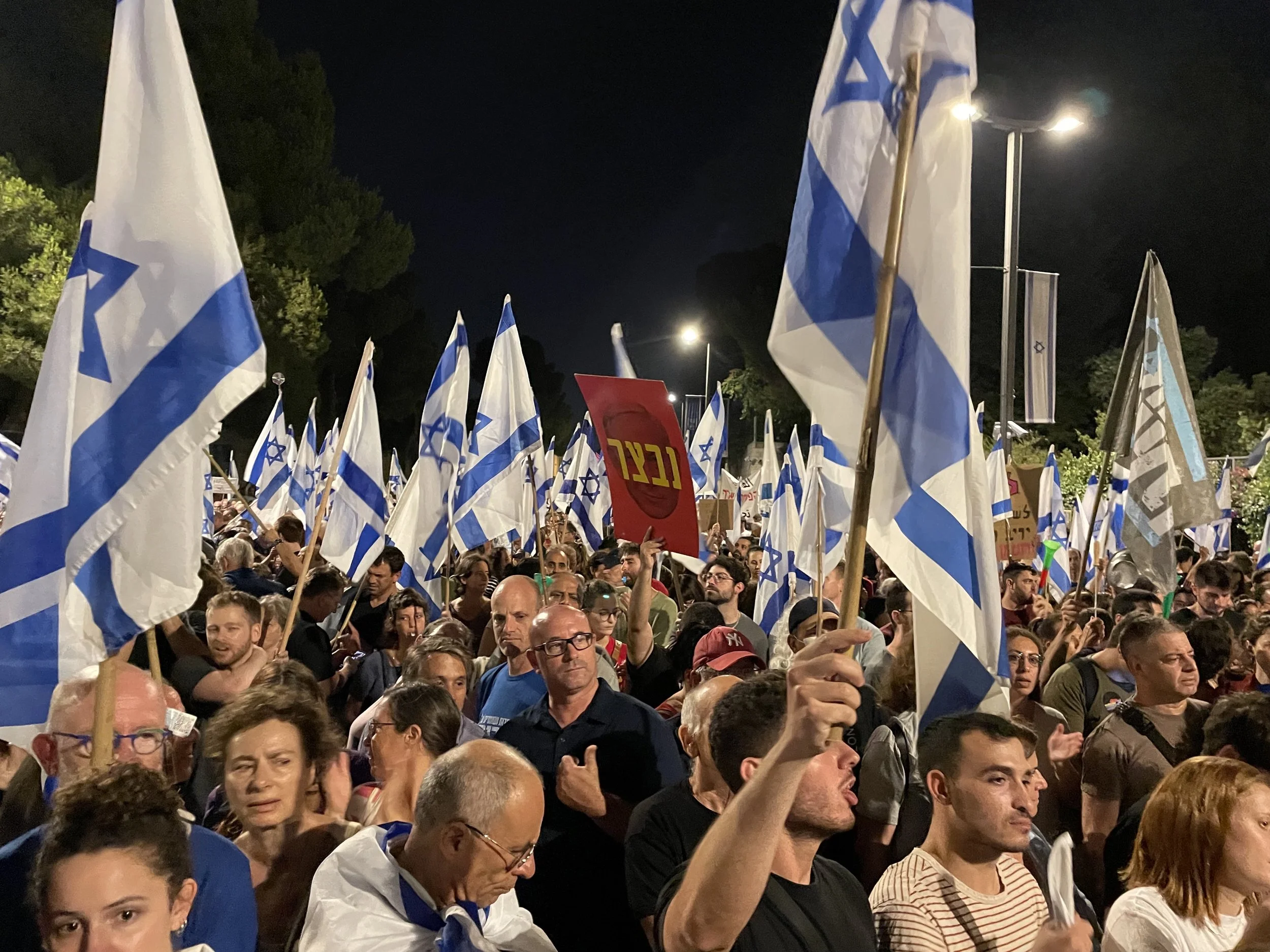
Look at all the flags. July 2023 in Jerusalem (Photo: NG)

But simultaneously, the demonstrations were awash in the national colors of blue and white. There were Israeli flags everywhere. Every gathering paused to commence or conclude with the singing of Hatikvah. It was not lost on a single soul that the purpose of the demonstrations was to reclaim the very idea of “Israeli-ness,” to take it back from zealots who insisted that only those who conformed to their vision were the true lovers of the nation.

In the past few years, we’ve attended no shortage of demonstrations in America as well—Women’s Marches, Black Lives Matter, No Kings, and so on. And I have no doubt that we who oppose MAGA are patriots—but try a little thought experiment. Imagine marching at any of those with an American flag  and distributing flags to fellow demonstrators. Imagine stopping the rallies at strategic moments and saying, “Now we’re going to all sing ‘The Star-Spangled Banner.’” It would have been awkward; it would have been tone-deaf. I know; I was there.

In America, the center-left has long conceded the rhetoric of flag, nation, and putting-country-first to the political right. That is one of the right’s big strategic victories—and it’s tragic.

It’s tragic because I’ve always believed that love—and we’re talking about love, aren’t we?—is always about encouraging the loved one to be the best it can be. When I think of the love of my family, I know that my love is unconditional, but it does not mean I always approve of their decisions or choices. (And vice-versa for my family towards me. Trust me.) Love means: I want you to grow into the best version of yourself. Love means caring so much that the lover must sometimes say “No” or “The road you’re going down is destructive to you and others.”

A relationship without loving critique [in Hebrew, תוכחה] and redirection from a harmful path is certainly not the highest expression of love. It may not even be “love” at all.

It was not lost on a single soul that the purpose of the demonstrations was to reclaim the very idea of “Israeli-ness,” to take it back from zealots who insisted that only those who conformed to their vision were the true lovers of the nation.

This surely applies to the love of one’s country. And that’s profoundly what I saw at every anti-government, pro-hostage-family rally in Israel over the past few years. Israelis—and, G-d knows, Palestinians—are suffering under a government that has given license to the most extremist zealots and Kahanists. PM Netanyahu has empowered Ben Gvir and Smotrich and their ilk to prop up the government with their zealotry; there is a moral rot at the heart of the ruling coalition that the demonstrators are responding to in the name of their love of country and the country’s future.

We could use more of this at home.

Second, the Israeli rallies have been inclusive, not exclusive. The demonstrations that took place week after week throughout the war clearly had a political point of view: Netanyahu’s coalition of violent ultra-nationalists and religious zealots is toxic. But the thrust of the demonstrations was not the far-left. It was a coalition of the pro-democracy center-left, center, and center-right. It was composed of neighbors and fellow citizens who probably disagreed about a wide swath of policies—but agreed that the moral health of their country was at stake, so they were able to find common ground.

No doubt compromises were made by some in order to be there. Good. Moral purity is fine for a Mussar beit midrash, but compromise is a very healthy thing for democratic societies.
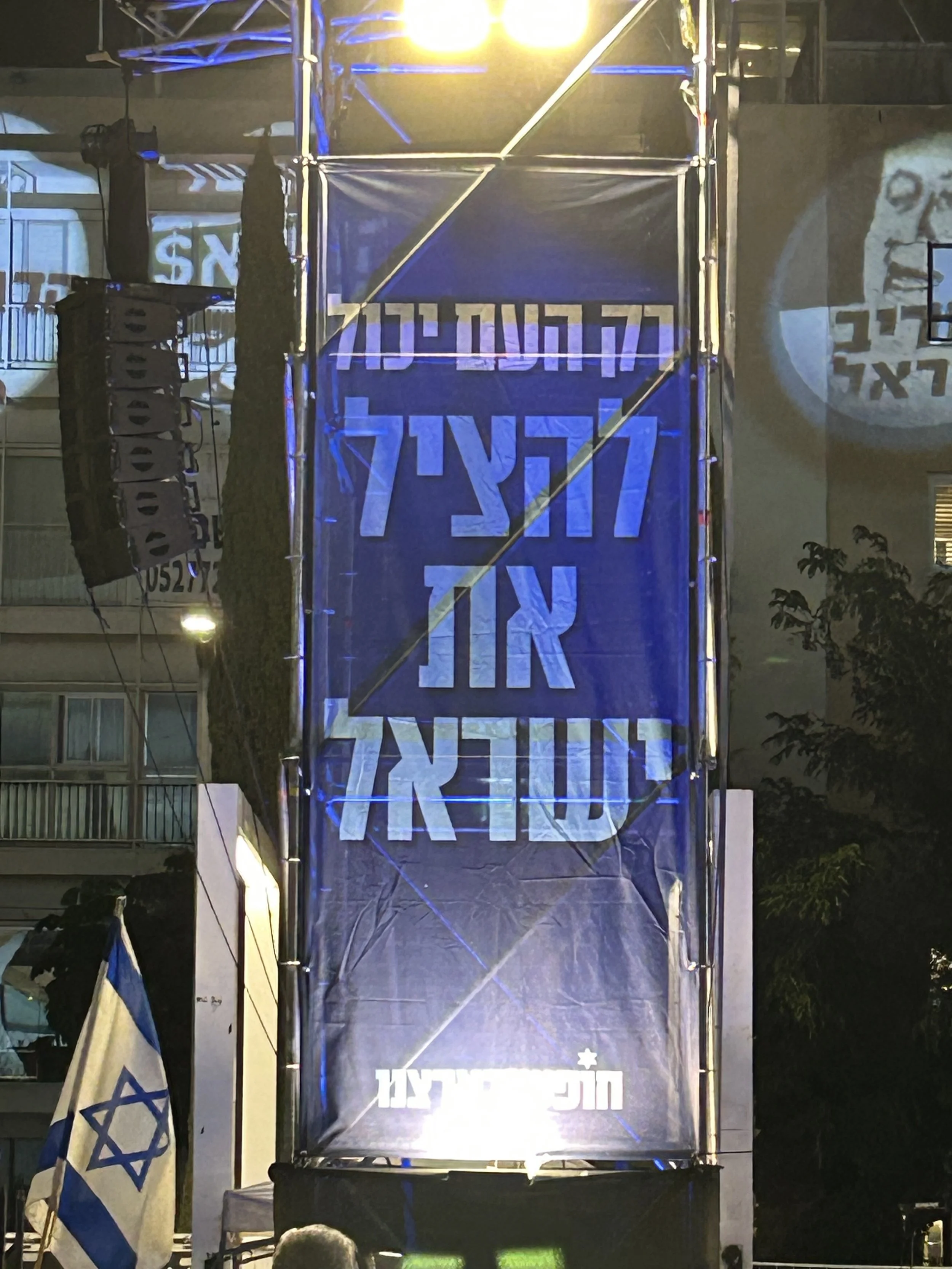
“Only the people can save Israel.” February 2026. (Photo: NG)

As for me, when I attended the New York pro-immigrant march in the wake of the ICE slayings of Renee Good and then Alex Pretti in January, I couldn’t have felt more peripheral. I’m appalled by the violent excesses of ICE and want to stand with the immigrant community. But that rally was dominated by the DSA—and their severity, intolerance, and outright antisemitism couldn’t have been clearer. I couldn’t get away from these people quickly enough.

Third, the Israelis have the persistence to be in this for the long haul. The most astonishing thing about the Israeli demonstrations was their refusal to go away—for months, then for years. The judicial crisis was such that people kept showing up, week after week; hundreds of thousands of them in cities all over Israel (this, for a country whose population is only 10.2 million). For years, Saturday nights have been given over to standing up for one’s country.

Again, I think of the American resistance rallies. They demand weeks of notification, publicity, planning. And the next day? Back to business or sports or our phones, as usual. Maybe the crowds will come out again six months from now.

So Chag Samayach to the People of Israel and all who support her and love her. Celebrate our accomplishments with pride and hope and endless resilience in the face of so much heartbreak. I’d give the last word to Amos Oz ז״ל, the great Israeli novelist whose voice of peace was profound because it was so unromantic, but absolutely pragmatic.

No man is an island, said John Donne, but I humbly dare to add: No man and no woman is an island, but every one of us is a peninsula, half attached to the mainland, half facing the ocean—one half connected to family and friends and culture and tradition and nation and sex and language and many other things, and the other half wanting to be left alone to face the ocean…

The condition of peninsula is the proper human condition. That’s what we are and that’s what we deserve to remain. So, in a sense, in every house, in every family, in every human condition, in every human connection, we actually have a relationship between a number of peninsulas, and we’d better remember this before we try to shape each other and turn each other around and make the next person turn our way while he or she actually needs to face the ocean for a while.

                        —Amos Oz, How to Cure a Fanatic [1]


[1] Amos Oz, How to Cure a Fanatic (Princeton: 2002), pp.69-71

Bein Ha-Sh’mashot: Between Memory and Independence

Sunday evening, May 12, is Yom HaZikaron / Israel’s Memorial Day.
Monday evening, May 13, is Yom HaAtzma’ut / Israel’s 76th Independence Day.

תָּנוּ רַבָּנַן: בֵּין הַשְּׁמָשׁוֹת סָפֵק מִן הַיּוֹם וּמִן הַלַּיְלָה
.סָפֵק כּוּלּוֹ מִן הַיּוֹם, סָפֵק כּוּלּוֹ מִן הַלַּיְלָה

Our Sages taught:
Bein Ha-Sh’mashot, twilight, is a place of uncertainty. Day or night?
It is uncertain if it belongs to the day or if it belongs to the night.
 
(Talmud Bavli, Shabbat 34b)


The Israeli national calendar does something rather extraordinary: it juxtaposes Memorial Day and Independence Day, so the former segues directly into the latter.

We find ourselves in a twilight place between memory and freedom.

I’ve often wondered, as an American, how each of those days in our calendar would be more profound and meaningful if our national holidays were similarly positioned. As it is, the American Memorial Day, the last Monday in May, mostly becomes a three-day weekend of barbecues and the informal beginning of summer—unless, of course, you happen to be in a military family.  And the 4th of July becomes a day of fireworks and beachgoing. Physically separated by five-and-a-half weeks in the calendar, these days are distinct and isolated from one another. Imagine how the meaning of each day would be deepened if they weren’t so far apart.

By contrast, in the Israeli model, the two days are inextricably connected, and each throws light upon the other. In other words, Israel’s fallen soldiers (and victims of terror) are remembered in the context of paying the ultimate price for everyone else’s gifts of freedom.

The flow from Yom HaZikaron into Yom HaAtzma’ut is organic, meaningful, and solemn.

This year, that seam between the two days seems to be the profoundest metaphor of the condition of Zionism. We truly find ourselves בֵּין הַשְּׁמָשׁוֹת /  bein ha-sh’mashot, in a twilight place between memory and freedom.

Please, please this year take a moment on Yom HaZikaron to remember. Remember not only the victims of Israel’s wars and the terrorist onslaughts she has faced throught the decades. Remember, too, the Hamas butchery of innocents on October 7: 1,139 people who were murdered, including the 364 who were killed at the Nova Music Festival in the desert, and the others from the kibbutzim and towns where the terrorists ruthlessly went door-to-door, executing children, elders, women, and men.

Remember that 250 people (in some situations, several generations of a single family; toddlers and grandparents) were kidnapped and held hostage in the dungeons beneath Gaza.

Remember that many of these women were raped and assaulted by the terrorists, and then their humiliations were sadistically posted to terrorist social media (with beheadings, torture, and more).

Remember that 128 people remain hostages today. May they be returned home before the holidays conclude on Tuesday.

And yes, we have room in our hearts to remember ALL the victims of war and terror, including the innocent Palestinian victims in Gaza. We have not forgotten, and we weep for all the victims. By mourning all the innocents, we assert that we are of a different moral caliber than our enemies.

But we also remember that there are such things as just wars, and we did not seek out or choose this war. The massacre of innocents and the hostages who are still behind enemy lines, without any Red Cross lifelines:  we remember them, and we will not forget, until every one is brought home.

Our Day of Memory will segue into our Day of Independence. And it may be hard to celebrate this year. But even acknowledging our diminished joy, I believe it is incumbent upon us to observe Yom HaAtzma’ut this year; to say in awe: “My G-d! We live in a generation that knows a State of Israel. What would our great-great-grandparents have said to us, to remind us that we live in one of the most extraordinary moments in all of Jewish history?”

Included in that sense of wonder is this: The reminder that Israel represents our refusal to be victims ever again. We have known pogroms and hostage-taking before in Jewish history. But the difference in our generation is the agency to fight for our freedom, to stand for justice and decency and independence and not to wait desperately for “deliverance from another place” (as Esther 4:14 would have it).

With that agency, of course, comes grave responsibility. A just war must be fought with just means. And the internal debates and wrestling that are going on within the Jewish community are (mostly) fair and, in the very fact that they are happening, a fruit of Independence.

As the world seethes—as antisemites aggressively spew their hate on college campuses and hypocrites dominate the opinion pages, as Jews are threatened once again from every quarter and every political angle—it occurs to me: I will observe Yom HaAtzma’ut with a renewed sense of vigor this year.

Observing Yom HaAtzma’ut with gratitude, commitment, and no small amount of wonder, will demand a certain amount of intention:

It will be an act of commitment to truth, which is in ever-diminishing supply.

It will be an act of pride in all the marvels that make up modern Israel.

It will be an act of solidarity with Jews everywhere, who continue to look towards Zion in hope.

It will be an act of rededication to working towards building the democratic and free society that is described in its Declaration of Independence:

The State of Israel will be open for Jewish immigration and for the Ingathering of the Exiles; it will foster the development of the country for the benefit of all its inhabitants; it will be based on freedom, justice and peace as envisaged by the prophets of Israel; it will ensure complete equality of social and political rights to all its inhabitants irrespective of religion, race or sex; it will guarantee freedom of religion, conscience, language, education and culture; it will safeguard the Holy Places of all religions; and it will be faithful to the principles of the Charter of the United Nations.

In other words, celebrating Israeli Independence this year will be an act of countercultural DEFIANCE that is at the heart of the Torah and Jewish tradition.

It may be hard to tell if this moment between memory and freedom belongs primarily to day or night, as the Talmud (above) would have it. But Israel and its extraordinarily resilient people continue to shine the light of courage, and I for one will raise a glass this year with my community to celebrate that unextinguished hope.


Forwarded to you? You can sign up to receive these notifications via email: https://www.atreewithroots.org/contact

On the 75th Anniversary of Israeli Independence


Macht keine Dummheiten wherend ich tot bin.
"Don't make any stupid mistakes when I'm dead."

—Theodor Herzl

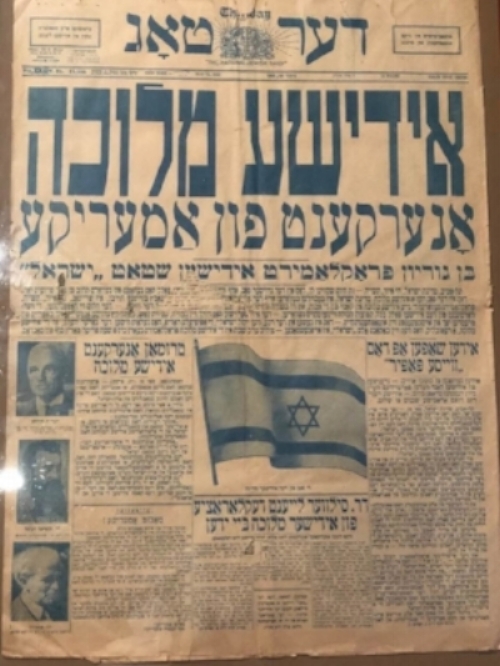
 Over my desk hangs my prized possession: A framed copy of Der Tog (“The Day”), the daily Yiddish newspaper published in New York from 1914 to 1971, dated May 15, 1948.

In 1000-point font, the headline cries Yiddishe Melukha (A Jewish State)!

On that day, the paper was printed in blue ink rather than black newsprint.

And there are images of three people on that front page:  President Harry S Truman, who sent official recognition from America; David Ben Gurion, the new Prime Minister; and Theodor Herzl, who set the political processes in motion half a century earlier.

I love this artifact and look at it every day. It was stashed away in my grandfather’s closet for years after he died; my grandmother presented it to me one day with an understated, “Do you want this?”

This is what patriotism looks like: A return to First Principles, enshrined in Israel’s Declaration of Independence, signed by a mosaic of ideologically diverse patriots exactly 75 years ago.

What I love about it is: It’s a reminder of the extraordinary impact of this moment for Jews everywhere in the world. As Ahad Ha’am predicted decades earlier, the arrival of Israel held enormous reverberations for Jewish people everywhere, not only those who would become citizens of the new state. Jews all around the world responded with celebration and wonder and dancing in the streets. Since it was Shabbat, special prayers were sung in shul the following morning. Most everyone recognized that a new chapter of Jewish history was being written.

I look at that headline with wistfulness today, as Israel is going through a revolution that is playing out in its streets.

What troubles me today are those—including Jewish leaders who should know better—who are saying that celebrating this 75th anniversary is “you know, complicated.”

I hope that for most of us, the celebration need not be complicated. 75 years is a wondrous milestone, a time for reflection and gratitude and celebration. We live in a generation that knows a Jewish state. What an incredible sentence that is! Our Jewish ancestors would have been astonished by that fact. Whoever they were, wherever they were in the world, they most certainly: (1) turned and faced the Land of Israel when they prayed; and (2) prayed daily to G-d to “bring us in peace from the four corners of the earth, and allow us to walk with dignity in our land.” They would have staggered to know that a Jewish state would become a reality, nearly 2,000 years after Jewish autonomy in our homeland ceased.

Look, I’m not naïve. I’ve been watching the political situation unfold in Israel for a long time. Israel is right now engaged in a genuine struggle for its very soul. For months, hundreds of thousands of Israelis have been pouring into the streets, on a weekly basis, demonstrating for democracy against the most extreme, autocratic, and corrupt regime that the nation has ever known. And those protests aren’t slowing down.

I’m with them. I know the implications if this governing coalition is allowed to succeed in its abominable, anti-democractic agenda.

But rather than ambivalence, I’m more energized than ever in my love for the state of Israel.

Why? Because those demonstrators in the street have revitalized me.

This is what patriotism looks like: A return to First Principles, enshrined in Israel’s Declaration of Independence, signed by a mosaic of ideologically diverse patriots exactly 75 years ago:

THE STATE OF ISRAEL will be open for Jewish immigration and for the Ingathering of the Exiles; it will foster the development of the country for the benefit of all its inhabitants; it will be based on freedom, justice and peace as envisaged by the prophets of Israel; it will ensure complete equality of social and political rights to all its inhabitants irrespective of religion, race or sex; it will guarantee freedom of religion, conscience, language, education and culture; it will safeguard the Holy Places of all religions; and it will be faithful to the principles of the Charter of the United Nations.

Tomorrow, there is a lot of work to do. It is imperative that we align ourselves with the voices of freedom, democracy, and peace.

Today, however, we celebrate—unambiguously, unapologetically, and with no small amount of wonder at reaching this moment. Our ancestors would have demanded nothing less.

Chag Samayach!

On Israel's 70th Independence Day

My prized possession:

The front page of the daily American Yiddish newspaper “Der Tog” ("The Day"), May 15, 1948, the day after Israel’s independence. On that day the paper was produced in blue ink. My grandfather saved it for me, giving it to me about five years after his death.

The large headline says, Iddishe Melukha: "Jewish State."

"Recognition from America"

“Ben Gurion proclaims Jewish State: 'Israel'”

Lower left corner: Truman, Herzl, and Ben Gurion


1,978 years after the destruction of Jerusalem.

!חג שמח