Netanya, the coastal Mediterranean city halfway between Tel Aviv and Haifa, has become one of our regular Shabbat destinations in Israel. This is thanks to the remarkable work of Rabbi Edgar Nof—more about him in a moment—and our dear friends Anita and Fred Finkelman, who bring me in as a scholar-in-residence to teach some classes. I’m so grateful, because this is one extraordinary community.
Kehillat Natan-Ya, part of the Israel Movement for Progressive Judaism, is a mosaic of nationalities. Looking around the packed room during the Shabbat services, I saw people who came here from Africa, Russia, Ukraine, Thailand, Georgia, Central and South America, the Philippines, the U.K., France, South Africa, and the U.S.—as well as the stam Israelis who were there. Part of the miracle of this place is that many of these are people who would not have found a place in a more mainstream Jewish community, for any of a variety of reasons. But Rabbi Edgar Nof brought them all home.
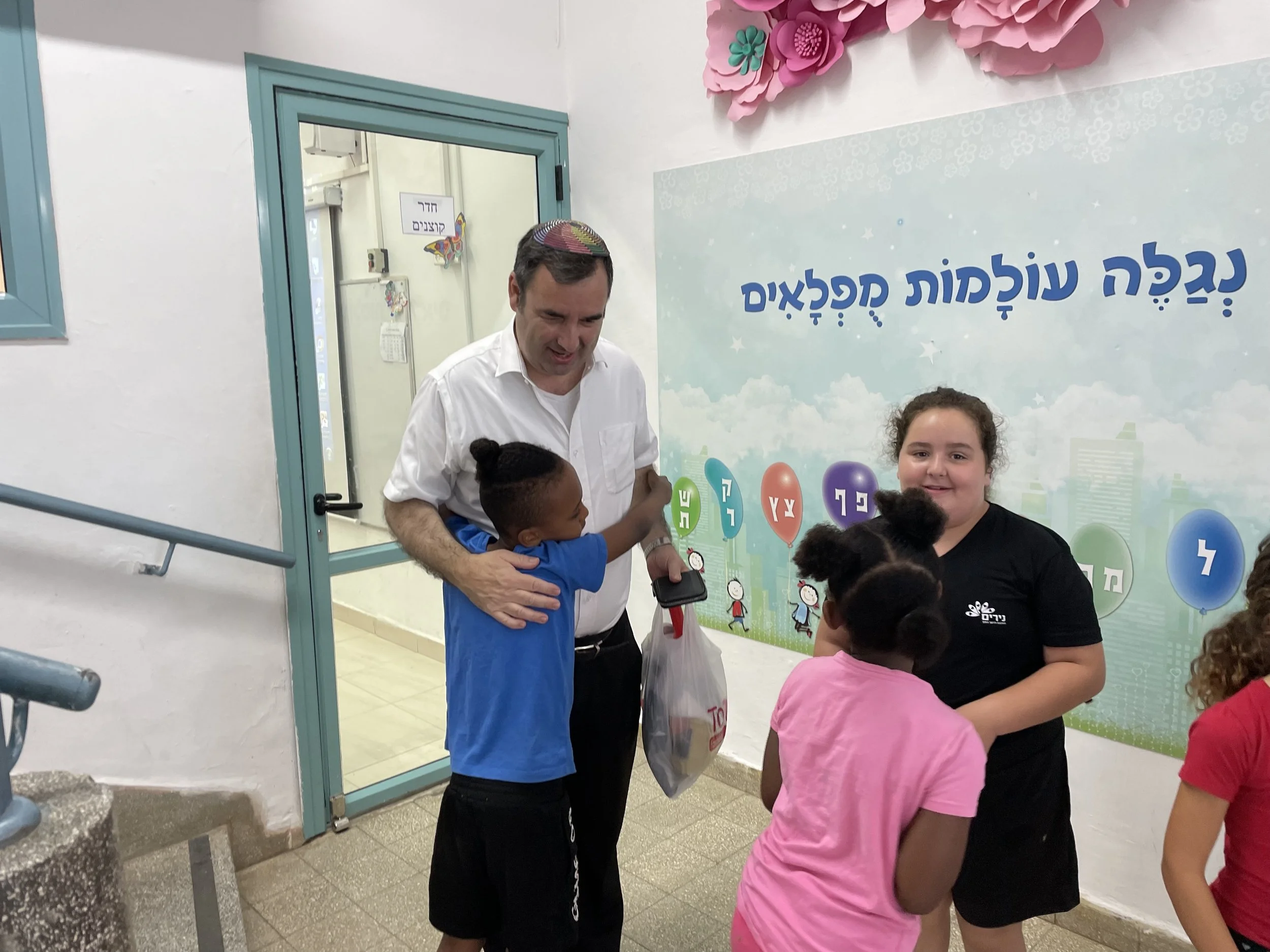
Here’s a photo of Rabbi Edgar Nof doing Mitzvahs in a Haifa school from two years ago. (Photo: NG)
Edgar is a whirlwind of Mitzvahs. The Kavod Tzedakah Fund, which my friends and I founded over 30 years ago, has supported Edgar’s organization Bridges for Hope (Gesharim LeTikvah) since its inception. He’s supporting impoverished families, victims of terror, new immigrants, elderly Holocaust survivors, and other people living on the fringe. He’s in a half-dozen of the poorest schools in Haifa, teaching pluralistic and open-hearted Judaism and working with administrators to get supermarket food cards to the neediest families.
Like everyone else, Edgar’s life and the life of this community was profoundly changed after October 7. He once told me about how, in the wake of the massacres, he officiated at a funeral of a family of four. And there are memorials all around the synagogue of its local heroes who were killed that day and in the aftermath.
Most indefatigably, he’s doing Jewish life-cycle events for those who may not have had any Jewish connection otherwise. Edgar must have officiated at four bar/bat mitzvah ceremonies this week alone. And conversions to Judaism: he tells Heidi and me that at this point he’s brought over 800 people to Judaism in his career. Just amazing, and we got to see some of it up close on Friday.
I arrived at Netanya to teach my class. Edgar said he couldn’t be with us beforehand—he had a memorial service earlier in the day and a bar mitzvah in the afternoon; then my class, which segues into Shabbat. (I used to think I had a busy schedule.)
The service is gloriously energetic. It’s noisy, and there are no formalities, and there aren’t enough siddurim. Children are up and down to the bimah to help Edgar out throughout the service; so, too, are adult honorees who come up to mark joyful milestones. Half the room has been given percussion instruments to tap or shake as we sing out the Shabbat prayers; it’s Shabbat Shirah, after all. The whole thing is a whirlwind and it’s wonderful.
In the middle of the service, a boy and his father are called up to the pulpit. Edgar opens the Aron Kodesh and places the Torah in the boy’s arms. He’s been studying and preparing for conversion—his mother is not Jewish—and this moment will make it official. He processes the Torah around the room, as everyone else rains candies upon his head and sings, Siman Tov u’Mazel Tov! The boy is composed, but his father has an awestruck look in his eyes—the echo of a hundred generations of Jews before him—as if he can’t believe that this moment was actually possible.
And then the entire room—this congregation from at least five continents—erupts and cries out: Achinu Atah! Achinu Atah! Achinu Atah! (Three times: “You are our brother!”).
Excuse me a moment, there’s something in my eye.
The service continues, Edgar strumming his guitar. Singing beside him is his longtime volunteer cantor Anna—she’s a young Philippine immigrant whom Edgar also brought to Judaism.
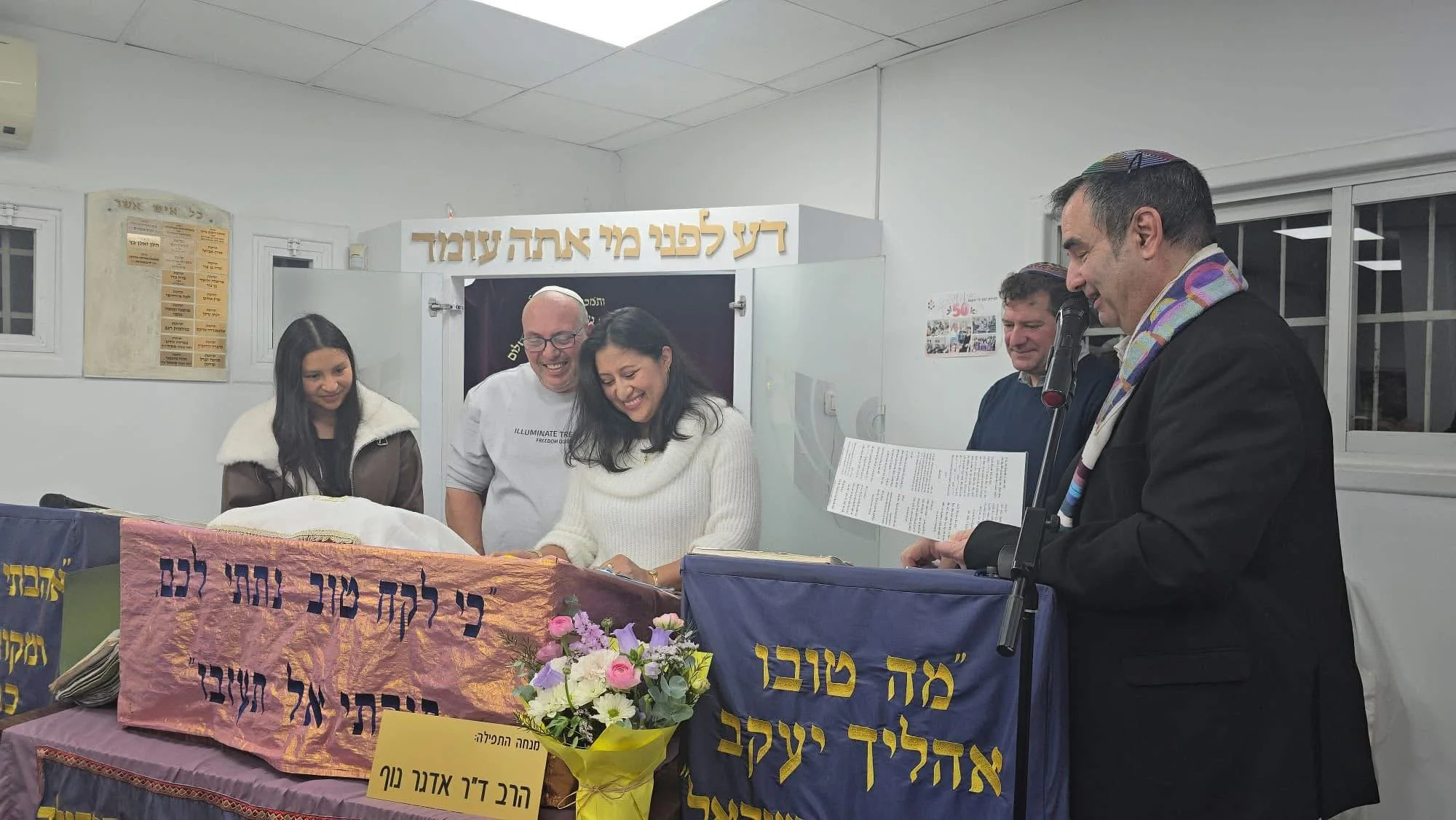
Elisheva officially becomes part of the Jewish people (screenshot from Natan-Ya’s livestream)
And then, breaking with the idea that the sequel is never as good as the original, another woman is called to the podium. She’s originally from Guatemala; she came to Israel and married a Sefardi man. Her husband and a handful of children stand beside her; she’s the second person tonight to celebrate a conversion to Judaism. She’s taken the Hebrew name Elisheva.
Elisheva takes out her prepared notes, and starts to thank her family, and the rabbi, and this community… but she gets choked up; it takes a while for her to regain her composure. And so, too, for the rest of us. And then, in unison and resounding with unbelievable excitement: Achoteinu At! Achoteinu At! Achoteinu At! (“You are our sister! You are our sister! You are our sister!”).
In the language of our tradition, she has been embraced “under the wings of the Shekhinah.” But she’s also just been embraced by the Jewish people, as represented by this beautiful mosaic of worshippers.
Frankly, it was one of the most joyful and loving Shabbat services I’ve been to in a long time, amidst the joyful cacophony. This is the authentic face that I wish Israel were more adept at putting forward to the world: pluralistic, joyful, and welcoming—with room for everyone.