Shalom from Tel Aviv. I’m in Israel for two weeks with the Good People Fund, visiting extraordinary changemakers whom the organization supports. I’ll be blogging about some of them over the next few days.
It’s a powerful moment to be in Israel. Last week Israel held its national elections, the first since the terrorist massacres of October 7 and the subsequent Gaza war. And Tuesday of course was the U.S. midterm elections, in which Israel and Jewish communities were given outsized attention.
These are fraught times for Israel and people who love her. I’ll write a future post about the view from here about these things. But for now I’m here for other reasons.
___________________________
וַתִּקְרָ֤א שֵׁם־ה׳ הַדֹּבֵ֣ר אֵלֶ֔יהָ אַתָּ֖ה אֵ֣ל רֳאִ֑י
כִּ֣י אָֽמְרָ֗ה הֲגַ֥ם הֲלֹ֛ם רָאִ֖יתִי אַחֲרֵ֥י רֹאִֽי׃
And Hagar called YHVH who spoke to her, “You Are El-roi,”
by which she meant, “Have I not gone on seeing after He saw me!” (Genesis 16:13)
On the first day of our site visits, this text from Bereishit was ringing in my ears. In Genesis 16, Hagar the slave flees from the household of Abraham and Sarah. That idea alone is sobering for Torah readers and should give us a sense of what the Torah thinks about any delusion of “Jewish supremacy.” The text states directly that Sarah was oppressive and Abraham was indifferent to Hagar’s suffering. She flees for her life.
In the wilderness, we can imagine how afraid and alone Hagar must be. Then G-d appears to her. (In Genesis, the distinction between “G-d” and “an angel of G-d” can be fluid; recall the angel who appears to Abraham at the climax of the Akedah in Genesis 22.) When Hannah is asked, “Where are you coming from and where are you going?” she can only muster an answer to the first question: אָנֹכִ֖י בֹּרַֽחַת she says, “I am fleeing.”
But then G-d speaks to her directly, and she responds by calling G-d by a unique name: “You are El-Ro’i!” El Ro’i: “G-d who sees me!”
Imagine what it means to Hagar, abused and alone, to know that she is seen. If not by people, then by G-d. An affirmation of her humanity, her human dignity, and perhaps a dose empowerment to begin to answer the second question, “Where are you going?”
That’s the text that I was thinking of on our first day with the Good People Fund, a golden thread running through our visits.
______________
Our first stop was Yotzrot: Turning the Tables, an extraordinary community that runs a series of workshops in Tel Aviv, protecting and saving women who have been sex workers.
The parallels to Hagar’s flight wereunsettling. Virtually every one of the women there was fleeing an abusive situation. And sex workers are certainly “invisible”; their desperation and humanity is rarely spoken of, and much of society would prefer not to acknowledge their existence.
But the Yotzrot team doesn’t do judgment. “First, we listen,” we were told by the director, Lilach Tzur Ben-Moshe. And so begins a process—sometimes a very long process—of a comprehensive program of restoring dignity, ending cycles of abuse, helping where it is needed (such as eliminating a woman’s financial debts), and mentoring that can move their clients away from sex work and open new horizons (one of their clients is now in law school!).
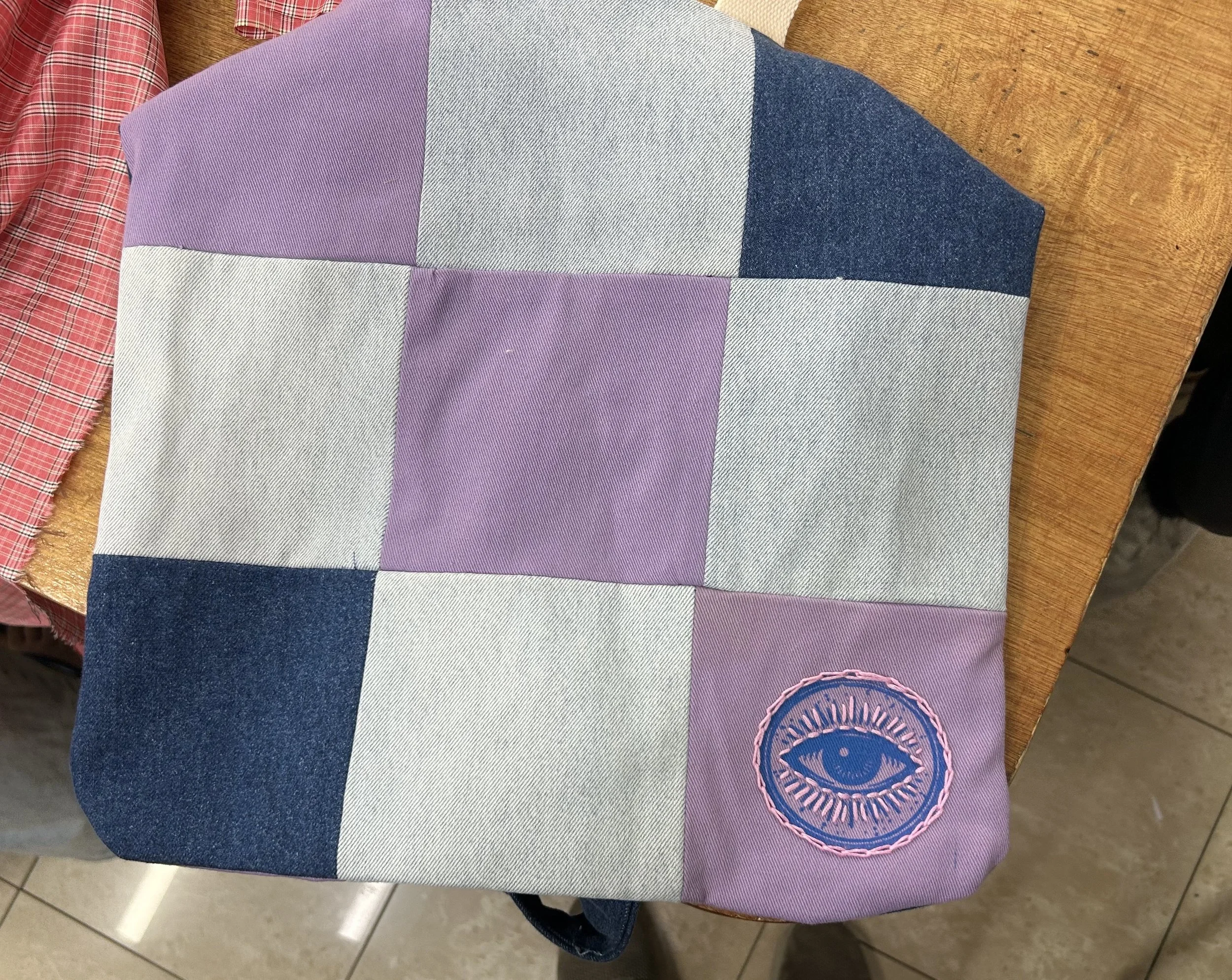
Art and creativity are part of the process of reinvention. We went to a workshop were the women were making denim handbags for sale. The workshop is called “Hotam,” which means “sign” or “seal.” Among other things, each artisan puts her distinct hotam on the bag she creates, such as this one (right), created by a woman who uses the eye-symbol as her distinctive brand.
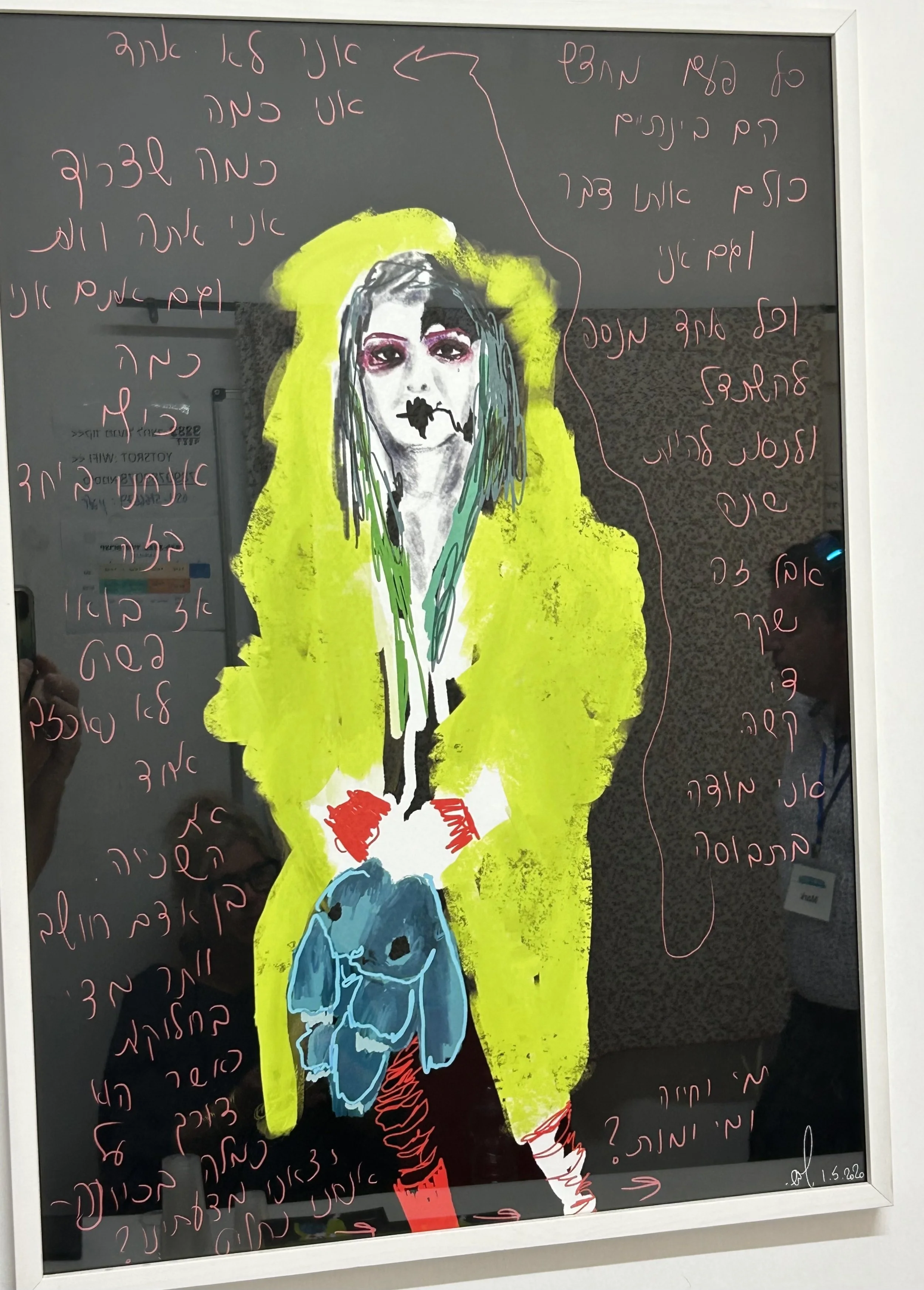
And this painting, below, by one of the women, on the wall of the studio, continues to haunt me:
_______________
Later we spent time in South Tel Aviv with the indefatigable Gideon Ben Ammi, the founder of Pesia’s Kitchen. In the early 2000s, South Tel Aviv was the limbo where asylum seekers fleeing devastation from Eritrea and Sudan were placed by an indifferent Israeli government. It quickly became a place of squalor—prostitution, drugs, and general devastation.
It was here that Gideon and his cousin began serving meals in 2012. In other words: they saw them—and they saw their opportunity to change things.
They began feeding the hungry residents of the neighborhood. They named the program “Pesia’s Kitchen,” after their grandmother, who had her own refugee story, coming to Israel before World War 2 and had already established a reputation for feeding people who were hungry. Gideon’s project grew far beyond South Tel Aviv; today they are preeminent rescuers of food and they partner with 40 schools in Israel to feed children and families who are hungry—Jews, Arabs, Bedouin, Druze, immigrants; anyone in need. Tons of kilos of food are have been saved and delivered to schools for distribution.
Gideon’s son Yoni has taken over as the Director of Pesia’s Kitchen, but, in his eighties, Gideon is as busy as ever. He told us the people are always asking him, “When are you going to retire, take a break?” His reply: “I take a break every day: I do what I love to do.”
_____________
Much more in the realm of empowering women: We meet Racheli Tadessa Malkai, the founder of Ma’atzimot, empowering Ethopian Israeli women. We hear from Esty Shushan, the founder of Nivcharot, which advocates for women in the Haredi world, where the very idea of empowerment is new and controversial. And Shana Aaronson of Magen, supporting survivors of sexual abuse and advocating for safer Jewish communities, who tells us some heartbreaking stories and an astonishing one about bringing a particular abuser to justice.
This trip is both physically and emotionally exhausting. And there is wonder and human grandeur around every bend in the road.
One more stop: The LGBTQ Center in Tel Aviv, which also knows a thing or two about saying “You are seen” to people who are running from dangerous situations. We met with Merav Livni Keish, the co-founder of Brit Ha’Leviot (“The Pride of Lionesses”), supporting families of transgender and gender diverse children.
And we met with Linor Abergal and Jannette Tayeb of the Israeli Transgender Association, providing a supportive and safe community for transgender Israelis, Jewish and Arab alike.
Each of them have powerful and wrenching stories of being lost and then being found by a community of gentle and caring people, restoring dignity and self-worth. Each is an inspiration.
____________________
This is an unbelievably powerful way to encounter Israel in 2026. Each day we are meeting extraordinary heroes who fight back against indifference, apathy, or outright cruelty. Each of these heroes we saw today is telling people who might otherwise be rendered invisible, “We see you.” And thus restoring human dignity and value.
Much more to come.