One Year's Passing Since "That Day"

.וְכָל הֵיכָא דְּאָמְרִינַן ״בּוֹ בַּיּוֹם״, הַהוּא יוֹמָא הֲוָה
Anywhere in the text where we simply say “That Day”—it’s referring to that day.
(Talmud, Berachot 28a)

March 10 is an auspicious and melancholy anniversary. It’s the date in my mind when everything changed for us.

It was on March 10, 2020—it was the afternoon of Purim in the Jewish calendar—and I was sitting with a group of students, planning an upcoming Holocaust-education program for our community.  It was late afternoon, and of course we were all aware of the encroaching pandemic and the murmuring that college campuses were closing down. And then it happened:  we all received the email simultaneously from the university President that informed us that Babson was shutting down, too.

Remember how young and innocent we all were back then? The initial outreach from the school encouraged students to take all their stuff with them when they left campus in a few days; it was Spring Break. The hope was that we would all be able to return in two or three weeks. Certainly, we figured, we would be back by Passover. Okay, by May 1. Okay… by graduation?  And everything kept getting pushed back by a week, then a month, and so on…

None of us imagined then that we’d be marking the one-year anniversary of staying-at-home, social distancing, and Zoom fatigue. Let alone well over a half-million Americans dead, due in no small part to the incompetent machinations of a self-serving federal government.

But here we are. And while some have told me that it’s “depressing” to mark such an anniversary, it is not my intention to be a downer. While I yearn for the physical presence of my friends and family as much as anyone, I draw inspiration from the remarkable resilience that I’ve seen from many people.

The role of technology in our lives has been incredibly valuable; just imagine the strain of staying at home if it were just a few years ago, before videoconferencing technology was as smooth and effective as it is now. For me, personally, this has been especially true. I had cochlear implant surgery in August 2019, and can actually hear with 90% clarity for the first time in many years. If the pandemic had struck just two years ago, I would have been rather hopeless in all of my Zoom classes, meetings, and interactions. I would have been much more isolated. I would have been in terrible trouble.

The anniversary is a useful time to reflect on “that day” – the moment when everything changed in our lives, and all of our responses and behaviors seem to be re-oriented around those changes.

The Talmud has a “that day”—it was the moment of a political shakeup that occurred among the Tanna’im in the 2nd century, when Rabban Gamliel was deposed (temporarily, it turns out) from community leadership and the entire structure of the Academy was democratized. On “that day,” new books were written, new rules were put into place, and new leadership (Rabbi Elazar ben Azariah) was installed.

But if a moment in Israel 1800 years ago is too esoteric, consider that each of us has a “that day” as well, depending on what generation we belong to:

The JFK assassination, of course. The murder of Yitzhak Rabin. 9/11, G-d knows. A diagnosis, a car accident…

And probably good things as well: weddings; births; b’nai mitzvah, certainly.  New jobs, new loves, moving to a new home…

Days when everything changed, for better or for worse.

Someday soon, G-d willing, these newly acquired Covid-behaviors will recede. We’ll be in the company of friends and even strangers again. The masks will come down, or at least loosen up. We’ll hug our distant family members. We’ll travel without reservation. There will no longer be daily Corona tolls in the media.

And when that happens, I hope we’ll remember the lessons that we’ve learned since “That Day.” Lessons about caring for the most vulnerable among us; about using technology for good; about how precious it is to be in the presence of people we care about. If it’s true that “everything will be different,” let’s pray that those differences will be to make us better, and that they will be for blessings.

Do you have a “That Day” in your life? You’re invited to tell us about it in the comments section below.
Parashat Shemot: The Big Lie

A thought as Shabbat approaches.

With this week’s sidra, we return to the Book of Exodus. As Exodus opens, the Israelites are well settled in the region of Goshen in the Land of Egypt. Then, of course, a new Pharaoh comes to power—a king who does not know history and the legacy of Joseph. This Pharaoh is a brute and a thug, but also a master manipulator of his citizenry. And he speaks words of incitement:

הָ֥בָה נִֽתְחַכְּמָ֖ה ל֑וֹ פֶּן־יִרְבֶּ֗ה וְהָיָ֞ה כִּֽי־תִקְרֶ֤אנָה מִלְחָמָה֙ וְנוֹסַ֤ף גַּם־הוּא֙ עַל־שֹׂ֣נְאֵ֔ינוּ וְנִלְחַם־בָּ֖נוּ וְעָלָ֥ה מִן־הָאָֽרֶץ׃
He said to his people, “Look, the Israelite people are much too numerous for us.
Let us deal shrewdly with them, so that they may not increase;
otherwise in the event of war they may join our enemies
in fighting against us and rise from the ground.”
(Ex. 1:10)

They’re just words, right? The same sorts of words and logic that common gutter racists have used countless times throughout history. But immediately in the next verse, Pharaoh’s audience acts on his words:

וַיָּשִׂ֤ימוּ עָלָיו֙ שָׂרֵ֣י מִסִּ֔ים לְמַ֥עַן עַנֹּת֖וֹ בְּסִבְלֹתָ֑ם
So they [they?!] set taskmasters over them to oppress them
with forced labor…
(Ex. 1:11a)


That’s how Israel became enslaved. You can imagine their bystander neighbors muttering, “Hey, I’m not racist, but if we don’t do something, there won’t be any real Egyptians left around here anymore…”

Yet lying tyrants are never satisfied. They always have to up their game:

וַיֹּ֙אמֶר֙ מֶ֣לֶךְ מִצְרַ֔יִם לַֽמְיַלְּדֹ֖ת הָֽעִבְרִיֹּ֑ת אֲשֶׁ֨ר שֵׁ֤ם הָֽאַחַת֙ שִׁפְרָ֔ה וְשֵׁ֥ם הַשֵּׁנִ֖ית פּוּעָֽה׃
וַיֹּ֗אמֶר בְּיַלֶּדְכֶן֙ אֶת־הָֽעִבְרִיּ֔וֹת וּרְאִיתֶ֖ן עַל־הָאָבְנָ֑יִם אִם־בֵּ֥ן הוּא֙ וַהֲמִתֶּ֣ן אֹת֔וֹ
וְאִם־בַּ֥ת הִ֖יא וָחָֽיָה׃
The king of Egypt spoke to the Hebrew midwives,
one of whom was named Shiphrah and the other Puah,
saying, “When you deliver the Hebrew women, look at the birthstool:
if it is a boy, kill him; if it is a girl, let her live.”
(Ex. 1:15-16).


This is the Egyptian version of the Big Lie, a term coined in Mein Kampf. If you repeat Big Lies often enough, and with enough charisma, people who don’t know better will follow, even to the point of dehumanizing others. Even to the point of radical violence.

Here’s what Yale history professor Timothy J. Snyder says about the Big Lie, in his crucial book On Tyranny (New York, Tim Duggan Books, 2017):

As observers of totalitarianism such as Victor Klemperer noticed, truth dies in four modes, all of which we have just witnessed.

The first mode is the open hostility to verifiable reality…

The second mode is shamanistic incantation. As Klemperer noted, the fascist styled depends upon “endless repetition,” designed to make the fictional plausible and the criminal desirable.

The next mode is magical thinking, or the open embrace of contradiction… requiring a blatant abandonment of reason.

The final mode is misplaced faith. It involves the sort of self-deifying claims… “I alone can do it.” (pp.66-70)

The American version of the Big Lie has been cultivated for a long time, by Donald Trump, his enablers, conservative media, et al. They have told their audiences outright falsehoods for years. They have repeated those mantras constantly (“Socialism!”, “Lock her up!”, “The elections are rigged!”). They love magical thinking (“the pandemic will disappear like a miracle”). And the misplaced faith: scientists, journalists, experts in the field, etc., are all lying; only Trump tells you the truth.

As you know, over sixty court cases verified that Trump decidedly was the loser in the November election. Governors and election officials from both parties around the country confirmed that the election was completely secure and accurate.

And yet the President and his minions repeat their Big Lie, that it was rigged and stolen.

The angel of decency passed over these people.

Now we’ve seen the fulfillment of what the Big Lie has done after all these years. Monsters in Auschwitz shirts and MAGA hats, with their gun in one hand and the flag of Southern treason in the other, storming the United States Capitol.

And when it was over, and the U.S. Congress reconvened to ratify the results of the November election, still eight Republican Senators and one hundred thirty-nine Republican Representatives voted to overturn the democratic election results representing the will of the American people. Learn their names; they are seditious traitors to democracy.

But those ignoble 147 know an open secret: Repeat the Big Lie long enough and the true believers will fall into line. And then G-d have mercy on the nation.

Don’t expect divinely-ordained miracles—a/k/a “Ten Plagues”—to rescue America from the suffering that the Big Lie has created. As Snyder instructs us:

            Post-truth is pre-fascism. (p.71)

But Shabbat is coming, so we have to find solace and comfort somewhere. It’s there in the Torah: While the rest of the Egyptians were following the lies that Pharaoh fed them—“we have to put Egypt First”—there were some heroes. We know their names: Shiphrah and Pu’ah, two midwives, who said that no matter how personally risky it would be for them to defy Pharaoh’s whims, they would not throw babies into the Nile.

We know their names.

The Torah doesn’t tell us the name of this Pharaoh. As far as the text is concerned, he’s just another tyrant of the sort we’ve seen in every generation, as the Haggadah reminds us. But these two Hebrew midwives, people with the strength of character to stand up to tyrants, who do what is right and decent and life-affirming, those are the names that get recorded and celebrated for all posterity.

Each of us is called upon, at this crucial moment, to be a Shiphrah and a Puah. Pharaohs and their enablers inevitably crumble under the weight of their own lies. Their names will, eventually, be buried in the shifting sands. Those who speak the truth, and apply it with decency, compassion, and love, will be the ones whose names endure.

Photo credit: Olam HaTanakh: Shemot, Tel Aviv, 1998

Statement from the Massachusetts Board of Rabbis on the Assault on America, January 6, 2021

Statement by the Massachusetts Board of Rabbis on the Assault
on the Nation’s Capital on January 6, 2021

23 Tevet 5781 | January 7, 2021

Like all Americans of good faith, the Massachusetts Board of Rabbis is horrified and appalled by the acts of insurrection in Washington, DC on Wednesday. We urge the members of our rabbinic council, and all the members of our communities, to renew the call for justice and decency in our country in accordance with our Jewish and American values:

1.    The perpetrators of Wednesday’s violence and their enablers are criminals and enemies of American democracy.

As Jews, we cherish dissent, differences of opinion, and the precious freedom to question authority and express unpopular opinions. Wednesday’s events, which included vandalizing the Capitol building, invading the offices of national representatives, and the clear threat of violence, violate each of these principles.

The Mishnah enjoins us: “Pray for the welfare of the government, for if it does not inspire respect, people will devour one another” (Pirkei Avot 3:2). Today we pray for those who defend the nation’s laws and maintain order with integrity and evenhandedness, especially those who have been put in harm’s way.

2.    Wednesday’s violence was predictable and, considering the history of incitement,  sadly inevitable. We demand accountability from President Donald Trump and his enablers.

One resounding lesson from Jewish history is that violent words directly lead to violent actions. The President’s winks and nods to alt-right and white supremacist groups—from his refusal to disavow neo-Nazis at Charlottesville in 2017, to his encouragement of the racist Proud Boys to “stand by”, to his feeble and cynical words of “We love you” for Wednesday’s insurrectionists—implicitly endorsed the assault on the Capitol.

We have no doubt that the President’s words incited Wednesday’s violence. Prior to the election, the President refused to indicate if he would support a peaceful transfer of power in the event that he lost. Earlier this week, the President encouraged his followers to go to Washington to protest the election that he lost, insisting that the protest on January 6 would be “wild.” The President’s counsel, Rudy Giuliani, likewise encouraged violence when he insisted the demonstrations would be “trial by combat.”

The President’s insistence that November’s election, which he decisively lost, was rigged and invalid has been proven unequivocally to be a lie. Over sixty court cases, and the affirmations of the election results by governors and election officials all over the country, have demonstrated that the elections were valid. The President’s public refusal to accept the results is not only a demonstration of his low character, but it also is an assault on the democratic institutions of our country, which directly led to Wednesday’s violence.


3.    We demand clarity about the clear racial disparity in the use of force by the authorities in responding to the attack on the Capitol.

Why were the responses of the Capitol Police and law enforcement so disproportionately mild compared to similar events of the past year, when Black Lives Matter protesters and other left-leaning protests were met with much more severe displays of force? MBR’s continued commitments to racial justice and our partnerships with our neighbors compel us to call attention, yet again, the unfair and unequal application of the law.

Our Torah insists: You shall have one law for stranger and citizen alike (Leviticus 24:22). We call for official investigations into the disparity of the applications of the force of law, and the apparent lack of security preparations, given the size and toxic incitement of the crowd.

We call upon our Rabbis and other leaders to name the transgressions that led to this moment. Rabbis should not engage in partisan politics from their pulpits, of course, but rabbis often feel constrained in voicing moral truths so as not to upset some members of their communities. But this is not a partisan moment: Democrats and Republicans, left-leaning and right-leaning constituents alike must be able to identify the profound offenses that have taken place in order to move our country forward.

Jewish tradition warns of “righteous people who had the power to protest the actions of others, but did not” (Talmud, Shabbat 55a). American democracy is resilient, and we are confident that the potential for national healing exists. But our shared future is in our own hands; we have much work to do.

This is not a time for  self-righteous pieties or genteel calls for peace. This is a moment to reclaim the integrity of our democratic institutions from those who would pervert them, and to demand accountability, even unto the highest office in the land.

Massachusetts Board of Rabbis Executive Committee
Rabbi Neal Gold, President (ndzahav@gmail.com)

Michael Oren's Ghostly and Liberating Tales

Michael Oren is certainly a Jewish renaissance man. He’s a respected historian who wrote the definitive history of the Six-Day War. He’s an accomplished diplomat, serving as Israel’s Ambassador to the United States from 2009-2013. He has been a widely admired political leader, representing the centrist Kulanu party in the Knesset from 2015-2019 and serving as a deputy minister in the Prime Minister’s cabinet.

To that list of accomplishments, add that he’s a terrific and provocative storyteller, as we discover in his new collection of short fiction The Night Archer and Other Stories.

Oren’s imaginative GPS is set to a place where the paths of Delmore Schwartz, Stephen King, O. Henry, Etgar Keret, I. B. Singer, and episodes of The Twilight Zone all intersect. This collection of stories—most of them are quite short, just three to six pages—reveal a vigorous and wide-ranging imagination. And underneath it all is a freewheeling and slightly wicked Jewish sensibility, even in the tales that have no obvious Jewish referents.

In the Introduction, Oren reveals that many of these stories were written and stored away during his years as a diplomat. No wonder: not only are Israeli political leaders expected not to publish books during their tenures, but these stories also unveil a dark, romantic imagination of the sort that politicians prefer to keep tamped down.

And many of these stories are quite haunting—and haunted.

Ghosts abound in Oren’s fiction. “Ruin,” the story that opens the collection, is a sort of ghost-story-in-reverse, with a clever moral at its climax.  In “The Reenactor,” a Polish actor has a job at a local Jewish museum (that is, a museum to Judaism; the Jews are gone from this place)—until he drunkenly stumbles into the forest, where the ghosts of Jewish martyrs are everywhere. Likewise in “Aniksht,” which also features an Eastern European forest which becomes a place of flight during the Holocaust—and many years later as well.

Some stories seem to draw inspiration from Stephen King. (A compliment: I think King is one of our greatest living storytellers, who knows the economy of words and whose oeuvre is much broader than he receives credit for.) Like King, in some of these stories you can viscerally feel the writer’s glee in taking an idea—sometimes a genuinely twisted one—and riding it home. “The Betsybob” is the most overtly King-ish story, concerning four women who, as childhood friends, once had a shared mystical encounter in the woods near their summer camp. In adulthood, they return, looking for one more connection with one more desperate wish.  Oren knows how to stick the landing, too: some of the tales build to a witty and occasionally shocking punchline.

That’s just the tip of the iceberg. These short stories also include: would-be political power couples, parents and children, love found and love lost, medieval conquistadors sojourning to the New World, lachrymose novelists, Civil War reenactors, outsider suburban schoolkids, and much more. Oren writes science fiction, mystery, romance, tragedy, animal fables, detective stories, some elaborate allegories, and many sober reflections on human absurdity. It’s all a lot of fun, and written with such economy of language that none of the chapters overstays its welcome.

Oren wears his Jewish sensibility comfortably; that is to say, it’s never heavy-handed or pandering. Two of the stories here—“Day Eight” and “The Book of Jakiriah”—are outright midrashim, told through a comedic lens. And “The Betsybob,” too, is self-aware enough to make reference to the famous Talmudic legend of the Four Sages Who Entered the Orchard (of mystical speculation). Still, Oren’s grasp is much larger than the narrow niche of “Jewish literature.”

In his Introduction, Oren makes the case for a Jewish sensibility that underlies everything that he writes. In particular, he reflects on the paradoxical relationship that Judaism has with freedom: namely, that true freedom is framed by responsibilities and statutes. As it says in Pirkei Avot:

The tablets were God’s work, and the writing was God’s writing, incised [חָרוּת] upon the tablets (Exodus 32:16).
Don’t read “חָרוּת/incised on the tablets,” but rather “חֵרוּת/freedom was on the tablets.”

Michael Oren’s freedom—after years of serving the Jewish people in a public capacity—has been well-earned. Here’s hoping there are many more wonders to be drawn from his prolific literary imagination.

I’ll be hosting Ambassador Michael Oren in conversation about The Night Archer on my online platform on Thursday, November 12, at 12:00 noon Eastern time. Register here to receive the Zoom link and passcode.

Light in Darkness

This short piece was written for the newsletter of Babson College’s Office of Religious &
Spiritual Life, who requested a post on the subject “creating light at dark times.”

I was invited to write a short piece about “Light in the Darkness.” Well, there is a sequence of ideas sprinkled throughout the Torah that leads us, I think, to a provocative and timely conclusion.

Hang on tight and follow my logic:

(1)  The Torah opens with darkness. The second verse of Genesis reads: “…darkness over the surface of the deep, and wind from God sweeping over the water…” before any act of creation came into being.

(2)  And then, the first act of creation: “And God said, ‘Let there be light.’” (Gen. 1:3). Divine creativity commences by pushing away darkness with light.

So far, so good. Except for one dilemma. A seventh-grader reading Genesis for the first time can spot the obvious quandary: the sun, moon, and stars do not come into being for a few more paragraphs, not until the 4th day of Creation! So what kind of light was this on Day One?

The Zohar, the preeminent book of Kabbalah, suggests that the divine light of the 1st day of Creation—this primordial Light, by which one could see from one end of the universe to another—was withdrawn for a variety of reasons. Its replacement, the light of the celestial bodies, is something qualitatively different.

But that’s not the end of the story, for there continue to be periodic glimpses of the divine Light.

(3)  Noah, says Jewish lore, had a radiant jewel in the midst of the ark that radiated the Light, so that the remnants of life could survive the flood.

(4)  Similarly, when the infant Moses was born into the slave-house of his parents, the Rabbis said that the house was flooded with Light.

(5)  Presumably, this is the sort of Light with which the burning bush glowed, not to be consumed.

 And so on.

But after a while, the Torah doesn’t take up the idea of the Light again, not for a long time. You could be forgiven for thinking that the Torah forgot all about the subject, for the sake of other things: creating families, freeing slaves, giving laws, etc.

(6)   Then, a couple of dozen books later, a thousand pages ahead (1,633 pages in the Hebrew-English Bible I’m looking at), there it is, the great secret:  “The human spirit is the lamp of God” (Proverbs 20:27).  That concealed light from Day One was hidden away - in each human soul, including your own. Human beings have the potential to illuminate the world with the divine Light of Creation. People bring light to the darkness. This is what it means to be God’s partner in completing Creation, an important Jewish theological idea.

If you followed the trail this far, you can draw the logical conclusion:  If the world seems dark, due to ignorance or cruelty or barbarism or selfishness… then you’ve gotta be the light.

Election 2020 / A Lesson from the Days of Barry Goldwater

On October 21, 1964, Rabbi Arnold Jacob Wolf wrote the following in his monthly synagogue bulletin:

 In every single deviant position, Senator Goldwater has opposed not only the American consensus but also the religious commonality. No religious body in America, no serious church leader, no responsible congregation would today dream of sharing his dangerous nationalism, his economic primitivism, or his incredible appeal for good feeling rather than plain justice between the races. No Protestant, no Catholic, no Jew. Goldwater has placed himself squarely against the whole ecumenical struggle of the American churches to find a better way to live together.

…I believe that religious men and especially Jews, and most especially members of this congregation, of whatever party and whatever conviction, should take it upon themselves to name Goldwater their enemy… He will not be the last threat to our American integrity, but he is the clear and present danger, and we should fight him while we still can.

 May G-d help us to elect Lyndon Johnson president![1]

Rabbi Wolf was one of the great Jewish voices of the 20th century. Much of his career was based in Chicago, first in its northern suburbs (where this was published), then, after an interim at Yale, on the south side of city. He was a profound religious philosopher and a great teacher of halacha and the imperatives that underpin being a religious person in the modern world.

He obviously knew that congregations are not supposed to be politically partisan. The power of this writing is that he was saying: there is a limit; we are at a once-in-a-lifetime moment where our typical behavior must change.[2]

My commentary to the above, in light of where we are right now in America:

In every single deviant position. Goldwater was an extremist and nuclear warmonger. But at least in 1964 they were debating issues! Today that notion seems almost quaint. This election is not about a rational discussion about the issues that challenge our nation. It comes down to this: Does Donald Trump have any middot/virtuous character traits that you would want your child to emulate? 

No religious body in America. I presume Rabbi Wolf was overstating the situation in 1964, just as this would be an exaggeration today. Conservative religious bases are often the last refuge of right-wing extremists, especially since Reagan.

But I understand it this way. People of good faith do not have to agree on policy matters, as long as we agree to a certain common ground, namely: Human beings are endowed with a basic dignity. Hungry people should be fed. Homeless people should be housed. The oppressed should be liberated. Peace is a primary value. So is equitable distribution of justice. The individual’s pursuit of dignity and success and happiness should not be infringed upon—unless that pursuit causes harm to one’s neighbor. And every human being, being made in the image of G-d, is therefore endowed with inalienable rights.

And people of good faith—conservatives and liberals—can rationally disagree on the valid, best paths to take in order to arrive at these shared goals. It seems to me that this is the basis of how to live together respectfully in a community, or family, of people with different opinions.

I see nothing in today’s Trumpian agenda that shares those once-mutual goals. That is why Wolf’s “no religious body…” statement remains valid.

Between the races. 1964! And 2020. The Trumpian embrace of white supremacy is just one of a multitude of reasons why this regime must be vomited out.

No Protestant, no Catholic, no Jew. It was 1964, so this is what was understood to be an ecumenical/interfaith statement. Will Herberg’s famous sociological study of the American mid-20th century melting pot was called Protestant, Catholic, Jew, and surely that is what Wolf is referencing. Of course in 2020 we wouldn’t say it that way; our interfaith tent is much wider, to include many other faiths, especially Muslims (who continue to be cast as a fifth-column by right-wingers), Hindus, Buddhists, Sikhs, and Native American traditions. Our pluralistic tent is richer and broader than it was in the Sixties, to the betterment of all.

He will not be the last threat. Yup.

While we still can. The current president’s dictatorial instincts have been made clear in the past few weeks (and in truth, much much longer), and the urgency of this message is that the basic institutions of our democratic society—such as fair and free elections and peaceful transition of power—are gravely at risk.

This is a most perilous moment for everything America represents; like never before has its democracy been ready to unravel. Rabbi Wolf was prescient about the stakes in 1964, a time when it was time to say yesh g’vul, there is a limit to what we, in a free society, may accept.

May G-d help us to elect Joe Biden president!


Photo credit: Doug Mills, New York Times

[1] Congregation Solel (Highland Park, IL) Pathfinder, October 21, 1964; in Unfinished Rabbi: Selected Writings of Arnold Jacob Wolf, Ivan R. Dee: 1998, 187-188.

[2] Sometimes—with great and weighty hesitation—extreme moments call for conventional rules to be broken. In the language of halacha:  It is a time to act for the L-rd, for they have violated Your Torah (Psalm 119:126). The Rabbis read this verse backwards, violate Your Torah, because it is a time to act for the Lord;  and they interpret: Because we are facing the most extreme set of circumstances, the moment calls for extreme measures to be adopted. Rashi: “When the time comes to do something for the sake of the Holy One, and we must violate the Torah.” See the Babylonian Talmud, Yoma 69a; Berachot 63a.

A Troubling Thought on the Death of Ruth Bader Ginsberg זצ''ל


.תני רבן שמעון בן גמליאל אומר אין עושין נפשות לצדיקים דבריהם הן הן זכרונן
Rabban Shimon ben Gamliel taught:
We do not need to make monuments for the righteous—
their words serve as their memorial.
(Talmud Yerushalmi, Shekalim 11a)


Like many of us, I’m grieved by the death of Justice Ruth Bader Ginsberg זצ''ל (the memory of a righteous person is a blessing) on Erev Rosh Hashanah. She was everything people are saying about her: an icon of justice and equality, a shatterer of glass ceilings, and a role model for all Americans. And like others, I gape at the transparent hypocrisy and ethical hollowness of the GOP seeking to fill her seat six weeks before the election: We remember Merrick Garland.

For Jewish Americans in particular, her stature was enormous. Which is why the decisions around her funeral are burial are so unfortunate and saddening.

As has been widely reported, Justice Ginsberg* will receive national honors, with public viewings and opportunities for admirers to pay their respects. First her body will lie “in repose” at the U.S. Supreme Court, and subsequently it will lie “in state” in at the Capitol building. Amazingly, she will be the first woman in American history to lie in state. Second, the funeral and burial will be held after Yom Kippur—more than ten days after her death.

These national rites are intended to honor her in a manner befitting her stature, to be sure.

But these secular honors contravene Jewish tradition and values, and that’s a shame—especially for a person who carried her Judaism as proudly and confidently as Justice Ginsberg.

Two Jewish laws in particular are in play here. First, Judaism rejects “viewing” the deceased. Second, Judaism urges that a body should be buried as quickly as is feasible. Each of these traditions are rooted in two thousand years of practice.

The overarching principle for these laws is the idea of k’vod ha-met, which literally means “the honor/dignity accorded to a dead body.” In Judaism, the body is considered a holy container that once held a person’s spirit. After death, that container is washed and purified with love and respect. And it is to be lovingly returned to the earth from which it came. 

But that container is not the person who died. “Viewing” is not the Jewish way of showing honor or respect. We maintain that kavod—honor and dignity—means that people don’t view you when you have no control over your appearance. Kabbalah refers to the countenance of a dead person as a mareh litusha, or “a hammered image,” a grotesque distortion of the human being, made in the Image of G-d.

We bury quickly for the same reason: that Divine Image should be restored to the earth as promptly as is feasible. Sometimes there is a delay, when we honor a person by making appropriate arrangements for a Jewish burial, but Jewish law emphasizes that praise and honor require a quick burial (Shulchan Aruch, Yoreh De’ah 357:1-2).

But here’s what troubles me the most: Those who justify these violations of Jewish tradition by saying, “Yes, but she was important.” I’ve seen that argument in print—and even from rabbis. Yet the glory and beauty of Jewish burial practices is precisely this: we are all important, and we are all equal, in death.

A short excerpt from the Talmud’s laws of burial should make this principle clear:

At first, they would uncover [for “viewing!!”] the faces of the deceased rich people, but they would cover the faces of decease poor people, because the faces of the poor were often blackened by famine. The Sages established that every cadaver’s face should be covered—for the honor of poor people.

At first, deceased rich people were carried out for burial on an elaborate bier, and deceased poor people were carried out on a plain bier. The Sages established that every cadaver should be taken out on a plain bier—for the honor of poor people. (Talmud, Mo’ed Katan 27a-b)

And most striking of all:

At first, burying the dead was more difficult for relatives than the death of a loved one itself (because of the great expense of funerals)!  It got so bad that relatives would sometimes abandon the corpse and run away. Then Rabban Gamliel came and set some of his own honor aside, and instructed that he should be buried in plain linen garments. And the people adopted this practice after him, that the dead should be buried in plain linen garments.

Rav Pappa said: And now, everyone (!!) follows the practice of burying the dead in rough, cloth garments that cost only a zuz. (Ibid.)

All the Jewish funeral symbols—pocketless shrouds; a plain pine casket; no viewing; a speedy burial—emphasize humility and the idea that we are all equal in death. They even teach us about economic justice: there is no “rich” and “poor” when it comes to facing the Angel of Death.

Surely Justice Ginsberg, whose legacy is so bound up with the principle of equality, would have appreciated these extraordinary and powerful ideals.

I fear that when rabbis say, “Yes, but we make an exception for her—she was important,” they are not only denying these ideals; they are setting a bad precedent for the future. What happens when some super-wealthy financier dies and the rabbi is told, “Look, he was important, so we’re going to have a viewing, an extravagant casket, and bury him in a $10,000 suit”? Or some big donor says, “Rabbi, you have to make an exception to Jewish custom for my mother; she was important”? It’s a dangerous precedent—precisely what Rabban Gamliel was trying to save the Jewish community from so long ago.

It is a sublime religious ideal that even in death, we can still teach our family, friends, and students, by dying according the ideals that we lived by.

I concede there are more important issues to focus on right now, like stopping Mitch McConnell’s hypocritical crusade to fill her seat before the election. But imagine how rousing it would be to Jewish people—including all those young girls whom Justice Ginsberg so inspired!—if they said, “We appreciate the state honors, but she lived and died as a Jew, and we will honor her according to Jewish values.”

Justice Ginsberg taught and inspired us in so many ways with her life. I’m saddened that she did not choose to teach and inspire us in her death.

* I’ll refer to her as Justice Ginsberg in this essay. Out of deep respect, I’ll avoid calling her “RBG”, even though I appreciate her iconic status to liberals everywhere, who affectionately say “RBG speaks for me” and humorously call her “Notorious R.B.G.” And I won’t call her “Ruth,” as if I knew her personally. While she did have a public image that made people feel affectionate towards her, there is a casual sexism in referring to her by her first name or nickname, while similar men would be afforded the respect of title and surname.

Have We Forgotten What Good News Looks Like?

Today there was good news in the world. After months of unremitting bad news, I fear we may have forgotten what good news looks like.

Watching the historic peace treaty signings today between Israel and the United Arab Emirates and Bahrain, I felt detached and dispassionate about the proceedings. I’m usually much more emotional when it comes to these things. I have strong memories of September 13, 1993, when the Oslo Accords were signed on the White House lawn. I was alone in my apartment in Jersey City, NJ, with tears streaming down my cheeks as Yitzhak Rabin z”l intoned, “Oseh shalom bim’romav…”

And I still have hanging over my desk a large photo of Rabin and King Hussein lighting each other’s cigarettes on the occasion of the peace treaty between Israel and Jordan in October 1994. It makes me melancholy and wistful when I look at the faces of these leaders from a different era. I take these things personally.

Today: no tears, and no goosebumps. Maybe that’s because Trump and Netanyahu are a different species of leader: unvarnished opportunists with grotesque records when it comes to promoting democracy. Or maybe because the UAE and Bahrain have abysmal human rights records, and it feels a bit like making friends with the nasty kid on the playground—he’s cool as long as he picks on others, not us.

But my own sentimentality doesn’t matter. To tell the truth, I am well aware that this is, in fact, a momentous occasion.

I’ve had conversations with lefty friends in recent days who scorned this turn of events. They’ve said that Trump is a self-serving narcissist, and doesn’t care about peace, and this is all about his reelection. They point to his unabashed statement this summer, when he admitted that the relocation of the U.S. embassy to Jerusalem in 2018 was “for the evangelicals”—recalling Secretary of State James Baker’s “F—k the Jews, they didn’t vote for us.” They argue that Bibi, too, is an autocrat who is solely bent on self-preservation.

To all of which I say: Point taken, but so what?  It’s not exactly breaking news to say that politicians act in their own political interests.

But I fear there’s something dangerous in my friends’ opposition to these peace deals. I think that they would unequivocally support the exact same deals if they were marshaled together by an American president whom they respected. I think that some left-leaning, pro-Israel people oppose this deal because Trump himself is so noxious, and they imagine that anything that makes Trump look good—anything that he can put in his “win” column—makes his prospect for reelection go up, G-d forbid.

In other words, they say: if it’s good for Trump, we oppose it.

That’s a pretty disastrous way of thinking. It’s just like hoping that the economy will tank, because presidents tend not to be reelected in a bad economy. Or hoping that there won’t be a coronavirus vaccine until after the election. It’s a manner of thinking that says: Trump is so grotesque that I don’t care how many people suffer in the short term, as long as he is booted out decisively in November.

I, for one, hope that in the short term, bad things won’t happen: that the economy won’t completely implode; that there won’t be more slayings of innocent black people by police; that there won’t be any more school shootings; that the fires ravaging the American West will stop.  (Can you imagine someone saying, “I want the fires keep burning until after the election?” That’s just sick.)

And I can hope for all these good things while campaigning with vigor for Trump to lose. You know what they say about broken clocks… 

In that spirit, I can rejoice that finally Israel is normalizing relationships in its “neighborhood.” This is what we’ve been yearning for since at least the Six Day War, when people prematurely fantasized that, due to Israel’s victories, the Arab nations would accept the fact that Israel was a permanent part of the modern Middle East. To hold otherwise is to play right into the hands of those who believe that what is good for them is what’s good for the world—and vice-versa.

What about the Palestinians? Yes, they are going to be the losers here—because of precisely this same logic. People who say, “You shouldn’t be allowed to engage with Israel until there is progress with the Palestinians” miss the whole point. When the PA and its enablers give up the pipe dream of “from the River to the Sea”, and engage with Israel as a permanent neighbor, there will be progress. I’m not absolving Israel of its responsibilities toward the Palestinians—Israel’s policies of dissembling and humiliation have been disastrous. But, frankly, I think that the deals with the UAE and Bahrain (and others that have been whispered) show that this has nothing to do with the Palestinians. Or, if anything, that the Arab world is nearly as exhausted with Palestinian rejectionism as Israelis are.

And while these protagonists make it impossible to feel unmitigated happiness, we should be able to recognize good news when it comes our way. At the end of a year’s ceaseless flow of bad news, this is indeed good news. Kein Yirbu—may it grow and expand in the New Year ahead.

A Day of Communal Compassion and Grief

As of 7:13 this morning, 132,237 Americans have died from Covid 19.

Five of the past nine days, including yesterday, have set records for new cases of the virus—so that number of deaths is certain to rise. 

And of course, this isn’t just in America—the devastation is happening in countries the world over, and especially in developing nations, as my friends from Tevel b’Tzedek report from the frontlines.

Today, the Boston Jewish community will pause for a communal day of reflection and mourning to mark all of this. The program will be broadcast live on YouTube from 12:00-12:15 EDT (and of course it is available for viewing later as well). At the centerpiece of the program will be the unveiling and dedication of a memorial that will stand for generations to come, in the heart of one of Boston’s largest Jewish cemeteries, marking the massive amount of loss in this year of pandemic.

Why now, while the pandemic is sure to continue? Two reasons:

First, we undertook this effort because of the astonishing absence of empathy and compassion coming from the highest office in the land. 132,237 dead Americans—and yet there has been no national reflection or words of comfort?

And, for that matter, there are all those who have lost loved ones in the past few months not due to Covid—but who have been restrained or limited in their mourning rituals because of the necessary distancing. For many, this is a terribly lonely time. Real leaders need to acknowledge that. In the national vacuum of compassionate leadership, we’ve had to take it on ourselves.  (No, the Boston program will not say any of this. The political commentary is strictly my own observation.)

Second, in the Jewish calendar, today is 17 Tammuz, a minor day of fasting and solemnity, commemorating events that led up to the Tisha B’Av fast three weeks from now. Here’s what I’ll say at the Boston commemoration:

In the Jewish calendar, these Three Weeks are known as Bein Ha-Metzarim: the tight period in between narrow straits.

And Bein Ha-Metzarim is surely how so many of us feel at this time. All our Jewish instincts feel so constrained. We desire to reach out and be present for one another. And it’s so hard to do at this time of distancing and quarantine.

G-d willing, someday soon we will be liberated from these narrow straits. When that day comes, I pray we’ll carry forward the lessons we’ve learned during these trying times about compassion, empathy, and love.

An Antidote to Cynicism

Book Review: Dreams Never Dreamed, by Kalman Samuels (Toby Press, 2020)


We live in strange and cynical times. It’s an era of discord and polarization, on the precipice of what will be the nastiest, most divisive political season in American history, exacerbated by the centrifuge that is social media. It’s difficult to escape, but we should do our best to protect ourselves: Cynicism, after all, is spiritual poison.

The antidote to cynicism arrived in my mailbox in the form of Dreams Never Dreamed, a memoir by Kalman Samuels, the founder of Shalva, the Israel Association for the Care and Inclusion of Persons with Disabilities. It looks like a generic feel-good memoir, and to be honest, I was unprepared for how deeply and profoundly I was moved by the story of the Samuels family.

The book works on a variety of levels. It is an Erin Brockovich-style saga of perseverance against entrenched and moneyed bureaucracies. It is also the story of a husband and wife, and a father and son. And it is the diary of one man’s spiritual journey and faith.

Kalman Samuels was born Kerry Samuels, raised in Vancouver in a normative suburban Jewish lifestyle. He was a jock, an inquisitive pupil, and a student leader. In young adulthood, he traveled to Israel, where his intellectual curiosity and openness brought him into the orbit of baal teshuvah-Jewish outreach. Incrementally he left the promise of university life behind for the life of a full-time Talmud student. No doubt that some members of his former circles were dismayed. But part of the sweetness of this book is that, unlike other memoirs of people who embrace haredi (ultra-Orthodox) Judaism, Kalman’s writing is open and affectionate about his youth. He doesn’t seem to have any regret or resentment about his upbringing; in fact, his teenage skills as a golfer, for instance, will help build important bridges much later in his life. Like I said, there is no cynicism to be found here.

Given the remarkable experiences that befall Kalman throughout the years, it’s hard not to be drawn into his faith, and to sense that something behind the scenes is pointing the way for him. Time and time again, as he becomes one of Israel’s leading advocates for disabled children and their families, an angel seems to lift him over yet another insurmountable obstacle. I kept thinking of the biblical Joseph, who constantly reminds others that his successes are not his own, but attributable to G-d whose hand is hidden behind the scenes.

It is also to Kalman’s great credit as a writer that he never sermonizes and these religious details are never heavy-handed. Nothing about the book is conversionary. He simply shares the elements of his deep faith that are germane to the astounding story he has to tell. That is refreshing, too.

Kalman and his wife Malki began to build their family in Israel in the mid-1970s. In autumn 1977, their one year-old son Yossi received a routine DPT (diphtheria, pertussis, tetanus) vaccination that all babies receive. And that is the moment the family’s life changed. Later they would discover that the pertussis element of that batch of vaccinations was corrupted. Soon their sweet and alert boy would begin having seizures, and he was becoming blind. By the time he was three years old, they realized he had become deaf as well.

Yossi Samuels eventually would become known as the “Helen Keller of Israel.”

For Kalman and Malki, Yossi’s disabilities  launched a years-long battle in the courts against those who negligently—and ruthlessly—permitted the faulty vaccines to be distributed to Israeli families. Entrenched corporate forces and the Kafkaesque Israeli health system denied culpability at every turn. Kalman tells the story of his family’s pursuit of accountability in direct and compelling terms. The setbacks are excruciating. The denouement, when it comes, is exhilarating. 

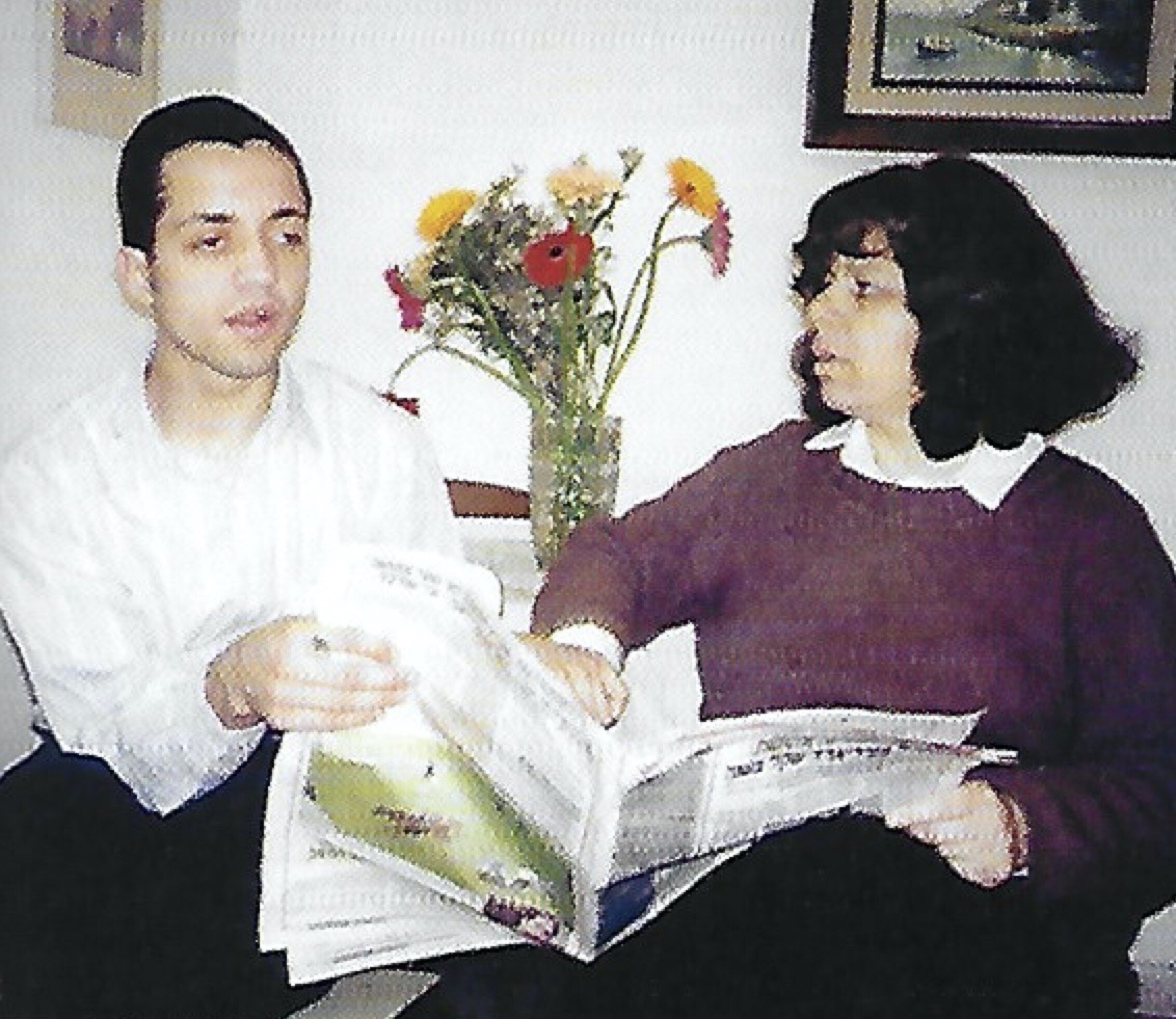
Yossi Samuels and Shoshana Weinstock, in an image from the book.

The emotional center of the book is Yossi’s emergence into the world. Just as Helen Keller had a teacher, Annie Sullivan, whose painstaking efforts finally broke into her world, Yossi had a teacher named Shoshana Weinstock. Shoshana does the work of teaching Yossi by fingerspelling letters into the palm of his hand. Here is the moment of breakthrough:

In the course of one such lesson, Shoshana suddenly appeared at our house with Yossi, knocking loudly at our door, breathless with excitement. “He got it! He got it!” she cried. “His life has changed forever!”

Malki and I had no idea what she was talking about. We looked at his hands to see what he had “got.” “No! No!” Shoshana shouted. “He got it! He understands that I’m signing letters in his palm. His entire world has just opened.”

“We were sitting at the table in my house and I was fingerspelling the five symbols that spell the word ‘table’ [shulchan in Hebrew] into the palm of his hand, while his other hand rested on the table.” She continued excitedly, “I have done this for the past few lessons but Yossi didn’t respond. Today,” she said, “a smile suddenly lit up his face and he began to touch the table deliberately, and we both knew that he’d understood I was spelling shulchan. We did it over and over and he smiled again and again, touching the table every time. He has a new life. I can teach him all twenty-two letters of the Hebrew alphabet and give him language.”

We were all sobbing as Shoshana began to demonstrate on the palms of Yossi’s sister and brothers how to spell shulchan and how to sign the other letters. She told them: “You, too, are going to learn the letters, and you’ll at last be able to speak to your brother.” (p.94-95)

Excuse me for a moment, I have something in my eye.

Yossi’s widening horizons and development into a passionate, active young man is thrilling, to say the least. Just as inspiring, however, is Malki Samuels’s relentless vision. She is the catalyst behind Shalva. She knows firsthand how caring for a disabled child can be physically and spiritually exhausting for an entire family. The original vision was to create a center for children with disabilities that would provide love, care, and growth—and which would give parents a much needed respite, to focus attention on the rest of their families, or to reenergize themselves. These are lessons that could only come from parents who have experienced the challenges of raising disabled children themselves.

Shalva opens in the apartment building next door to the Samuels’ home. But this book is really about Shalva’s exponential growth, thanks to two factors: (1) Malki’s crystal-clear vision for what disabled children and their families need—which is not always in sync with what “the experts” believe; and (2) Kalman’s indefatigable, serendipitous, and often comic ability to make things happen or to raise the necessary funds. You root for them, even as you are certain that their efforts will be successful. (As Joseph would remind us, “Not me! But G-d…”)

The final battle is to find Shalva’s permanent home in central Jerusalem, on a vast campus with an amphitheater, public café, and an enormous array of amenities for the development or simple of joy of the children and their families. Shalva is even more than that: It’s a portal that welcomes visitors to Jerusalem as they enter the city from the west. For Jerusalem is not meant to (merely) be a place of politics and business. It is also supposed to be a gateway to more supernal dimensions, and that gateway is channeled through chesed / compassion and love. Do go visit the Shalva campus, it’s an essential part of understanding what Jerusalem is about.

And if you’re still not convinced, spend a little time with the astonishing Shalva Band. You’ll come around.

I got to know Kalman back in the 1990s, during my summers in Israel with Danny Siegel. Indeed, a chapter about Yossi and Shoshana is included in Radiance, the new anthology of Danny’s writing that I edited. Kalman’s book fills in lots of the gaps that I didn’t know and brings his story to a remarkable and heady fulfillment.

If you’re looking for a little inspiration—never maudlin nor cliched, but honest, touching and often very funny—read Kalman’s joyful, uplifting book. 

Quite simply, it’s the antidote to cynicism.